

Between 1 October 2025 and 31 May 2026, ACLED recorded 336 security incidents in Hasaka governorate. Of these, 172 were coded as violence against civilians, 83 as explosions/remote violence, and 81 as battles. The majority of the incidents occurred in January 2026 (138 incidents). An analysis of ACLED data for the period since the fall of Bashar Al-Assad, from 9 December 2024 to 31 May 2026, indicates two peaks in security incidents in the governorate: January 2025, with 169 incidents, and January 2026.845 The first peak coincided with attacks by Turkish forces and their affiliated factions in Hasaka.846 In comparison, the second peak occurred during the takeover of SDF-controlled areas in Hasaka by Syrian transitional government forces.847 Between April and December 2025, as well as since March 2026, the monthly number of recorded security incidents remained at or below 42 per month.848
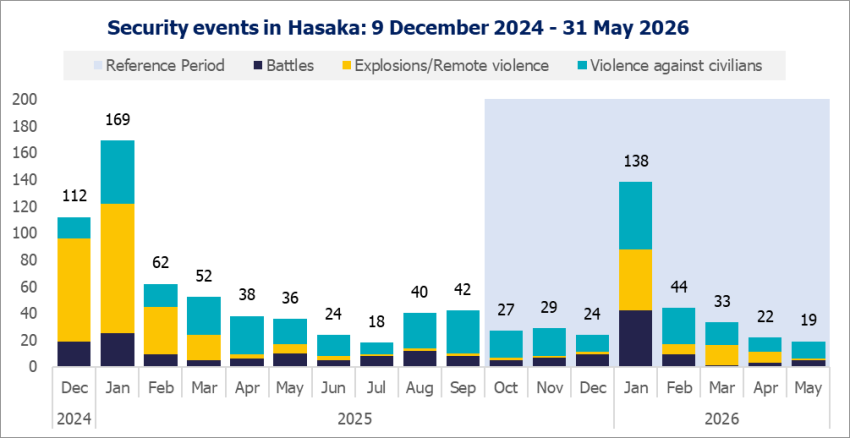
Figure 18: Evolution of security events in Hasaka per type, based on ACLED data849
During the reference period, ACLED recorded security incidents in all four districts of Hasaka governorate. The highest number was documented in Hasaka district (198 incidents), followed by Malikiya (59 incidents) and Qamishli (50 incidents). Hasaka district was also the district with the highest number of overall incidents recorded in the governorate since the fall of Bashar al-Assad, followed by Ras Al-Ain, with 145 incidents. By contrast, during the reporting period, Ras Al-Ain was the district with the lowest number of recorded incidents (29).850
According to ACLED data, the SDF were the main actor involved in security incidents during the reference period. They appeared in 215 recorded incidents, either as Actor 1 or Actor 2. This was followed by the military forces of Syria, which were coded as Actor 1 or Actor 2 in 59 incidents. Taken together, these actors were involved in more than 80 % of the security incidents during the reference period. The nature of their involvement differed. Syrian military forces were primarily associated with battles, accounting for 34 incidents, and explosions or remote violence, accounting for 23 incidents. By contrast, more than half of the incidents involving the SDF, 120 out of 215, were coded as ‘violence against civilians’. Unidentified armed groups were further involved in 55 incidents. Other actors were also recorded, though less frequently. ISIL in 14, the PKK in 12, and the military forces of Türkiye and its Gendarmerie also in 12 incidents. A comparison between the current reference period and the overall security situation since 9 December 2024 indicates that the military forces of Türkiye no longer featured as a major actor in security incidents in the governorate.851
During the reporting period, 172 security incidents were coded as ‘violence against civilians’, the majority of which related to the detention of civilians for a variety of reasons (from conscription to charges of supporting the Syrian government). Middle to end of January 2026 showed a different pattern, with the majority of coded incidents involving the killing of civilians. More than 75 % of all incidents of violence against civilians involved the SDF, Asayish and YPG. Unidentified armed groups were involved in 19 incidents, the PKK in 8 and the Gendarmerie of the military forces of Türkiye in 7 incidents.852
- 845
EUAA analysis based on ACLED data. ACLED, Data Export Tool, Syria, data covering 9 December 2024 to 31 May 2026, as of 9 June 2026, url
- 846
SOHR, Ongoing escalation | Turkish forces and their proxies attack villages in Al-Hasakah countryside, 13 January 2025, url; NPA, Turkish drone strikes hit Syria’s Hasakah amid escalating attacks, 19 January 2025, url
- 847
HRW, Syria: Civilian Protection Lacking in Northeast Escalation, 25 January 2026, url
- 848
EUAA analysis based on ACLED data. ACLED, Data Export Tool, Syria, data covering 9 December 2024 to 31 May 2026, as of 9 June 2026, url
- 849
EUAA analysis based on ACLED data. ACLED, Data Export Tool, Syria, data covering 9 December 2024 to 31 May 2026, as of 9 June 2026, url
- 850
EUAA analysis based on ACLED data. ACLED, Data Export Tool, Syria, data covering 9 December 2024 to 31 May 2026, as of 9 June 2026, url
- 851
EUAA analysis based on ACLED data. ACLED, Data Export Tool, Syria, data covering 9 December 2024 to 31 May 2026, as of 9 June 2026, url
- 852
EUAA analysis based on ACLED data. ACLED, Data Export Tool, Syria, data covering 9 December 2024 to 31 May 2026, as of 9 June 2026, url