

Between 1 October 2025 and 31 May 2026, ACLED recorded 189 security incidents in Quneitra governorate. Of these, 1 incident was coded as battle, 106 were coded as explosions/remote violence and 82 incidents were coded as violence against civilians.1346
The number of incidents recorded per month during the reference period ranged from 6 to 46. ACLED’s records showed a steady increase in security incidents during the reference period, from 6 incidents recorded each in October and November 2025 to 21 incidents in December 2025. In 2026, ACLED recorded from 20 to 46 security incidents per month, with figures peaking in March and April 2026 (46 and 39 incidents), mainly due to actions by the Military Forces of Israel, and Hezbollah targeting Israeli positions.1347
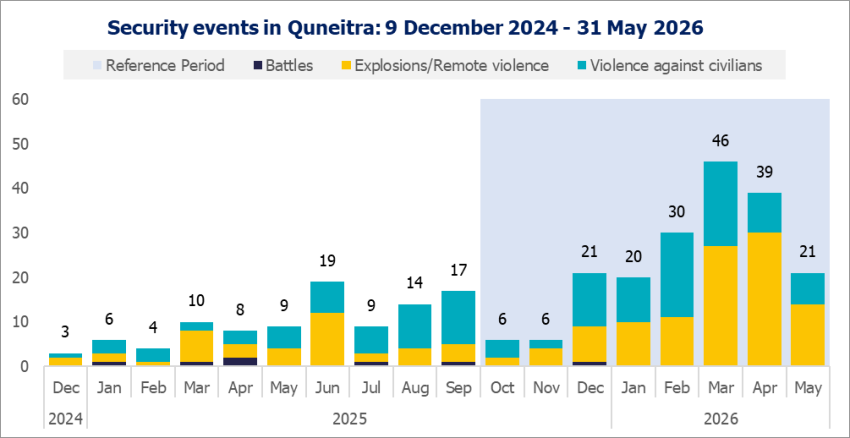
Figure 31: Evolution of security events in Quneitra per type, based on ACLED data1348
An analysis of ACLED data for the period since the fall of Bashar Al-Assad, from 9 December 2024 to 31 May 2026, shows between 3 and 10 recorded security incidents per month from December 2024 to May 2025. This was followed by an increase in June, August and September 2025, with 19, 14, and 17 incidents, predominantly involving violence against civilians and explosions/remote violence. The figures declined in October and November 2025 and have risen again since then.1349
During the reference period, ACLED recorded security incidents in both districts of Quneitra governorate, almost all of them in Quneitra district (175 of the 189 recorded incidents). Similarly, most of the security incidents recorded since the fall of Bashar Al-Assad occurred in Quneitra district (272 of 288).1350
According to ACLED data, Military Forces of Israel and Hezbollah were the main actors involved in security incidents during the reference period. Military Forces of Israel were recorded in 156 of the 189 incidents, while Hezbollah was recorded to be involved in 41 security incidents.1351
Compared with the overall security situation since 9 December 2024, the number of security incidents involving unidentified armed groups as either Actor1 or Actor2 has dropped to almost zero (only one incident during the reference period), and no incidents involving Military Forces of Syria or Military Forces of Iran (except for the Iranian IRGC, which was involved in two incidents) were recorded during the reference period. Military Forces of Israel have remained the primary actor involved in security incidents since the fall of Bashar Al-Assad, while Hezbollah became a main actor during the reference period.1352
82 security incidents during the reference period were coded as ‘violence against civilians’, all of them involving Military Forces of Israel, often involved in the detention of civilians for unknown reasons.1353
- 1346
EUAA analysis based on ACLED data. ACLED, Data Export Tool, Syria, data covering 9 December 2024 to 31 May 2026, as of 9 June 2026, url
- 1347
EUAA analysis based on ACLED data. ACLED, Data Export Tool, Syria, data covering 9 December 2024 to 31 May 2026, as of 9 June 2026, url
- 1348
EUAA analysis based on ACLED data. ACLED, Data Export Tool, Syria, data covering 9 December 2024 to 31 May 2026, as of 9 June 2026, url
- 1349
EUAA analysis based on ACLED data. ACLED, Data Export Tool, Syria, data covering 9 December 2024 to 31 May 2026, as of 9 June 2026, url
- 1350
EUAA analysis based on ACLED data. ACLED, Data Export Tool, Syria, data covering 9 December 2024 to 31 May 2026, as of 9 June 2026, url
- 1351
EUAA analysis based on ACLED data. ACLED, Data Export Tool, Syria, data covering 9 December 2024 to 31 May 2026, as of 9 June 2026, url
- 1352
EUAA analysis based on ACLED data. ACLED, Data Export Tool, Syria, data covering 9 December 2024 to 31 May 2026, as of 9 June 2026, url
- 1353
EUAA analysis based on ACLED data. ACLED, Data Export Tool, Syria, data covering 9 December 2024 to 31 May 2026, as of 9 June 2026, url