

3.2.1. Tehreek-e Taliban Pakistan (TTP)
Tehreek-e Taliban Pakistan (TTP) has been described as a ‘coalition’,295 ‘network’296 or ‘umbrella’ organisation of various armed militant groups297 operating in areas of KP near the border with Afghanistan.298 It was formed in December 2007 by a shura (council) of 40 high-ranking Taliban commanders as a reaction to Pakistani military operations that targeted al-Qaeda-affiliated insurgents in the former FATA. Drawing heavily from the tenets of the Deobandi school of Islamic thought,299 TTP seeks to overthrow the Pakistani government300 and to create a state based on Islamic rule.301 Since 2018, the group has been headed by Noor Wali Mehsud.302 Under his leadership, and especially since the August 2021 Taliban takeover in Afghanistan, the group has undergone a resurgence303 and is currently deemed the most lethal insurgent group in Pakistan. Since 2018, the group has reportedly incorporated over 70 militant factions into its coalition,304 including Taliban factions that had temporarily withdrawn from the TTP umbrella (e.g., Jamat-ul Ahrar (JuA), Pakistani al-Qaeda affiliates (e.g., the Aslam Farooqi group),305 and even militant factions from both Pashtun- and Baloch-majority areas of Balochistan.306 According to a mid-2025 UN estimate, TTP had around 6 000 fighters.307 The group’s recruitment efforts mainly focus on North Waziristan, Dera Ismail Khan, and Peshawar districts.308
TTP maintains its centralised command structure309 but was also reported to provide room for decentralised operations led by smaller, flexible units.310 The group has sought to establish structured quasi-governance systems.311 It has declared to have set up shadow administrations in the former tribal districts and southern KP,312 as well as in North and South Punjab313 and Balochistan.314 In late 2025, TTP presented an organisational blueprint for 2026 that divides the country into northern, southern central, and western zones, each further subdivided into multiple so-called ‘waliyats’ (administrative units). As of late 2025, the group’s military commands and intelligence/counterintelligence cells existed to varying degrees across the northwest and certain areas of Balochistan.315 At the same time, 2025 saw recurring signs of internal disagreement within the TTP ranks, especially between its leadership and JuA loyalists.316 The TTP has gained greater operational manoeuvrability in Pakistan317 and continued to attack security forces318 and infrastructure to undermine the state’s authority.319 As the group reinforced its organisational structure, it shifted towards more strategic and coordinated high-profile operations320 and away from indiscriminate attacks on civilians.321 However, the group continued to strike civilians with perceived links to the state in targeted attacks.322 A new ‘general code of conduct’ introduced in 2025 broadened TTP’s declared set of legitimate targets from a narrower focus on security forces to include other state-related targets323 such as ‘military-owned businesses’324 and individuals working in the legal and judicial domains.325 The group sustained a high pace of operations throughout 2025, 326 with some attacks resulting in large numbers of casualties. The lethality of attacks was enhanced by TTP’s continued access to sophisticated weaponry327 such as sniper rifles, night-vision goggles, and drones.328
In 2025, KP’s former tribal districts and their adjoining border districts remained the TTP’s core operational theatre.329 In these areas, the group has set up roadblocks and checkpoints, and its fighters were reported to roam freely and live among the population while not maintaining sizeable bases.330 Beyond these core areas, the group has also expanded its activities to the province’s northwest and south, particularly Bannu, Lakki Marwat and Dera Ismail Khan,331 and has maintained persistent operational intensity in these areas.332 Some of TTP’s operations in 2025 also extended to areas like South Punjab and Pishin333 in Balochistan.334 Although TTP has yet to establish a strong operational presence in regions outside KP,335 it has reinforced its footprint in these areas through alliances with influential local militant factions (notably in northern and southern Punjab336 and Karachi).337
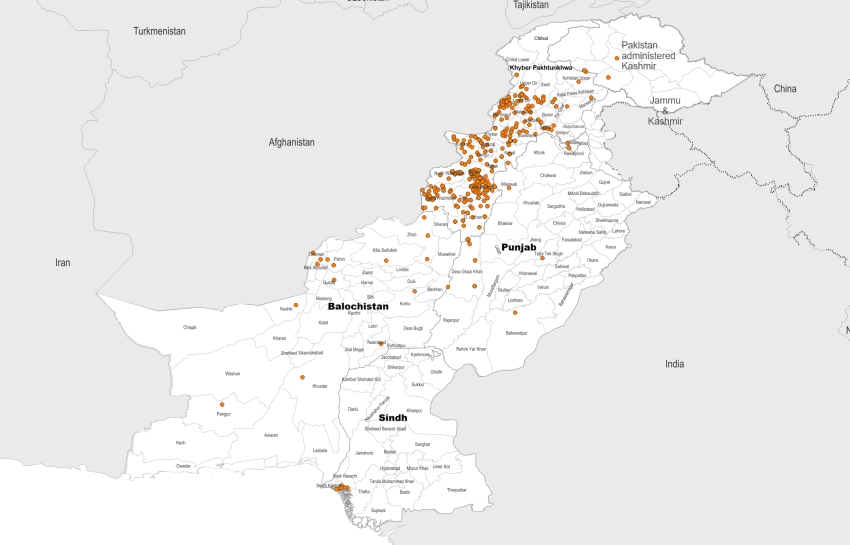
Map 2: TTP activities in Pakistan between 1 November 2024 and 21 April 2026338
Please note: The depictions on Map 2 do not imply any opinion whatsoever on the part of EUAA concerning legal status or effective control over any country, territory, city, or area. Every effort is made to ensure this map is free of errors, but there is no guarantee that the map or its features are either spatially or temporally accurate or fit for a particular use. This map is provided without any warranty of any kind whatsoever, either expressed or implied.
Beyond developments on the ground, TTP now employs propaganda as a principal tool for extending its influence,339 showing enhanced capabilities in using social media as a means of recruiting new members.340 Its recent messaging, amplified by its multilingual AI-supported Umar Media channel, blends traditional Islamist ideology with Pashtun nationalist rhetoric.341
The group continued to benefit from significant operational and logistical support from Afghanistan’s Taliban de facto authorities. Some member states of the UN Security Council reported of sustained tactical-level relations between TTP and Islamic State Khorasan Province (ISKP). According to one member state, TTP operatives also provided training to insurgents in Balochistan,342 although there was disagreement between members states as to the degree of cooperation between TTP and the Balochistan Liberation Army (BLA).343 For further information see section 3.2.1. Haqqani Network of the EUAA COI report Pakistan - Country Focus (December 2024).
- 295
CRSS, Complex terrorism landscape in Pakistan-Afghanistan region: Afghan Emirate as counter-terror partner, 24 January 2025, url, p. 29
- 296
Basit, A., The Transformation of TTP: Rise, Fall and Resurgence, 31 December 2024, url, p. 1
- 297
Sayed, A., TTP Projecting Power Outside Pakistan’s Northwest, The Jamestown Foundation, 6 November 2025, url; Tahir, S. and Jadoon, A., Leaders, Fighters, and Suicide Attackers: Insights on TTP Militant Mobility Through Commemorative Records, 2006-2025, May 2025, url, p. 26; IEP, Global Terrorism Index 2025, 2025, url, p. 17
- 298
ACLED, Pakistan battles rising militancy that risks spreading beyond the frontiers, 11 December 2025, url
Sayed, A., TTP Projecting Power Outside Pakistan’s Northwest, The Jamestown Foundation, 6 November 2025, url; Tahir, S. and Jadoon, A., Leaders, Fighters, and Suicide Attackers: Insights on TTP Militant Mobility Through Commemorative Records, 2006-2025, May 2025, url, p. 24
- 299
Tahir, S. and Jadoon, A., Leaders, Fighters, and Suicide Attackers: Insights on TTP Militant Mobility Through Commemorative Records, 2006-2025, May 2025, url, p. 26
- 300
Guardian (The), Pakistan declares ‘open war’ against Afghanistan after cross-border attack – as it happened, 27 February 2026, url; IEP, Global Terrorism Index 2025, 2025, url, p. 17
- 301
Guardian (The), Pakistan declares ‘open war’ against Afghanistan after cross-border attack – as it happened, 27 February 2026, url; CRSS, Complex terrorism landscape in Pakistan-Afghanistan region: Afghan Emirate as counter-terror partner, 24 January 2025, url, p. 29
- 302
Reuters, Militant leader at heart of Afghan-Pakistan conflict survived strike that provoked clashes, 16 October 2025, url
- 303
CRSS, Complex terrorism landscape in Pakistan-Afghanistan region: Afghan Emirate as counter-terror partner, 24 January 2025, url, p. 29
- 304
Jadoon, A., Confronting Pakistan’s Deadly Trifecta of Terrorist Groups, South Asian Voices, 17 October 2025, url
- 305
CRSS, Complex terrorism landscape in Pakistan-Afghanistan region: Afghan Emirate as counter-terror partner, 24 January 2025, url, p. 38
- 306
Basit, A., The Transformation of TTP: Rise, Fall and Resurgence, 31 December 2024, url, p. 16
- 307
UN Security Council, Letter dated 21 July 2025 from the Chair of the Security Council Committee pursuant to resolutions 1267 (1999), 1989 (2011) and 2253 (2015) concerning Islamic State in Iraq and the Levant (Da’esh), Al-Qaida and associated individuals, groups, undertakings and entities addressed to the President of the Security Council [containing thirty-sixth report of the Analytical Support and Sanctions Monitoring Team submitted pursuant to resolution 2734 (2024) concerning ISIL (Da’esh), Al-Qaida and associated individuals and entities], S/2025/482, 24 July 2025, url, para. 93
- 308
Tahir, S. and Jadoon, A., Leaders, Fighters, and Suicide Attackers: Insights on TTP Militant Mobility Through Commemorative Records, 2006-2025, May 2025, url, p. 32
- 309
CRSS, Organizational Structures and Security Implications of TTP and IS-K in Pakistan, 9 February 2026, url; Jadoon, A., Confronting Pakistan’s Deadly Trifecta of Terrorist Groups, South Asian Voices, 17 October 2025, url
- 310
Jadoon, A., Confronting Pakistan’s Deadly Trifecta of Terrorist Groups, South Asian Voices, 17 October 2025, url
- 311
CRSS, Complex terrorism landscape in Pakistan-Afghanistan region: Afghan Emirate as counter-terror partner, 24 January 2025, url, p. 39
- 312
TOI, Pakistan Taliban running ‘shadow government’ in North Waziristan, 4 December 2023, url
- 313
Basit, A., Tehreek-e-Taliban Pakstan Ingress Into Punjab: Prospects and Challenges, The Diplomat, 28 May 2024, url
- 314
Rehman, Z., Pakistani Taliban move into new territories, DW, 3 May 2023, url
- 315
Sunday Guardian (The), TTP unveils 2026 plan, signals shift to shadow-govern Pak, 28 December 2025, url
- 316
PICSS, Pakistan's Comprehensive National Security Profile – Annual Report 2025, 7 January 2026, url, p. 24
- 317
IEP, Global Terrorism Index 2025, March 2025, url, p. 23
- 318
Masomy, M.J., Can Pakistan Play a Role in Regime Change in Afghanistan?, RUSI, 9 January 2026, url; CRSS, Complex terrorism landscape in Pakistan-Afghanistan region: Afghan Emirate as counter-terror partner, 24 January 2025, url, p. 29
- 319
IEP, Global Terrorism Index 2025, March 2025, url, p. 23; note that the IEP uses artificial intelligence and machine learning technologies to analyse and process GTI data.
- 320
CRSS, Complex terrorism landscape in Pakistan-Afghanistan region: Afghan Emirate as counter-terror partner, 24 January 2025, url, p. 33
- 321
Jadoon, A., Confronting Pakistan’s Deadly Trifecta of Terrorist Groups, South Asian Voices, 17 October 2025, url
- 322
ACLED, The battle for the borderlands: The Tehreek-i-Taliban Pakistan challenges the state’s control, 6 October 2025, url
- 323
PICSS, Pakistan's Comprehensive National Security Profile – Annual Report 2025, 7 January 2026, url, p. 24
- 324
UN Security Council, Letter dated 8 December 2025 from the Chair of the Security Council Committee established pursuant to resolution 1988 (2011) addressed to the President of the Security Council [containing Sixteenth report of the Analytical Support and Sanctions Monitoring Team submitted pursuant to resolution 2763 (2024) concerning the Taliban and other associated individuals and entities constituting a threat to the peace, stability and security of Afghanistan], S/2025/796, 8 December 2025, url, para. 85
- 325
PICSS, Pakistan's Comprehensive National Security Profile – Annual Report 2025, 7 January 2026, url, p. 24
- 326
PICSS, Pakistan's Comprehensive National Security Profile – Annual Report 2025, 7 January 2026, url, p. 24; UN Security Council, Letter dated 8 December 2025 from the Chair of the Security Council Committee established pursuant to resolution 1988 (2011) addressed to the President of the Security Council [containing Sixteenth report of the Analytical Support and Sanctions Monitoring Team submitted pursuant to resolution 2763 (2024) concerning the Taliban and other associated individuals and entities constituting a threat to the peace, stability and security of Afghanistan], S/2025/796, 8 December 2025, url, para. 82, 86
- 327
UN Security Council, Letter dated 21 July 2025 from the Chair of the Security Council Committee pursuant to resolutions 1267 (1999), 1989 (2011) and 2253 (2015) concerning Islamic State in Iraq and the Levant (Da’esh), Al-Qaida and associated individuals, groups, undertakings and entities addressed to the President of the Security Council [containing thirty-sixth report of the Analytical Support and Sanctions Monitoring Team submitted pursuant to resolution 2734 (2024) concerning ISIL (Da’esh), Al-Qaida and associated individuals and entities], S/2025/482, 24 July 2025, url, para. 93
- 328
Guardian (The), ‘An environment of terror’: deadly resurgence of Pakistan Taliban gathers pace, 13 October 2025, url
- 329
PICSS, Pakistan's Comprehensive National Security Profile – Annual Report 2025, 7 January 2026, url, p. 23
- 330
Guardian (The), ‘An environment of terror’: deadly resurgence of Pakistan Taliban gathers pace, 13 October 2025, url
- 331
ACLED, The battle for the borderlands: The Tehreek-i-Taliban Pakistan challenges the state’s control, 6 October 2025, url
- 332
PICSS, Pakistan's Comprehensive National Security Profile – Annual Report 2025, 7 January 2026, url, p. 23
- 333
Jadoon, A., Confronting Pakistan’s Deadly Trifecta of Terrorist Groups, South Asian Voices, 17 October 2025, url
- 334
Dawn, Five terrorists killed in Pishin operation: CTD, 27 January 2026, url
- 335
Sayed, A., TTP Projecting Power Outside Pakistan’s Northwest, The Jamestown Foundation, 6 November 2025, url
- 336
Basit, A., The Transformation of TTP: Rise, Fall and Resurgence, 31 December 2024, url, p. 16
- 337
Basit, A., Implications of TTP-Hafiz Gul Bahadur Group Competition for Pakistan’s Internal Security, The Diplomat, 25 February 2025, url
- 338
EUAA map visualisation based on ACLED data for the reference period and publicly available administrative division boundaries.
- 339
Firdous, I., The reinvention of the Tehrik-e-Taliban Pakistan, XCEPT, March 2025, url, p. 1
- 340
Jadoon, A., Confronting Pakistan’s Deadly Trifecta of Terrorist Groups, South Asian Voices, 17 October 2025, url
- 341
Jadoon, A., Beyond Counterterrorism: A Legitimacy-Centered Framework for Pakistan’s Security Crisis, Hudson Institute, 6 October 2025, url
- 342
UN Security Council, Letter dated 21 July 2025 from the Chair of the Security Council Committee pursuant to resolutions 1267 (1999), 1989 (2011) and 2253 (2015) concerning Islamic State in Iraq and the Levant (Da’esh), Al-Qaida and associated individuals, groups, undertakings and entities addressed to the President of the Security Council [containing thirty-sixth report of the Analytical Support and Sanctions Monitoring Team submitted pursuant to resolution 2734 (2024) concerning ISIL (Da’esh), Al-Qaida and associated individuals and entities], S/2025/482, 24 July 2025, url, para. 93
- 343
UN Security Council, Letter dated 21 July 2025 from the Chair of the Security Council Committee pursuant to resolutions 1267 (1999), 1989 (2011) and 2253 (2015) concerning Islamic State in Iraq and the Levant (Da’esh), Al-Qaida and associated individuals, groups, undertakings and entities addressed to the President of the Security Council [containing thirty-sixth report of the Analytical Support and Sanctions Monitoring Team submitted pursuant to resolution 2734 (2024) concerning ISIL (Da’esh), Al-Qaida and associated individuals and entities], S/2025/482, 24 July 2025, url, para. 95