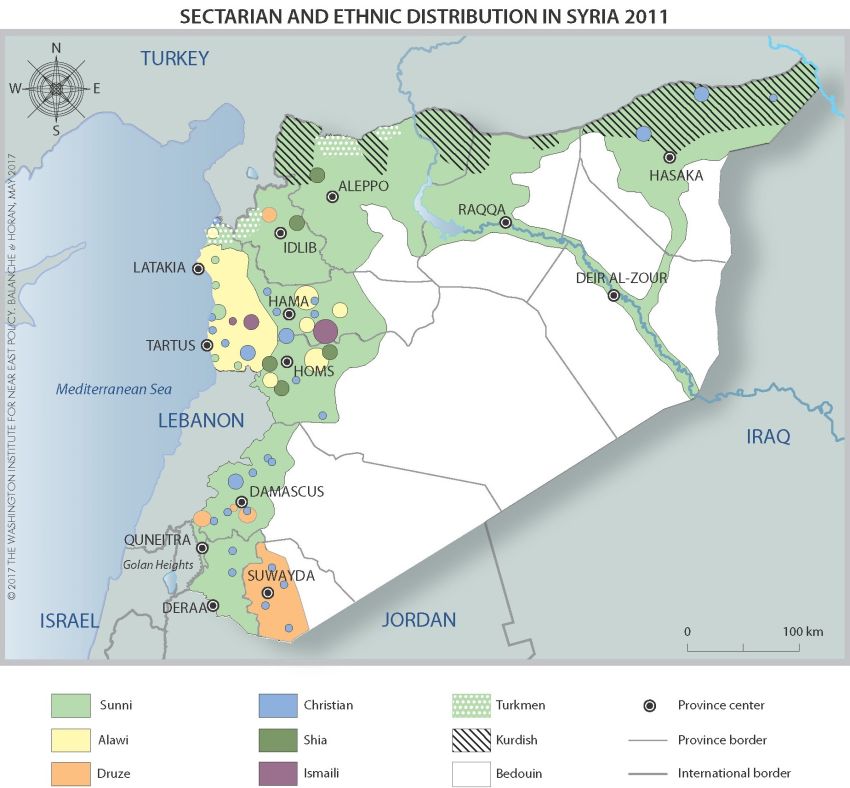
Home Syria: Country Focus 2. Treatment of certain profiles and groups of the population 2.7. Ethno-religious minorities Table of contents Table of Contents Acknowledgements Disclaimer Glossary and abbreviations Introduction Methodology Defining the terms of reference Collecting information Quality control Sources Map 1. State structure and governance 1.1. Internal political developments 1.1.1. Territorial control 1.1.2. Developments in the relationship between the transitional government and Druze actors 1.1.3. Developments in the relationship between the transitional government and SDF 1.2. International relations 1.3. Security institutions 1.3.1. Recruitment practices 1.3.2. Capacity and effectiveness of security forces 1.4. Judiciary 1.4.1. Judicial reforms 1.4.2. Capacity and effectiveness of the judiciary 1.4.3. Transitional justice process and accountability 1.5. Death penalty 1.6. Prison conditions and treatment of detainees 2. Treatment of certain profiles and groups of the population 2.1. Individuals affiliated or perceived to be affiliated with the former Government of Syria 2.1.1. Former soldiers and security personnel 2.1.2. Other categories of professionals 2.1.3. Factors influencing targeting 2.1.4. Targeting by unidentified actors 2.2. Individuals opposing or perceived to be opposing the Transitional Government 2.2.1. Political opposition 2.2.2. Freedom of expression, civic space and criticism of the authorities 2.2.3. Relatives of critics 2.2.4. Journalists and other media professionals 2.2.5. Monitoring of online activities 2.2.6. Reaction of pro-government supporters to criticism of the government 2.3. Individuals perceived to be opposing the SDF/YPG 2.4. Individuals with (perceived) affiliation to ISIL 2.4.1. Situation of individuals affiliated with or perceived to be affiliated to ISIL in detention in northeast Syria 2.4.2. Arrests of individuals with perceived affiliation to ISIL in SDF-controlled areas 2.5. Individuals fearing forced or child recruitment by Kurdish-led forces 2.5.1. Developments regarding military service in DAANES 2.5.2. Recruitment of minors by armed groups associated with SDF 2.6. Individuals perceived to have transgressed religious/moral laws, norms or codes 2.6.1. Behaviour that may be perceived as transgressing moral codes 2.6.2. Atheists and apostasy 2.6.3. Converts 2.7. Ethno-religious minorities 2.7.1. Kurds 2.7.2. Alawites 2.7.3. Druze 2.7.4. Christians 2.7.5. Palestinians 2.8. LGBTIQ persons 2.8.1. Legislative framework and developments 2.8.2. Treatment by state, non-state and societal actors 2.9. Women and girls 2.9.1. General overview of violations against women 2.9.2. Situation of IDP women 2.9.3. Honour-based violence 2.9.4. Sexual and gender-based violence 2.9.5. Female headed households 2.9.6. Access to services 2.10. Children 2.10.1. Impact of violence on children 2.10.2. Access to education 3. Returns from abroad 3.1. Administrative requirements for returnees 3.2. Return trends and conditions upon return 3.2.1. Return trends 3.2.2. Conditions upon return 3.2.3. Measures to support integration of returnees 4. Socio-economic situation with a focus on Damascus city 4.1. Overview of economic situation 4.2. Employment 4.3. Poverty 4.4. Food security 4.5. Housing, water, and sanitation 4.5.1. Housing 4.5.2. Water and sanitation 4.6. Health care 4.7. Education 4.8. Mobility and admittance 4.8.1. Freedom of movement at country level and in Damascus 4.8.2. International flight connections 4.8.3. Requirements for settling in Damascus Annex 1: Bibliography Oral sources, including anonymous sources Public sources Annex 2: Terms of Reference Citation Please cite as: EUAA, '2.7. Ethno-religious minorities' in Syria: Country Focus, July 2026. Copy Print Map 3: © A map of Sectarian and ethnic distribution in Syria 2011, Fabrice Balanche & Mary Kalbach Horan, The Washington Institute for Near East Policy504 504 Balanche, F., Sectarianism in Syria’s civil war, 2018, url, Introduction XIII Book traversal links for Syria: Country Focus Previous Parent Next