

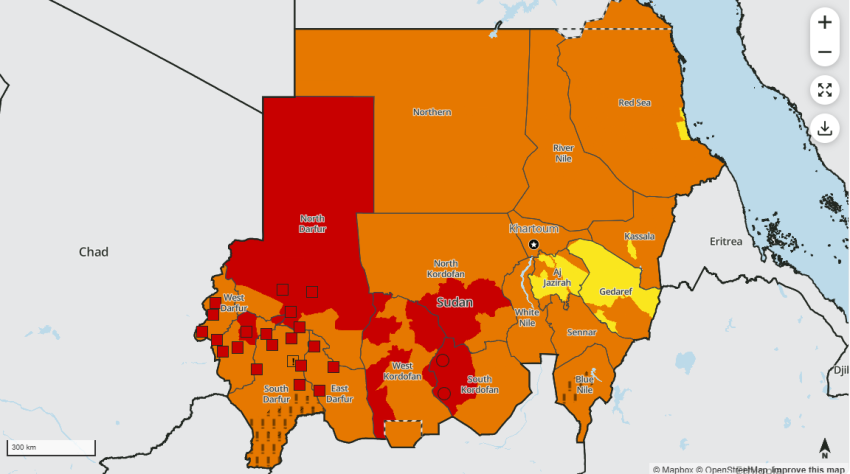
Acute food insecurity is widespread, with an estimated 29 million people in need of humanitarian food assistance as of February 2026.690
Agriculture represented a key source of income in the rural areas and accounted for more than 39 % of the country’s total income.691 Crop production has fallen below the five-year average in 2025 due to conflict, high production and transport costs, and rainfall variability, while livestock production has been adversely affected by pasture shortages and limited access to veterinary medicines and vaccines.692 Access to essential inputs – such as seeds, legumes, vegetables and spare parts for agricultural machinery – and the maintenance of irrigation systems has been curtailed. The conflict has disrupted the entire value chain, from production and transport to processing and retail.693 The destruction of agrifood processing facilities, a large percentage of which were based in Khartoum, has created a major gap in food supply across the country.694
The results of the Welfare Monitoring Survey Round IV conducted between May and July 2025 indicated that several areas, particularly in parts of Darfur and Kordofan states, were facing famine or conditions approaching famine, driven by the conflict, market disruption, climate vulnerability, and constrained humanitarian access. Information on food consumption in Northern and eastern states (Nile, Red Sea, Khartoum) suggested a larger share of households with acceptable food consumption and comparatively stronger food security conditions.695
Refugees were disproportionately affected by hunger, with urban refugees facing some of the harshest conditions, potentially owing to a lack of food assistance available outside of camp locations. The lack of access to education worsened food insecurity among refugees: those without schooling were most prone to food insecurity, whereas individuals with higher education levels generally enjoyed better food security. The Welfare Monitoring Survey uncovered that non-displaced individuals have better food consumption outcomes than IDPs and refugees. Respectively 61 % and 62 % of IDPs and refugees had insufficient food consumption—categorised as either borderline or poor; compared to 45% of non-displaced. 696
While Sudanese households primarily relied on market purchases to source their food, refugees had to count heavily on food aid provided by the WFP and NGOs, which accounts for 61 % of their food supply. Such reliance on food aid was increasingly precarious due to the declining international assistance, and 65 % of surveyed refugees reported that food rations declined since the start of 2025. The significant drop in food rations for refugees was confirmed by operational data from the WFP, which indicated that refugees in Sudan received just 70% of the targeted daily food ration of 2 100 kilocalories per person by mid-2025. The situation was equally alarming among IDPs, and food assistance remained limited: about 43% of food insecure IDPs reported receiving food assistance, compared to 78% of refugees.697
Map 4. Sudan Acute Food Insecurity: February 2026 assessed outcomes698
The conflict has also exacerbated food insecurity across Sudan. More than half a million children reportedly died from starvation by July 2025.699 In April 2025, the WFP reported that the levels of hunger and desperation were ‘extremely high’.700 Later, in June 2025, the WFP Sudan representative and country director confirmed that ‘severe’ levels of hunger were found in Jebal Awlia, a town around 40 kilometres south of Khartoum.701
As of April 2026, the Famine Early Warning Systems Network (FEWS NET) estimated that 22 million or more people in Sudan, representing approximately 40–45 % of the population, were in need of food assistance. Projections indicated that food insecurity was expected to worsen between June and September 2026. Estimates for October 2026 suggested that needs were expected to remain stable, indicating sustained high levels of food insecurity. Available data indicated that the 2026 levels were similar to those recorded in 2025 but higher than the five-year average, suggesting a persistent crisis.702
- 690
FEWS NET, Famine thresholds no longer met, but credible risk of Famine persists in parts of Sudan, February 2026, url
- 691
Mohamed, E.M. and Lucero-Prisno, D-E,The Effects of Sudan's Armed Conflict on Economy and Health: A Perspective, Health Science Reports, 6 February 2025, url
- 692
Elnour, I.B. and Mokhtar, T.M. (2025): Socio-Economic Impact of the Sudan War: A Critical Analysis of the Humanitarian Crisis and Development Challenges. International Journal of Sudan Research (IJSR), Vol. 13, Nos 1/2, pp. 25-36, August 2025, url, pp. 5, 20
- 693
FAO, The Sudan Employment and self-employment through agriculture and livelihoods support for vulnerable populations, 2025, url
- 694
IFRC, Operation update #2, Sudan, Complex Emergency, 8 December 2025, url, p. 2
- 695
World Bank (The), Sudan's Crisis: Navigating Disparities, Resilience, and Recovery for Refugees, IDPs, and Host Communities, 25 January 2026, url, p. 11
- 696
World Bank (The), Sudan's Crisis: Navigating Disparities, Resilience, and Recovery for Refugees, IDPs, and Host Communities, 25 January 2026 url, p. 6
- 697
World Bank (The), Sudan's Crisis: Navigating Disparities, Resilience, and Recovery for Refugees, I DPs, and Host Communities, 25 January 2026 url, pp. 11, 2
- 698
FEWS NET, Sudan Acute Food Insecurity: February 2026 assessed outcomes, February 2026, url
- 699
New Arab (The), Khartoum: Destroyed buildings, cars covered in ash tell horrors of war in Sudan capital, 8 July 2025, url
- 700
WFP, Operational updates on food assistance to famine-risk populations in Sudan, 25 April 2025, url
- 701
The New Arab, High risk of famine near Sudan capital, says World Food Programme, 10 June 2025, url
- 702
FEWS NET, Sudan, Latest food insecurity analysis, April 2026, url