

3.1. Socio-economic situation
Sudan's economy has been severely destabilised by the ongoing conflict. Significant economic deterioration was recorded across key sectors such as agriculture, industry, and services,615 alongside the widespread loss of livelihoods and displacement of millions of people.616 The national economy experienced a sharp decline617 and triple-digit annual inflation persisting for years.618 The Gross Domestic Product (GDP) declined from 51.67 billion USD in 2022 to 31.51 billion USD in 2025. Projections suggested a total reduction of 48 % by the end of 2025, equivalent to economic losses of 15 billion USD.619 The inflation rate increased due to the over printing of money, from 200 % in 2020 to 500 % in 2025.620 Consumer price inflation, which reached 359.1 % in 2021, remained extremely high over time reaching 185.7 % in 2023 and 151.1 % in 2024. Data from the International Monetary Fund (IMF) indicated that the public debt rose significantly, reaching 253 % of GDP in 2023 and slightly reduced to 221 % in 2025.621 A financial expert cited by the Sudan Media Forum indicated that ‘high inflation and currency depreciation have eroded incomes, significantly shrinking the middle class and expanding poverty.’622
The national currency has collapsed. 623 The value of the SDG against USD on the black market deteriorated from 55 SDG/ 1 USD in 2020 to 601 SDG/ 1 USD in 2023 and 3 500 SDG/ 1 USD in April 2026.624
Between 70 and 80 % of industrial facilities have either ceased operations or sustained damaged due to supply chains disruptions and operational challenges. 625
The conflict has reshaped economic geography by creating separate economic zones under SAF and RSF control, which has inhibited trade flows, raised prices, and reduced access to food.626 Declining production and persistent logistical disruptions have led to a marked contraction in Sudan’s exports — particularly in gold and agricultural commodities.627 Agriculture, a key pillar of the country’s economy, has also seen production decline by between 30 % and 50 %. Contributing factors included ‘lack of financing, rising input costs, and logistical constraints.’628 The introduction of multiple fees on livestock exporters since the beginning of the war has affected further exports operations.629 At the same time, the depreciation of the SDG has driven up import costs, limiting the country’s capacity to procure essential goods.630
The banking system continued to face a liquidity crisis.631 Banking operations, most of them based in Khartoum, have been suspended for the most part due to insecurity, power outages, and looting.632 Khartoum Bank lost over 38 % of its funds, and banks entered acute liquidity shortages prompting many users to shift to electronic banking applications licenced by the Central Bank such as Cashie, Cyper Pay, and Bravo. The mobile app Bankak, operated by the Bank of Khartoum, is reportedly widely used, particularly because it allows users to open new accounts entirely online using only the national identification number and allows high financial limits.633 As of March 2026, the liquidity crisis continued in Khartoum where people rely entirely on banking applications such as Bankak and Okash with transfer fees sometimes reaching fifteen per cent.634
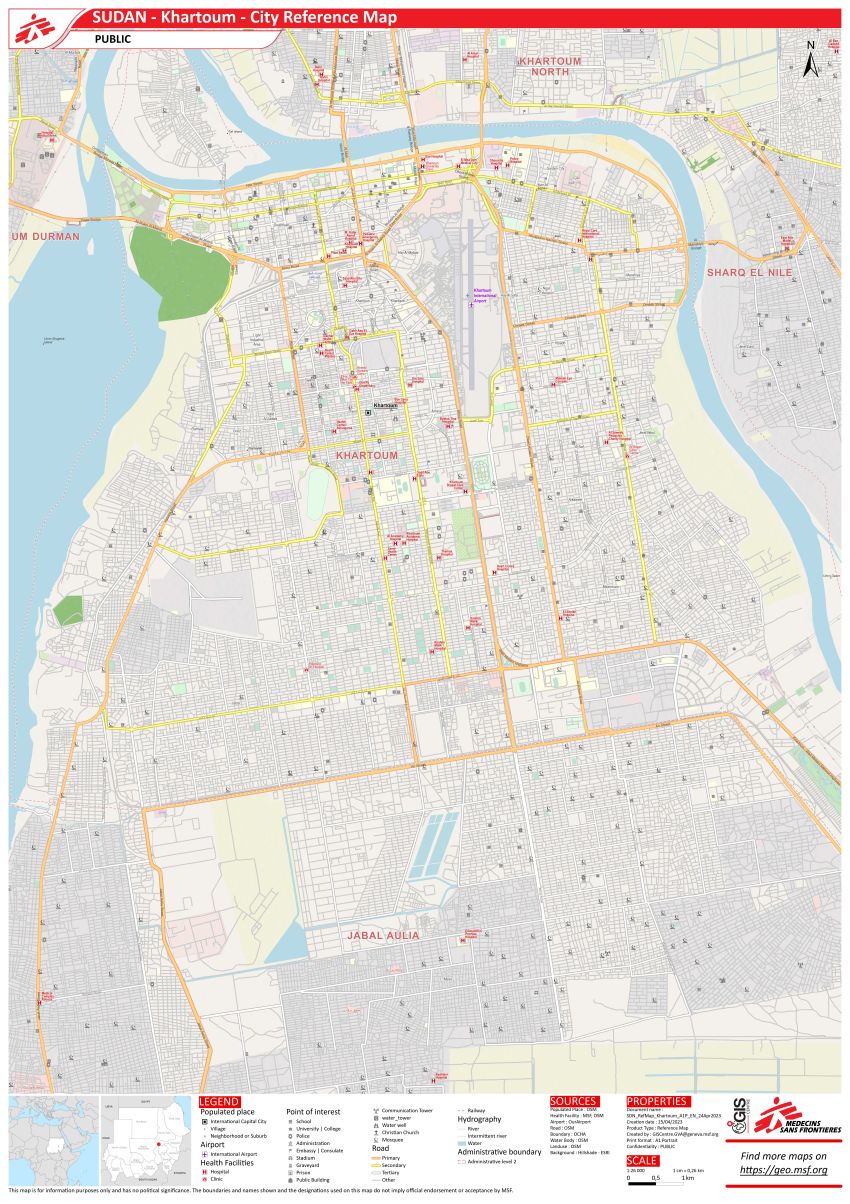
Map 2: Khartoum reference map635
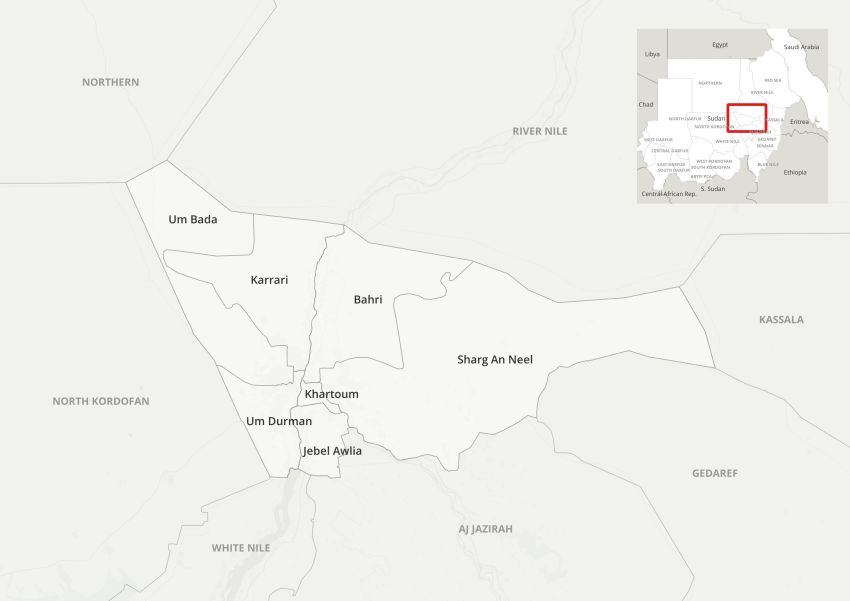
Map 3: Khartoum neighbourhoods636
Civilian Infrastructure in the capital Khartoum
Khartoum suffered major infrastructure damage.637 Armed actions have damaged Sudan’s infrastructure, including roads, supply chains638 and three major bridges.639 According to a report from July 2025, central areas of the capital — including banks, media offices, government buildings, and the Presidential Palace — suffered major destruction. The Jabal Awliya area showed widespread damage to cars, homes, and military vehicles. The walls of the Ministry of Interior in south Khartoum have collapsed and display evidence of gunfire, while military headquarters and other prominent buildings have also been heavily affected. As Khartoum’s cemeteries became full due to the rising number of casualties from the conflict, makeshift burial grounds spread across the capital. Sudanese families resorted to burying their loved ones in public spaces and along roadsides.640 UNDP Sudan reported in January 2026 that schools and hospitals in the country were in ruins, wells contaminated, markets shut and electricity and water supplies were failing.641
Khartoum’s electricity network lost 90 % of its capacity due to shelling, theft, and looting. 642 As of February 2026, much of the city still lacked power, especially in eastern and southern areas, while some neighbourhoods, like Al-Sahafa, have seen partial restoration. The looting of underground cables and a shortage of transformers— with only 400 arrived out of the 14 000 required — hampered repairs. Despite ongoing outages, sales offices reopened, and public-awareness campaigns warned against dangerous informal connections, with fines up to 300 000 SDG [approximately EUR 95] for violations.643
Telecommunications infrastructure became an early and deliberate target by warring parties, pushing entire regions and cities into prolonged digital isolation.644 In February 2024, the RSF had seized control of the data centres of several internet service providers in Khartoum and most areas controlled by the RSF lacked consistent internet connectivity through Sudan’s mobile network operators.645
Environmental experts warned of a ‘catastrophic’ situation, highlighting that the collapsed infrastructure in Khartoum, together with outdated land distribution and a lack of modern sewage or water networks, posed major challenges to the reconstruction of the city.646 By December 2025, reportedly only one out of thirteen water stations remained operational, severely limiting water supplies.647 As of February 2026, most residents across Khartoum continued to face unresolved drinking water shortages, forcing many returnees to relocate to west, central and east Khartoum.648
After visiting Khartoum in June 2025, the WFP Sudan representative and country director reported that there was ‘widespread destruction, limited access to water, healthcare and electricity, and a cholera outbreak. In parts of the city, life was returning - but many neighbourhoods remain abandoned, like a ghost city’. 649 In December 2024, the government estimated reconstruction costs in areas regained by the SAF at around 200 USD billion.650 By January 2026, the UN had raised the estimate to at least 350 USD billion.651
- 615
Elnour, I.B. and Mokhtar, T.M., Socio-Economic Impact of the Sudan War: A Critical Analysis of the Humanitarian Crisis and Development Challenges, 20 August 2025, url, p. 3, 6
- 616
Siddig, K. et al., War and Resilience: The Multifaceted Impacts of Sudan’s Conflict and Pathways to Recovery. Washington, DC: International Food Policy Research Institute, 2026, url, p. 57-58
- 617
IMF, World Economic Outlook, October 2025, url, p. 129
- 618
Africanews, Sudan's war has left the country's economy shattered, 20 January 2026, url; Conversation (The), Sudan’s war is an economic disaster: here’s how bad it could get, 16 July 2025, url
- 619
Elnour, I.B. and Mokhtar, T.M., Socio-Economic Impact of the Sudan War: A Critical Analysis of the Humanitarian Crisis and Development Challenges, 20 August 2025, url, p. 3, 6
- 620
Elnour, I.B. and Mokhtar, T.M., Socio-Economic Impact of the Sudan War: A Critical Analysis of the Humanitarian Crisis and Development Challenges, 20 August 2025, url, p. 6
- 621
IMF, World Economic Outlook, October 2025, url, p. 129
- 622
Sudan Media Forum, Sudan at the Heart of an Economic Storm: Sharp Contraction and an Uncertain Future, 28 March 2026, url
- 623
Africanews, Sudan's war has left the country's economy shattered, 20 January 2026, url
- 624
Africanews, Sudan's war has left the country's economy shattered, 20 January 2026, url; Elnour, I.B. and Mokhtar, T.M., Socio-Economic Impact of the Sudan War: A Critical Analysis of the Humanitarian Crisis and Development Challenges, 20 August 2025, url, p. 6; the Sudanese Pound exchange rate for April 2026 was retrieved from Inforeuro
- 625
Sudan Media Forum, Sudan at the Heart of an Economic Storm: Sharp Contraction and an Uncertain Future, 28 March 2026, url
- 626
IFPRI, War and resilience: The multifaceted impacts of Sudan’s conflict and pathways to recovery, 14 April 2026, url
- 627
Sudan Media Forum, Sudan at the Heart of an Economic Storm: Sharp Contraction and an Uncertain Future, 28 March 2026, url
- 628
Sudan Media Forum, Sudan at the Heart of an Economic Storm: Sharp Contraction and an Uncertain Future, 28 March 2026, url
- 629
Sudan Tribune, Sudan livestock exporters halt shipments over 17% vat tax, 14 January 2026, url
- 630
Sudan Media Forum, Sudan at the Heart of an Economic Storm: Sharp Contraction and an Uncertain Future, 28 March 2026, url
- 631
Africanews, Sudan's economy contracts 40% as war rages, 13 August 2024, url; Sudanhrizon, Banking Applications After the War: A Missing Competition, 8 March 2026, url
- 632
IFPRI and UNDP, The Socioeconomic Impact of Armed Conflict on Sudanese Urban Households: Evidence from a National Urban Household Survey, November 2024, url, p. 59; IRC, Watchlist Crisis Alert: Sudan — A Catastrophe the World is Choosing to Ignore, 25 June 2024, url, p. 15
- 633
Alnilin, التطبيقات البنكية بعد الحرب.. منافسة غائبة , [Banking apps after the war: a lack of competition], 9 March 2026, url
- 634
YCON Sudan, Implication of war in Sudan, March 2026 report, 23 April 2026, url, p. 29
- 635
MSF, GeoMSF Platform, Khartoum Reference Map, 28 June 2023, url
- 636
EUAA visualisation of Khartoum neighbourhoods. Map data: Information Management Working Group (IMWG), OCHA, url; Open
- 637
BISI, Khartoum Under Sudan Armed Forces Governance: Inflation, Supply Shortages, and Urban Damage in Wartime Sudan, March 2026, url
- 638
Africanews, Sudan's economy contracts 40% as war rages, 13 August 2024, url; IFPRI and UNDP, The Socioeconomic Impact of Armed Conflict on Sudanese Urban Households: Evidence from a National Urban Household Survey, November 2024, url, p. 3; Elnour, I.B. and Mokhtar, T.M. (2025): Socio-Economic Impact of the Sudan War: A Critical Analysis of the Humanitarian Crisis and Development Challenges. International Journal of Sudan Research (IJSR), Vol. 13, Nos 1/2, pp. 25-36, p. 3, 20 August 2025, url
- 639
The New Arab, Sudan war leaves Khartoum on brink of total service collapse, 30 December 2025, url
- 640
New Arab (The), Khartoum: Destroyed buildings, cars covered in ash tell horrors of war in Sudan capital, 8 July 2025, url
- 641
UNDP Sudan, After 1,000 days of war, Sudan’s people can’t wait to rebuild their lives, 12 January 2026, url
- 642
New Arab (The), Sudan war leaves Khartoum on brink of total service collapse, 30 December 2025, url
- 643
Atar Network, Khartoum struggles to restore water and power after war, 16 February 2026, url
- 644
Geeska, Starlink on the ruins of Sudan’s networks, 5 February 2026, url
- 645
Accessnow, #KeepItOn: Time to end Sudan’s isolation; lift the WhatsApp block now, 25 September 2025, url
- 646
Sudan Tribune, Sudan’s displaced return to a ‘capital of ruins’ as savings dry up, 12 March 2026, url
- 647
New Arab (The), Sudan war leaves Khartoum on brink of total service collapse, 30 December 2025, url
- 648
Atar Network, Khartoum struggles to restore water and power after war, 16 February 2026, url
- 649
New Arab (The), High risk of famine near Sudan capital, says World Food Programme, 10 June 2025, url
- 650
Africanews, Sudan's war has left the country's economy shattered, 20 January 2026, url
- 651
Africanews, Reconstruction underway in Khartoum even as war in Sudan continues, 22 January 2026, url