

COMMON ANALYSIS
Last update: October 2026
The analysis below is based on the following EUAA COI products: COI Update 2026; Country Focus 2026, 3.1., 3.2., 4.1., 4.2.; Country Guidance should not be referred to as a source of COI.
This section should be read in conjunction with 1. General situation in Pakistan. For this guidance, Pakistan Administered Kashmir is used to refer to the areas named ‘Azad Jammu and Kashmir (AJK)’ and ‘Gilgit-Baltistan (GB)’ in EUAA, COI Report – Pakistan: Country Focus, May 2026.
Pakistan’s security environment deteriorates from late 2024 and remains highly volatile, despite some month-to-month fluctuations in the intensity of attacks. This deterioration reflects both domestic and regional dynamics: internally, an increase in terrorist attacks was accompanied by intensified counter-terrorism operations, while externally, armed tensions along the borders with Afghanistan and India added instability. Militant groups still maintain a high operational tempo while security forces conduct notable counterterrorism operations. Although the state — above all the military — continues to possess operational reach, persistent insurgencies and recurring attacks against official installations, security personnel and civilian locations eroded security in several parts of the country, especially Khyber Pakhtunkhwa (KP) and Balochistan. State actors and non-state actors have also been implicated in human rights abuses, including extrajudicial killings, enforced disappearances, and torture.
The security situation is shaped by multiple state and non-state actors. On the state side, the Pakistan Army, the Frontier Corps, Rangers, intelligence services such as the ISI, and the police remain central to counter-terrorism and internal security. Among non-state actors, TTP remained the most prominent militant organisation. It functions through a combination of central leadership and decentralised operational cells, allowing operations across several theatres. TTP has used targeted killings, coordinated assaults on security forces and checkpoints, improvised explosives, and increasingly sophisticated means such as drones and advanced weaponry. Islamic State affiliates, notably ISKP and ISPP, also carried out attacks, often with a sectarian dimension, while Baloch insurgent groups continued separatist violence in Balochistan. Militants targeted state institutions, infrastructure and persons seen as linked to the authorities, but civilians were also affected.
Security incidents have remained concentrated in KP — particularly in the former tribal districts bordering Afghanistan — and in Balochistan, where insurgent and separatist activity remained entrenched. Balochistan remains the most affected province by security incidents, closely followed by KP, while the former FATA areas continue to experience high number of casualties. At the same time, the geographical reach of insecurity broadened, with signs of militant expansion into Punjab and attacks also recorded in Karachi and Islamabad. Cross-border violence intensified along the Afghan frontier, involving airstrikes, infiltration and clashes between state forces, while in May 2025 Indian strikes caused disruption in Pakistan-administered Kashmir. Civilians continued to face harm from deliberate attacks and collateral damage during clashes and bombings. Even where militant groups increasingly focused on state-linked targets, civilians remained exposed in areas affected by frequent violence or military operations, and high-casualty bombings and suicide attacks continued to drive fatalities.
Conflict-related displacement has remained significant. Military operations, militant presence and fear of violence forced temporary movements, particularly in KP and Balochistan; notably, operations in KP displaced around 100 000 people in 2025. Border tensions and operations near the Afghan frontier caused further disruption, while Indian strikes in May 2025 generated additional displacement in Kashmir.
Beyond death, injury and displacement, civilians were affected by human rights violations, including enforced disappearances, arbitrary detention and surveillance targeting journalists, activists and perceived dissenters. Digital monitoring and restrictive legal measures narrowed civic space, while insecurity disrupted transport networks and livelihoods, reduced access to services and deepened socio-economic vulnerability in conflict-affected areas.
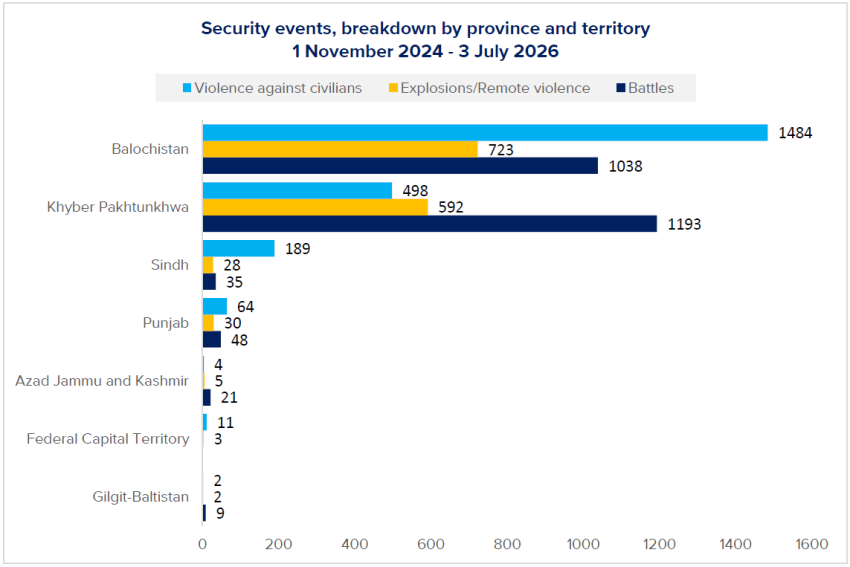
From 1 November 2024 to 3 July 2026, ACLED reported 9 021 fatalities in Pakistan, with the highest numbers recorded in Khyber Pakhtunkhwa (4 502) and Balochistan (4 076). (18)

Overall, parts of Pakistan are marked by persistent insurgency, expanding militant capabilities and a notable civilian toll within a complex conflict setting across peripheral regions.
- 18
All ACLED fatality figures provided here are estimates based on ACLED’s methodology. ACLED’s database does not distinguish between civilian and non-civilian fatalities and only provides figures of direct deaths or fatalities per event, not of injured persons and casualties.