

GUIDANCE NOTE
Last update: October 2026
The guidance note on Pakistan is produced by the EUAA together with EU+ countries (4) in accordance with Article 11 of the EUAA Regulation (5). It is based on and summarises the conclusions of the comprehensive common analysis. The aim of the guidance note and the common analysis is to assist EU+ countries in the examination of applications for international protection, thereby fostering convergence of asylum practices and decisions across the EU.
This guidance note is part of the ‘Country Guidance: Pakistan’ and should be read in conjunction with the Common analysis.
Among the main Actors of persecution or serious harm who are reported to commit serious human rights violations, state actors include the Pakistani armed forces, Intelligence services, paramilitary groups and the police. They are nationwide present, with dense deployment in conflict-affected areas. Also reported to commit serious human rights violations, non-state actors include regionally anchored armed groups and the society at large, community members, and even family members.
Among the most commonly encountered profiles of applicants for international protection, the following would in general have a well-founded fear of persecution and would highly likely qualify for refugee status:
-
Leaders and prominent members of the Pashtun Tahafuz Movement (PTM - see Human rights defenders and activists)
-
Leaders and prominent members of groups advocating for Baloch rights (see Human rights defenders and activists)
-
Journalists and other media workers (seen as) critical to the Pakistan armed forces
-
Persons formally charged with blasphemy (see Individuals (perceived as) transgressing Islamic norms)
Further guidance is provided on the risk-impacting circumstances which may affect the probability of granting refugee status for the following profiles:
-
PTI members and supporters (see PTI and MQM-L members and supporters)
-
Human rights defenders and activists others than leaders and prominent members of PTM and groups advocating for Baloch rights
-
Journalists and other media workers other that those (seen as) critical to the Pakistan armed forces
-
Shia Muslims including Hazaras
-
Individuals (perceived as) transgressing Islamic norms other than those formally charged with blasphemy
For persons under the following profiles the threshold of persecution would be reached in exceptional cases:
-
MQM-L members or supporters (see PTI and MQM-L members and supporters)
If an applicant is not considered eligible for refugee status, the assessment should proceed with the examination of subsidiary protection.
With regard to Article 15(a) QR: death penalty or execution, while no executions were reported since 2019, if there is real risk of execution, and no nexus to a reason for persecution can be substantiated, subsidiary protection under Article 15(a) QR shall be granted.
Article 15(b) QR: torture or inhuman or degrading treatment or punishment may be applicable, when no nexus to a reason for persecution can be substantiated, to cases of Arbitrary arrests, illegal detention and prison conditions, Trafficking in human beings and Violence in relation to land disputes.
With regard to subsidiary protection under Article 15(c) QR, the guidance provides an assessment of the level of indiscriminate violence as displayed in the map below. Notably, it is assessed that indiscriminate violence takes place in Balochistan and South and West Khyber Pakhtunkhwa (KP), however not at a high level. In the provinces of Islamabad Capital Territory (ICT), North and East Khyber Pakhtunkhwa (KP) including Peshawar, Pakistan Administered Kashmir, Punjab, and Sindh, there is no real risk for a civilian to be personally affected within the meaning of Article 15(c) QR.
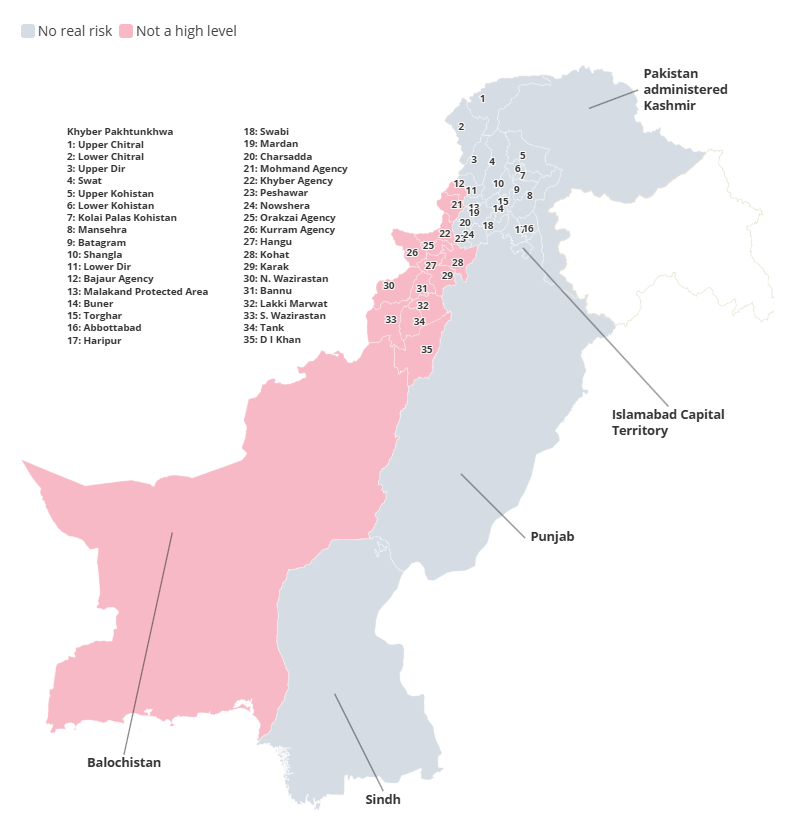
While the Pakistani state is generally able to provide protection across most of its territory, its willingness to do so can be undermined by several factors (see Actors of protection).
It is further assessed that Internal protection alternative may be applicable in Islamabad, Karachi, and Lahore, depending on the profile and individual circumstances of the applicant. This conclusion is without prejudice to the possibility to apply IPA to other locations in Pakistan.
Finally, Exclusion considerations may be relevant in a number of cases concerning applicants from Pakistan, such as (former) members of the Pakistani state armed forces, including the Pakistani army, police, rangers and/or other state supported armed militias; (former) members of Islamist, terrorist and/or insurgent groups, such as LeT, TTP and affiliated groups, and BLA; (former) members of groups known for sectarian violence such as the Sipah-e Sahaba Pakistan (SSP); (former) members of trafficking networks; individuals involved in mob attacks; individuals involved in riots and perpetrators of forced marriage, child marriage or forced conversion.
- 4
The assessment and guidance reflect the conclusions of the EUAA Country Guidance Network, which consists of EU Member States, Iceland, Norway and Switzerland. The guidance note has been endorsed by the EUAA Management Board.
- 5
Regulation (EU) 2021/2303 of the European Parliament and of the Council of 15 December 2021 on the European Union Agency for Asylum and repealing Regulation (EU) No 439/2010.