

Section 9. Safeguards for children and applicants with special needs

EU legislation contains provisions to address the special needs of applicants who may be considered particularly vulnerable in the asylum system. These provisions ensure that applicants in a vulnerable situation receive adequate support to benefit from their rights and comply with the obligations which are defined under CEAS so that they can be on an equal footing with other applicants.
The concept of vulnerability is present across the legislative instruments under the Pact, obliging authorities in Member States to swiftly identify and follow up on potential special procedural and reception needs. The assessment of special needs must start as soon as possible and be completed in 30 days, after which an applicant’s situation is to be monitored throughout the asylum procedure. The assessment is individualised and undertaken by staff who must be qualified, specialised and continuously trained. If needed, the process is assisted by an interpreter.
The best interests of the child must be the primary consideration of national authorities when applying the Pact instruments, in all decisions that affect a child. Applicants must receive information within 3 days about their rights, obligations and consequences of not complying, with consideration given to their special needs and the help of an interpreter provided by the authorities when necessary.
For children, the information must also be available in a child-friendly format. A representative is appointed as soon as possible within 15 days for unaccompanied children for the entire procedure. The representative is a natural person who must be qualified and trained, may be in charge of a sest number of children and has specific tasks identified under each piece of legislation. As a rule, children are not detained. When detention would put an applicant’s physical or mental health at serious risk, they should not be detained either.

While the Pact introduced strong safeguards for the swift identification of and support for applicants with special needs, one of the main challenges for EU+ countries remains the operationalisation of these measures. In the screening stage, national authorities are required to conduct preliminary health and vulnerability checks within 7 days and ensure adequate and timely follow-up. Based on the newly-developed screening toolbox, the operational testing of screening started in October 2025, with funding provided by the European Commission, the EUAA and Frontex.460
At the national level, several asylum authorities focused on capacity-building by training staff. With several stakeholders involved in the identification of and support for applicants with special needs, training was often provided to a range of professionals, for example police officers in Croatia461 or lawyers and social workers in Bulgaria.462 As part of an AMIF project on vulnerabilities and special procedural needs, the CGRS refined its practices, created new practical information sheets for case officers and developed a train-the-trainer programme about its implementation. It also organised several information sessions and workshops for case officers on understanding vulnerability.
Strengthening cooperation among stakeholders was another key objective in many countries. The MIGRA information system in Slovakia, used jointly by the Migration Office and the Border and Foreign Police, was updated to include official documentation on vulnerabilities and the person’s social situation. Through the system, competent staff can access up-to-date information and exchange information rapidly with all stakeholders. In the Netherlands, the IND started a pilot project to allow additional stakeholders, such as COA employees and lawyers, to request a priority assessment of cases involving highly-vulnerable applicants. Romanian authorities were working on improving their identification and referral mechanism as part of the operational plan with the EUAA, based on the EUAA’s vulnerability toolkit.
The Spanish government approved amendments to implement urgent measures to guarantee the best interests of children and adolescents “in situations of extraordinary migration contingencies”.463 Under the measures, an autonomous community hosting triple the number of unaccompanied minors than its ordinary capacity can request the government to activate a relocation mechanism, establish criteria for the relocations and provide funding for ordinary capacity in the reception system. To alleviate pressure on the reception system of the Canary Islands, internal instructions were issued to prioritise applications from unaccompanied minors. Focusing on long-term perspectives for unaccompanied children, the EU-funded CO.A.ST project promoted closer collaboration between guardians and legal professionals to ensure strengthened support for unaccompanied children as they transition into adulthood.464

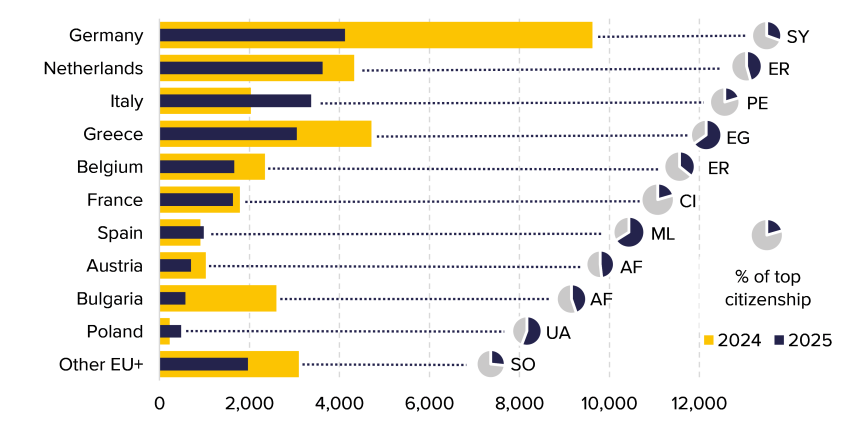
In 2025, 22,000 asylum applications were lodged by self-claimed unaccompanied minors, approximately one-third less than in 2024 and the least since 2020. Despite recording the largest absolute decline, Germany continued to receive the most (4,100 applications), accounting for almost one-fifth of the total (see Figure 14). Germany was followed by the Netherlands (3,600), Italy (3,400) and Greece (3,100). Among these top receiving countries, only Italy recorded an increase in applications by unaccompanied minors in 2025. In fact, applications there rose by two-thirds to the highest level in 7 years. On a smaller scale, applications by unaccompanied minors also rose sharply in Poland (480) and Latvia (210), where they reached unprecedented levels. In Poland, this was mainly due to more Ukrainians and to a lesser extent Belarussian unaccompanied minors applying, while in Latvia they were almost exclusively Somalis.
Five nationalities accounted for more than one-half of all asylum applications lodged by unaccompanied minors in 2025, namely Afghans (2,800), Eritreans (2,400), Egyptians (2,300), Somalis (2,300) and Syrians (2,100, the least on record). Previously, Syrian and Afghan unaccompanied minors topped the list, however their applications dropped sharply in 2025, as well as those by unaccompanied minors from Egypt. Conversely, applications by unaccompanied Eritrean minors almost doubled and were the most since 2015 on account of a sharp increase in the Netherlands. In far smaller numbers, applications by unaccompanied minors from Mali (880, mainly in Spain), Peru (700, almost all in Italy), Ukraine (450, more than half in Poland) and Sudan (440, mainly in the Netherlands and Greece) all rose substantially in 2025 and were at the highest level since at least 2014.
Figure 15. Top 10 EU+ countries receiving applications by self-claimed unaccompanied minors, 2025 compared to 2024 and share of applications lodged by the main citizenship of unaccompanied minors, 2025
Asylum authorities continued to review their laws and policies for multidisciplinary age assessments, as required under the APR and in line with the EUAA’s practical guide published in 2025.465 In Spain, the reform of the age assessment procedure was proposed, changing it from an administrative to a judicial process.466 In practice, Fundación Cepaim observed delays with the age assessment procedure, often prolonging access to the asylum procedure.467 The Cypriot Asylum Service drafted a manual and standard operating procedures on multidisciplinary age assessments, with support from the EUAA.
In Greece, a joint ministerial decision established a new framework for age assessments, whereby instead of a cascade approach using different methodologies, three different methods must be implemented on the same day.468 Civil society organisations expressed concern about this approach and noted that non-medical approaches must be given priority and the in dubio pro minorem principle must be respected.469 An application was filed by one of the organisations for the annulment of the legislation with the Council of State.470
Legislative amendments formalised the practice that the Maltese AWAS must carry out an age assessment for certain categories of foreigners when there is doubt about their age, including for applicants for international protection, people considered for resettlement and humanitarian admission, relocated applicants and beneficiaries of international protection, and people disembarked after a search and rescue operation.471 Following the ECtHR judgement in F.B. v Belgium,472 a series of judgments in Belgium addressed the reliability of and safeguards for age assessments, especially on the need to give express consent to medical age assessments,473 as is required under the APR. From 25 April 2025, the Guardianship Service amended its procedure to comply with the ECtHR judgement: the Guardianship Service verifies age by examining all evidence in the file from the interview and, in the event of persistent doubt, by a medical examination as a last resort. Consent for the medical examination is always sought from the applicant.
Several EU+ countries were faced with an insufficient number of legal guardians who are appointed for the care and support of unaccompanied children.474 The EU-funded GuardianXChange project continued to strengthen guardianship services in the four EU+ countries involved (Belgium, Poland, Portugal and Slovenia).475 In Bulgaria, UNHCR proposed the establishment of a national working group to assess different guardianship models and find the most suitable solution for the country.476 The rules on remuneration and the reimbursement of costs for statutory representatives of unaccompanied minors were amended in Slovenia, increasing the remuneration for representatives and clarifying the criteria and procedures for claiming remuneration and reimbursement.477
Unaccompanied children in Slovakia are now entitled to free legal aid also during the procedure at first instance. Previously this was available only during the appeal stage.478

With the revised EU Anti-Trafficking Directive to be transposed by July 2026, EU Member States implemented various projects and training for the prevention of trafficking in human beings and better identification of victims.479 EMN published a study which identifies several areas for improvement, such as strengthening existing institutional structures, better coordination, more robust financial investigations related to trafficking networks and addressing issues of trafficking in the digital space.480 ECRE’s policy note offered recommendations on adopting gender-sensitive laws and policies throughout the ongoing legislative process, highlighting the need for clear safeguards for the non-punishment and non-prosecution of trafficking survivors for acts they may have been forced to do.481
Since the presentation of the Pact proposals, several stakeholders expressed concerns about the potential negative impact of the changes on applicants with special needs throughout the asylum procedure.482 As the legislative process is ongoing at the national level, those concerns often re-emerged in the national context through comments on the law proposals.483
Academia provided insights for a fairer treatment of applicants with diverse sexual orientation, gender identity and expression, and sex characteristics (SOGIESC) in the asylum procedure.484 The new legal framework on safe countries of origin raised special concern by LGBTIQ advocacy groups.485
Many initiatives focused on better support for applicants with special needs in reception. In Cyprus, the competences for the reception of unaccompanied children were transferred from the Deputy Ministry for Social Welfare to the Deputy Ministry for Migration and International Protection, and the Cypriot Asylum Service was designated to take over the operation and management of unaccompanied minor shelters from the Welfare Services. In Greece since January 2025, the Reception and Identification Service (RIS) can undertake the full registration of unaccompanied minors in the RICs of Malakasa and Diavata, without having to refer them for this purpose to the competent asylum offices. In addition, several projects in Greece were launched or continued to be implemented to support children and victims of domestic violence, including training organised by RIS in thematic areas related to vulnerability, child protection, gender-based violence and the prevention of sexual exploitation.486 Following consultations with its staff in the field, and other stakeholders with relevant expertise (including the National Centre for Social Solidarity), RIS updated its guidance on the identification and management of cases of human trafficking. In addition, RIS issued new guidance for its staff on how to respond, depending on their role, to cases when residents have expressed the intention to harm themselves or others.
The Bulgarian SAR launched a pilot project providing specialised social services in four municipalities. 487 Fedasil in Belgium concluded several AMIF-funded projects, for example on child-friendly reception centres,488 LBTIQ+-friendly reception and a restorative approach, and a new reception centre opened for applicants with special medical needs at the beginning of 2026.489 COA and COC Netherlands renewed their partnership to strengthen safety and inclusion for LGBTIQ+ applicants.490 ECRE analysed the potential of the recast RCD 2024 to strengthen the protection of women and girls in reception.491 Civil society organisations continued to deliver crucial services to support applicants, either as a service provider contracted by national authorities or through initiatives funded through the EU, international or private funds.492
Despite ongoing efforts, inadequate conditions and insufficient support persisted in several EU+ countries,493 for example due to the lack of resources494 or gaps and delays in funding.495 Following the change to use more collective accommodation centres instead of small-scale housing in Sweden, the Swedish Federation for Lesbian, Gay, Bisexual, Transgender, Queer and Intersex Rights highlighted the potential negative impact on applicants with diverse SOGIESC, who may be at more risk of harassment and harm.496 The Refugee Law Clinic at the Justus Liebig University reports that on several occasions applicants told them that their cancer treatment was paused while waiting to be transferred to another federal state within Germany or to another EU+ country under the Dublin III Regulation.497 The French National Assembly concluded in its inquiry report that foreign unaccompanied children often received lower quality support than other children in the child protection system and urged for measures to ensure that they benefit from equal treatment.498
Concerns about the detention of persons with special needs, especially children, continued to be voiced and documented in court judgments499 and reports from international and civil society organisations.500
Several court cases analysed special needs and vulnerabilities in the context of Dublin transfers (see here) and returns (see here). CEDAW highlighted in several cases that victims of trafficking and victims of gender-based violence cannot be transferred under the Dublin III Regulation without an individualised, gender-sensitive assessment of the real risk of harm.501 Two cases by the Luxembourgish Administrative Tribunal annulled inadmissibility decisions for applicants who had already been granted international protection in another Member State. In the first case involving a couple with newborn twins, the court concluded that the presumption of adequate protection by the other Member State was rebutted, while in the second case concerning a pregnant woman with a young son, the court found that the authorities failed to demonstrate that adequate and immediate medical care would be available upon their return.502
- 460
European Commission. (11 November 2025). Communication from the Commission to the European Parliament and the Council The European Annual Asylum and Migration Report. COM/2025/795 final.
- 461
Croatian Law Centre | Hrvatski pravni centar. (25 April 2025). Workshop Held for Police Officers on Access to the International Protection System and the Protection of Vulnerable Groups.
- 462
Republic of Bulgaria National Legal Aid Bureau | Република България Национално бюро за правна помощ. (2025). Обучение на адвокати и социални работници за защита и закрила на жертви на трафик [Training for lawyers and social workers on the protection and support of victims of human trafficking].
- 463
Real Decreto-ley 2/2025, de 18 de marzo, por el que se aprueban medidas urgentes para la garantía del interés superior de la infancia y la adolescencia ante situaciones de contingencias migratorias extraordinarias [Royal Decree 2/2025, of March 18, adopting urgent measures to safeguard the best interests of children and adolescents in situations of extraordinary migration emergencies], 18 March 2025.
- 464
Kids in Need of Defense (KIND). (18 June 2025). Strengthening Guardianship and Legal Support for Unaccompanied Children in Europe | CO.A.ST Project.
- 465
European Union Agency for Asylum (EUAA). (November 2025). Practical Guide on Age Assessment.
- 466
Proyecto de Ley por la que se modifica la Ley 1/2000, de 7 de enero, de Enjuiciamiento Civil, para regular el procedimiento de determinación de la edad. (121/000040) [Draft Law amending Law 1/2000, of January 7, on Civil Procedure, to regulate the procedure for determining age. (121/000040)], 26 November 2024.
- 467
Convive - Foundation Cepaim | Convive – Fundación Cepaim. (2026). Input to the Asylum Report 2026.
- 468
Ministry of Migration and Asylum | Υπουργείο Μετανάστευσης και Ασύλου. (22 August 2025). Κοινό Δελτίο Τύπου των Υπουργείων Μετανάστευσης και Ασύλου και Υγείας – Νέο πλαίσιο για τη διαπίστωση της ανηλικότητας αιτούντων άσυλο [Joint Press Release of the Ministries of Immigration and Asylum and Health – New framework for determining the minor status of asylum seekers]. Ministry of Migration and Asylum, Reception and Identification Service (n.d. ). Summary description of procedures in force.
- 469
Network for Children's Rights | Δίκτυο για τα Δικαιώματα του Παιδιού. (2026). Input to the Asylum Report 2026.
- 470
Network for Children's Rights | Δίκτυο για τα Δικαιώματα του Παιδιού. (2026).Input to the Asylum Report 2026.
- 471
170 of 2025 - Agency for the Welfare of Asylum Seekers (Amendment) Regulations, 5 August 2025.
- 472
Council of Europe, European Court of Human Rights [ECt
- 473
Agency for Immigration and Civic Education Immigration Law and International Family Law | Agentschap Integratie en Inburgering Vreemdelingenrecht en Internationaal Familierecht. (24 February 2025). Leeftijdsbepaling: bewijskracht van documenten gaat voor op medische leeftijdstesten [Age determination: evidential value of documents takes precedence over medical age tests]; Belgium, Council of State [Raad van State – Conseil d’État], A.M. v Belgian State represented by the Ministry of Justice, No 263 448, 27 May 2025. Link redirects to the English summary in the EUAA Case Law Database; Belgium, Council for Alien Law Litigation [Conseil du Contentieux des Étrangers – CALL], X. v Belgian State represented by the Minister for Asylum and Migration and Social Integration (Ministre de l’asile et de la migration, et de l’intégration sociale), No 325 448, 18 April 2025. Link redirects to the English summary in the EUAA Case Law Database; Belgium, Council for Alien Law Litigation [Conseil du Contentieux des Étrangers – CALL], X. v Belgian State represented by the Minister for Asylum and Migration and Social Integration (Ministre de l’asile et de la migration, et de l’intégration sociale), No 325 976, 29 April 2025. Link redirects to the English summary in the EUAA Case Law Database.
- 474
Network for Children's Rights | Δίκτυο για τα Δικαιώματα του Παιδιού. (2026). Input the Asylum Report 2026; Save the Children. (2026). Input the Asylum Report 2026; Helsinki Foundation for Human Rights | Helsińska Fundacja Praw Człowieka. (2026). Input to the Asylum Report 2026; Andalusia Welcomes Federation – South Welcomes | Federación Andalucía Acoge – Sur Acoge. (2026). Input to the Asylum Report 2026.
- 475
International Organization for Migration (IOM). (2025). Guardian
- 476
United Nations High Commissioner for Refugees (UNHCR). (30 May 2025). UNHCR Hosts High-level Roundtable on Strengthening Guardianship for Unaccompanied Children in Bulgaria.
- 477
Pravilnik o nagradi in povračilu stroškov zakonitim zastopnikom mladoletnikov brez spremstva [Rules on remuneration and reimbursement of expenses to legal representatives of unaccompanied minors], 24 April 2025.
- 478
Centre for Legal Aid | Centrum právnej pomoci. (2026). Input to the Asylum Report 2026.
- 479
European Union Agency for Asylum (EUAA). (10 July 2025). Victims of Human Trafficking in Asylum and Reception, Fact Sheet No 34; Safe House Shelter | Patvērums "Drošā māja. (4 December 2025). Starptautiska sanāksme par cilvēktirdzniecības novēršanu Baltijas jūras reģionā [International meeting on preventing human trafficking in the Baltic Sea region]; Government of Malta | Gvern ta' Malta. (15 January 2025). Stqarrija mis-segretarjat parlamentari għall-ugwaljanza u r-riformi: Appoġġ internazzjonali għat-twettiq tal-istrateġija kontra t-traffikar tal-bnedmin [Press release by the parliamentary secretariat for equality and reforms: International support for the implementation of the strategy against human trafficking]; Safe House Shelter | Patvērums "Drošā māja. (20 May 2025). Starptautisks pētījums atklāj cilvēktirdzniecības realitāti, arī Latvijā [International study reveals the reality of human trafficking, including in Latvia].
- 480
European Migration Network (EMN). (July 2025). Trafficking in human beings – the international dimension.
- 481
European Council on Refugees and Exiles (ECRE). (8 May 2025). Reception Conditions: Protecting Women and Girls in EU Asylum Systems ECRE’s Analysis of Gender-responsive reception conditions under the Recast Reception Conditions Directive.
- 482
European Union Agency for Asylum (EUAA). (12 June 2025). Asylum Report 2025.
- 483
Irish Human Rights and Equality Commission | Coimisiún na hÉireann um Chearta an Duine agus Comhionannas. (15 October 2025). Commission raises concerns with Bill before Justice Committee; Ombudsman for Children | Ombudsman do leanaí. (14 October 2025). Observations on the International Protection Bill 2025 – Joint Oireachtas Justice Committee Opening Statement; Irish Human Rights and Equality Commission | Coimisiún na hÉireann um Chearta an Duine agus Comhionannas. (15 July 2025).Commission Raises Grave Concerns Over Proposed Asylum System’s Fairness and Effectiveness; Jesuit Refugee Service Ireland. (June 2025). Submission to the Committee on Justice, Home Affairs and Migration on the General Scheme of the International Protection Bill 2025; Swedish Refugee Law Centre | Asylrättscentrum. (2026). Input to the Asylum Report 2026; Nidos Foundation | Stichting Nidos. (2026). Input to the Asylum Report 2026; Safe Passage International. (2026). Input to the Asylum Report 2026; Queer Youth Sweden | RFSL Ungdom. (2026). Input to the Asylum Report 2026; European Network of Migrant Women. (2026). Input to the Asylum Report 2026; German NGO Network against Trafficking in Human Beings | Bundesweiter Koordinierungskreis gegen Menschenhandel_KOK e.V. (2026). Input to the Asylum Report 2026; Lesbian and Gay Association in Germany Berlin-Brandenburg | Lesben- und Schwulenverband in Deutschland (LSVD). (8 July 2025). Referentenentwürfe “GEAS-Anpassungsfolgegesetz” und “GEAS-Anpassungsgesetz” des Bundesministeriums des Innern [Draft bills “CEAS Consequential Amendments Act” and “CEAS Amendment Act” from the Federal Ministry of the Interior].
- 484
Thomas Wimark. (July 2025). The Limits of Refugee Status Determination Through Credibility Assessment: Empirical Evidence from Sexual Orientation Asylum Cases; Thomas Wimark. (9 September 2025). Decoding Sexual Orientation in Refugee Status Determination: The Influence of Accounts of Emotions on Decision-Making in Sweden; Uppsala University. (2026) Input to the Asylum Report 2026.
- 485
Lesbian and Gay Association in Germany Berlin-Brandenburg | Lesben- und Schwulenverband in Deutschland (LSVD). (6 October 2025). Innenausschuss diskutiert über „kleine“ sichere Herkunftsstaaten [The Interior Committee is discussing “small” safe countries of origin].
- 486
Ministry of Migration and Asylum | Υπουργείο Μετανάστευσης και Ασύλου. (30 October 2025). Μνημόνιο Συνεργασίας για την προώθηση της κοινωνικής ένταξης ασυνόδευτων ανηλίκων και νεαρών ενηλίκων αιτούντων άσυλο, την ενίσχυση των τοπικών κοινωνιών και την αποκέντρωση από τις δομές της Αθήνας [Memorandum of Cooperation to promote the social integration of unaccompanied minors and young adults seeking asylum, the strengthening of local communities and decentralization from the structures of Athens]; Ministry of Migration and Asylum | Υπουργείο Μετανάστευσης και Ασύλου. (27 November 2025). Ημερίδα και επίσκεψη εργασίας αντιπροσωπείας του Υπουργείου Δικαιοσύνης και Ασφάλειας της Ολλανδίας και NIDOS [Workshop and working visit of a delegation from the Ministry of Justice and Security of the Netherlands and NIDOS]; Ministry of Migration and Asylum | Υπουργείο Μετανάστευσης και Ασύλου. (30 July 2025). Κοινό Δελτίο Τύπου των Υπουργείων Μετανάστευσης και Ασύλου και Κοινωνικής Συνοχής και Οικογένειας, σχετικά με την υπογραφή Μνημονίου Συνεργασίας για την πρόληψη και αντιμετώπιση της έμφυλης και ενδοοικογενειακής βίας στον προσφυγικό και μεταναστευτικό πληθυσμό [Joint Press Release of the Ministries of Immigration and Asylum and Social Cohesion and Family, regarding the signing of a Memorandum of Cooperation for the prevention and treatment of gender-based and domestic violence among the refugee and migrant population].
- 487
State Agency for Refugees at the Council of Ministers | Държавната агенция за бежанците при Министерския съвет (SAR). (2025). За първи път у нас: Държавната агенция за бежанците с пилотен европейски проект за деца бежанци [For the first time in our country: The State Agency for Refugees with a pilot European project for refugee children]; State Agency for Refugees at the Council of Ministers | Държавната агенция за бежанците при Министерския съвет (SAR). (2025). Държавните агенции за бежанците и социално подпомагане обсъдиха мерките по изпълнението на пилотния проект за алтернативни социални услуги на непридружени деца бежанци [The state agencies for refugees and social assistance discussed the measures for the implementation of the pilot project for alternative social services for unaccompanied refugee children]; State Agency for Refugees at the Council of Ministers | Държавната агенция за бежанците при Министерския съвет (SAR). (2025). В Ивайловград: Председателят Иван Иванов и кметът Диана Овчарова отчетоха напредък в пилотния проект за социална грижа към непридружени деца бежанци [In Ivaylovgrad: Chairman Ivan Ivanov and Mayor Diana Ovcharova reported progress in the pilot project for social care for unaccompanied refugee children].
- 488
Odisee University of Applied Sciences, Knowledge Centre for Family Sciences | Odisee Hogeschool, Kenniscentrum Gezinswetenschappen. (2025). Être un enfant dans un centre d'accueil [Being a child in a reception centre].
- 489
Federal Agency for the Reception of Asylum Seekers | L’Agence fédérale pour l’accueil des demandeurs d’asile | Federaal agentschap voor de opvang van asielzoekers (Fedasil). (20 August 2025). Accueil de demandeurs d'asile à Schilde [Reception of asylum seekers in Schilde]. Federal Agency for the Reception of Asylum Seekers | L’Agence fédérale pour l’accueil des demandeurs d’asile | Federaal agentschap voor de opvang van asielzoekers (Fedasil). (14 January 2026). Premiers demandeurs d'asile à Schilde [First asylum seekers in Schilde].
- 490
Central Agency for the Reception of Asylum Seekers | Centraal Orgaan opvang asielzoekers (COA). (22 October 2025). COA en COC Nederland versterken samenwerking [COA and COC Netherlands strengthen cooperation].
- 491
European Council on Refugees and Exiles (ECRE). (8 May 2025). Reception Conditions: Protecting Women and Girls in EU Asylum Systems ECRE’s Analysis of Gender-responsive reception conditions under the Recast Reception Conditions Directive.
- 492
Jesuit Refugee Service (JRS) Romania. (2026). Input to the Asylum Report 2026; Network for Children's Rights | Δίκτυο για τα Δικαιώματα του Παιδιού. (2026). Input to the Asylum Report 2026; Holy House of Misericordy of Lisboa | Santa Casa da Misericórdia de Lisboa. (2026). Input to the Asylum Report 2026; Save the Children. (2026). Input to the Asylum Report 2026; Nidos Foundation | Stichting Nidos. (2026). Input to the Asylum Report 2026; Organization for Aid to Refugees | Organizace pro Promoc Uprchlíkům. (2026). Input to the Asylum Report 2026; Andalusia Welcomes Federation – South Welcomes | Federación Andalucía Acoge – Sur Acoge. (2026). Input the Asylum Report 2026; Croatian Red Cross | Hrvatski Crveni Križ. (2026). Input the Asylum Report 2026; Women’s Initiative Network. (2026). Input the Asylum Report 2026.
- 493
Swiss Refugee Council | Schweizerische Flüchtlingshilfe | Organisation suisse d’aide aux réfugiés. (2026). Input to the Asylum Report 2026; Italian National Union for Refugees and Exiles | Unione Nazionale Italiana per i Rifugiati ed Esuli (ESILE). (2026). Input to the Asylum Report 2026; European Network of Migrant Women. (2026). Input to the Asylum Report 2026; Dutch Advisory Council on Migration | Adviesraad Migratie. (3 September 2025). Gespreksnotitie voor TK-rondetafelgesprek over rechten van kinderen in de asielopvang [Discussion note for House of Representatives roundtable discussion on the rights of children in asylum reception]; Asylex. (2026). Input to the Asylum Report 2026. European Council on Refugees and Exiles (ECRE). (2026). Input to the Asylum Report 2026.
- 494
Ministry of Labour and Social Policies (Italy) | Ministero del Lavoro e delle Politiche Sociali. (5 May 2025). Conclusa l'indagine conoscitiva sul fenomeno dei minori stranieri non accompagnati (MSNA) [The fact-finding investigation into the phenomenon of unaccompanied foreign minors (MSNA) has concluded]; Italian National Union for Refugees and Exiles | Unione Nazionale Italiana per i Rifugiati ed Esuli (ESILE). (2026). Input to the Asylum Report 2026; Refugee Council Lower Saxony | Flüchtlingsrat Niedersachsen e.V. (2026). Input to the Asylum Report 2026; Spanish Commission for Refugee Aid | Comisión Española de Ayuda al Refugiado. (2026). Input to the Asylum Report 2026.
- 495
Ministry of the Interior (Italy) | Ministero dell‘Interno. (12 August 2025). Minori stranieri, Anci: “Ritardi nella copertura delle spese ai Comuni, va potenziato il SAI” [Foreign minors, ANCI: "Delays in covering expenses for municipalities, the SAI must be strengthened."]; Network for Children's Rights | Δίκτυο για τα Δικαιώματα του Παιδιού. (2026). Input to the Asylum Report 2026. Mobile Info Team. (3 April 2025). Mentally, physically, and practically, life is not possible here”: People continue to suffer in Greece’s mainland refugee camps; Migration Research Institute, Pontifical University Comillas | Instituto Universitario de Estudios sobre Migraciones Universidad Pontificia de Comillas. (2026). Input to the Asylum Report 2026; I want to help refugees | Gribu palīdzēt bēgļiem. (2026). Input to the Asylum Report 2026; German NGO Network against Trafficking in Human Beings | Bundesweiter Koordinierungskreis gegen Menschenhandel_KOK e.V. (2026). Input to the Asylum Report 2026.
- 496
The Swedish Federation for Lesbian, Gay, Bisexual, Transgender, Queer and Intersex Rights | Riksförbundet för homosexuellas, bisexuellas, transpersoners, queeras och intersexpersoners rättigheter. (2026). Input to the Asylum Report 2026.
- 497
Refugee Law Clinic Gießen, Justus Liebig University. (2026). Input to the Asylum Report 2026.
- 498
Inquiry Commission into Shortcomings in Public Policies for Child Protection | Commission d'enquête sur les manquements des politiques publiques de protection de l'enfance. (1 April 2025). Rapport [Report] ; Forum réfugiés-Cosi | Refugee Forum. (18 April 2025). Un rapport parlementaire souligne des défaillances de la protection de l’enfance pour les jeunes étrangers isolés [A parliamentary report highlights shortcomings in child protection for unaccompanied foreign minors].
- 499
Law for People | Zákony pro lidi. (30 October 2025). Rozsudek MSPH ze dne 30.10.2025 (10 A 103/2025 – 40) [MSPH judgment of 30 October 2025 (10 A 103/2025 – 40]; Croatia, Administrative Court [Upravni sud], Applicants v Ministry of the Interior of the Republic of Croatia‚ Directorate for Immigration‚ Citizenship and Administrative Affairs (Ministarstva unutarnjih poslova Republike Hrvatske‚ Uprave za imigraciju‚ državljanstvo i upravne poslove), Us I-3795/2024-7, 30 October 2025. Link redirects to the English summary in the EUAA Case Law Database; Cyprus, International Protection Administrative Court [Διοικητικό Δικαστήριο Διεθνούς Προστασίας], M.A. et al. v Republic of Cyprus, 2183/2024 et al, 13 August 2025. Link redirects to the English summary in the EUAA Case Law Database; Belgium, Council for Alien Law Litigation [Conseil du Contentieux des Étrangers - CALL], Applicant v Commissioner General for Refugees and Stateless Persons (le Commissaire Général aux Réfugiés et aux Apatrides; de Commissaris-generaal voor de vluchtelingen en de staatlozen; CGRS; CGRA; CGVS), 330 387, 25 July 2025. Link redirects to the English summary in the EUAA Case Law Database; Lithuania, Supreme Administrative Court of Lithuania [Lietuvos vyriausiasis administracinis teismas], Applicant v Migration Department of the Ministry of the Interior of the Republic of Lithuania, eA-1490-821/2025, 30 January 2025. Link redirects to the English summary in the EUAA Case Law Database; Italy, Supreme Court of Cassation [Corte Suprema di Cassazione], Applicant v Ministry of the Interior (Ministero dell'Interno), R.G. 30999/2025, 08 October 2025. Link redirects to the English summary in the EUAA Case Law Database; Netherlands, Council of State [Afdeling Bestuursrechtspraak van de Raad van State], Applicants v The Minister for Asylum and Migration (de Minister van Asiel en Migratie), 202305248/1/V3, ECLI:NL:RVS:2025:2256, 20 May 2025. Link redirects to the English summary in the EUAA Case Law Database; European Union, Court of Justice of the European Union [CJEU], GB [Adrar] v The Minister for Asylum and Migration (de Minister van Asiel en Migratie), C-313/25 PPU, ECLI:EU:C:2025:647, 4 September 2025. Link redirects to the English summary in the EUAA Case Law Database.
- 500
Save the Children. (2026). Input to the Asylum Report 2026; Border Violence Monitoring Network. (2026). Input to the Asylum Report 2026; Missing Children Europe. (June 2025). EU Pact on Migration and Asylum: Safeguarding Children in Migration at Risk of Going Missing; European Council on Refugees and Exiles (ECRE). (2026). Input to the Asylum Report 2026.
- 501
United Nations Committee on the Elimination of Discrimination against Women (CEDAW), C.O.E. v Switzerland, 172/2021, 2 July 2025. Link redirects to the English summary in the EUAA Case Law Database; United Nations Committee on the Elimination of Discrimination against Women (CEDAW), K.J. v Switzerland, 169/2021, 4 July 2025. Link redirects to the English summary in the EUAA Case Law Database; United Nations Committee on the Elimination of Discrimination against Women (CEDAW), Z.E. and A.E. v Switzerland, 171/2021, 4 July 2025. Link redirects to the English summary in the EUAA Case Law Database.
- 502
Luxembourg, Administrative Tribunal [Tribunal administratif], A1., A2. v Minister of the Interior, No 52672, ECLI:LU:TADM:2025:52672, 2 June 2025. Link redirects to the English summary in the EUAA Case Law Database; Luxembourg, Administrative Tribunal [Tribunal administratif], A. v Ministry of Home Affairs, No 52341, 4 April 2025. Link redirects to the English summary in the EUAA Case Law Database.