

4.4. Managing caseloads and assessing applications for international protection

Several countries updated policies based on changes in the countries of origin in order to support good quality and rapid decision-making.222 Nonetheless, the volatile situation in several countries of origin impacted case processing, with several authorities suspending the processing of cases by nationals from certain countries of origin. These decisions often had a significant impact on caseloads, pending cases and recognition rates.
An example was the responses triggered by developments in Syria in December 2024, when most EU+ countries suspended decision-making on the protection needs of Syrian applicants until there was more clarity on the situation in the country.223 Asylum authorities re-started processing of these cases at different times throughout 2025 (see Table 2). At the end of 2025, Syrians were the main nationality in the caseload of 12 EU+ countries. This nationality accounted for one-half or more of all pending cases in Austria, Cyprus, Germany and Norway.
Table 2. Resumption of assessments of applications submitted by nationals of Syria, 2025
| Month in 2025 | Country re-starting decisions on protection needs of Syrian applicants |
|---|---|
| April | Poland |
| May | Cyprus (partial resumption, full resumption confirmed for February 2026), Greece |
| June | Netherlands224 |
| July | Austria, Denmark, France |
| August | Malta |
| September | Czechia, Finland,225 Germany,226 Sweden,227 Switzerland (partial resumption for specific profiles)228 |
| October | Iceland, Latvia, Luxembourg |
| November | Belgium229 |
| December | Norway230 |
| Countries that did not suspend the decision-making on protection needs of Syrian applicants | Bulgaria, Estonia, Hungary, Portugal, Lithuania, Romania, Slovakia, Slovenia, Spain |
| Countries where the suspension remained in place at the end of 2025 | Croatia, Ireland (recommenced assessing cases in February 2026), Italy |
Table 3. Examples of the temporary suspension of decision-making on protection needs of applicants with certain profiles, 2025
| Profile of applicant | Time period | Country applying the policy |
|---|---|---|
| Nationals of Lebanon | 31 October 2024–1 May 2025 | Norway231 |
| Nationals of Lebanon | 14 November 2024–17 June 2025 | Netherlands232 |
| Applicants from the West Bank not registered with UNRWA | 12 March 2025–16 March 2026 | Belgium233 |
In these circumstances, the need for up-to-date, objective and balanced information on countries of origin was even more accentuated, putting at the forefront the work of COI units (see Table 4). Asylos warned that changes in the form and content of the US State Department annual reports risk undermining fair and evidence-based asylum decisions in EU countries.234 In Belgium, the coalition agreement stated that the CGRS’ COI unit (CEDOCA) will be given an additional mandate to investigate the rule of law and detention conditions in other countries in order to assess the feasibility of building or leasing prisons where convicted detainees in irregular stay can serve their sentences. These agreements could only be implemented if the detention is carried out in a proper and humane manner, respecting international legal obligations and would require judicial approval by the Council of State and advice from CEDOCA.235 In 2025, CEDOCA prepared nine papers for the Minister for Asylum and Migration related to this matter.
Digitalisation and the establishment of integrated case management systems remained a crucial objective for asylum authorities in strengthening capacity and preparing for compliance with some of the stricter timelines under the Pact (see Table 5). Academia warned about the risk for marginalisation of other perspectives in the process of increased technological use.236
Table 4. Fact-finding missions for country of origin information, 2025
| National authority | Mission |
|---|---|
| Czech Ministry of the Interior | Damascus and Lebanon on the topic of return migration and the security situation in Syria |
| French OFPRA and CNDA | Joint mission to Angola, followed by the publication of a joint mission report237 |
| Norwegian Directorate of Immigration (UDI) Landinfo | Afghanistan (together with the SMA), Syria (together with the SMA) |
| Swedish SMA, Lifos | Afghanistan (together with the Norwegian UDI Landinfo), Iraq/KRI (together with the Danish Immigration Service COI unit), Syria (together with the Norwegian UDI Landinfo) |
Table 5. Examples of digitalisation initiatives in EU+ countries, 2025
| Country | Initiatives |
|---|---|
| Austria | Ongoing initiatives for a speech-to-text and translation tool for asylum interviews. |
| Belgium | Adjusting the CGRS database to implement parallel procedures after the entry into application of the Pact. |
| Setting up a proof of concept at CALL to test an AI-powered search system making it easier and faster for staff to find information for decisions on appeals. | |
| Use of AI in COI: Training on prompting, automation of footnotes and bibliography, support for research and summaries. | |
| Bulgaria | Development of a modular IT case management system, with funding through TSI and from Switzerland.238 |
| Development of an internal COI platform. | |
| Cyprus | Ongoing digitalisation of physical files with EUAA support. Upgrade of the IT system of the Asylum Service is planned for 2026. |
| Czechia | Amendments to the Act on Asylum allow the Ministry of the Interior to use a technical interpretation device during proceedings in real time. Interpretation can also be done by videoconference, and if a document is not accompanied by an official translation, the Ministry of the Interior can use machine translation. |
| France | AMIF-funded project on piloting the use of AI tools, for example for document searches (but never for drafting decisions) and the digitisation of the asylum application processing system.239 |
| Ireland | The IPO launched the International Protection Application Portal, allowing registered applicants to check the status of their application, download their application form and upload documentation and submissions.240 |
| Luxembourg | On-going work on updating the digital case management system. |
| Malta | On-going work on a new case management system and a document management and case tracker tool. |
| Netherlands | On-going work on a new IT system. |
| Norway | Digitalisation of the entire migration sector continued in 2025 and legislative amendments were adopted to allow for the implementation of digital processes.241 |
| Portugal | Development of a translation and interpretation software to be used in the asylum procedure. |
| Spain | Progress in the development of a new case management system (LARES) which focuses on the interconnection of the Asylum Database with other national and international databases relevant to the processing of international protection cases. |
| Sweden | Development of a digital tool allowing case officers to monitor cases within a time-bound process and with automated statistics. |
In 2025, EU+ countries issued almost 874,000 first instance decisions, which is the most since 2017. The increase was driven by a sharp climb in the number of rejections, mainly for citizens of countries with a low recognitions rate (20% or lower). The most decisions were issued in Germany, followed by France and Spain. France, Ireland and Italy issued the most decisions on record. Several countries issued less decisions, mainly due to fewer decisions issued to Syrians. The largest declines in decision-making were seen in Austria, Greece and the Netherlands.
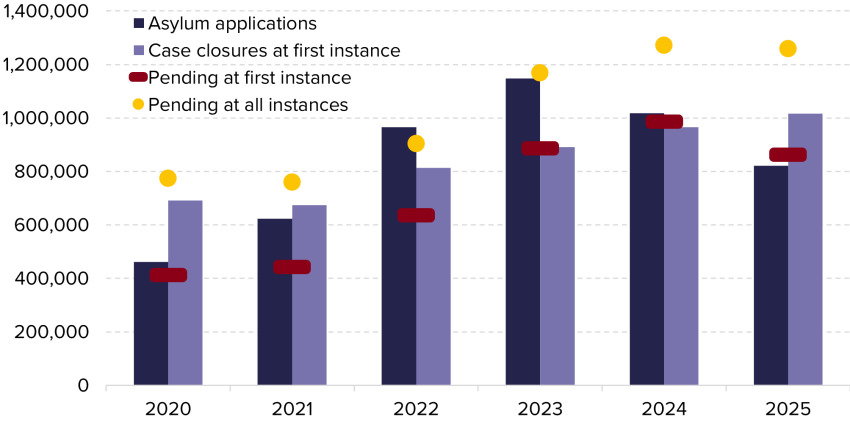
Pending cases at first instance decreased to 863,000 in 2025, from 986,000 in 2024 (approximately 13% decrease) (see Figure 5). While some EU+ countries ramped up first instance decision-making, the decline in pending cases was rather the result of fewer applications being lodged. The caseload shrank in 15 countries. In Germany, pending cases at first instance halved by the end of 2025 from a year earlier (102,000). Bulgaria recorded the largest relative decline. The number of pending cases declined to an unprecedented low in Sweden.
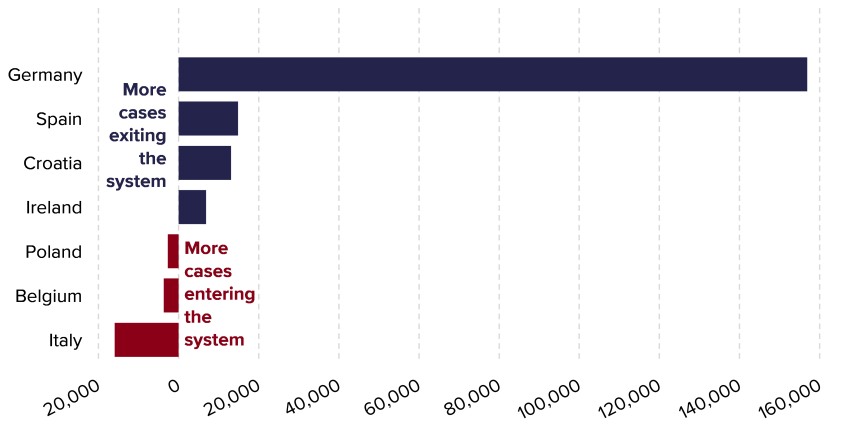
However in Italy, despite the record level of decision-making, the number of pending cases increased, becoming the country with the most pending cases across the EU+. The caseload remained high in Spain as well. Most pending cases in the EU+ pertained to Venezuelans (120,000, almost all in Spain), Syrians (100,000, nearly one-half in Germany) and Colombians (70,000, mostly in Spain). At the end of 2025, the caseload related to applicants from countries with a low recognition rate reached 63% of the total pending caseload.
Despite the drop in pending cases at first instance, more appeals overall implied a stable and high caseload at all instances.
Figure 5. Annual asylum applications, first instance case closures and year-end pending caseloads at first instance and all instances in EU+ countries, 2020-2025
Source: EUAA EPS data as of 3 February 2026 and Eurostat migr_asypenctzm as of 2 February 2026.
Figure 6. Disparity between asylum applications and case closures (first instance decisions, discontinuations after withdrawals and otherwise closed cases) in EU+ countries with the largest gaps, 2025
Source: EUAA EPS data as of 3 February 2026.
- 222
Minister of Asylum and Migration | Minister van Asiel en Migratie. (27 October 2025). Landenbeleid Libië [Country policy on Libya]; Minister of Asylum and Migration | Minister van Asiel en Migratie. (9 September 2025). Landenbeleid Somalië [Country policy on Somalia]; Minister of Asylum and Migration | Minister van Asiel en Migratie. (30 May 2025). Landenbeleid Turkije [Country policy on Turkey]; Minister of Asylum and Migration | Minister van Asiel en Migratie. (17 June 2025). Landenbeleid Mali [Country policy on Mali]; Minister of Asylum and Migration | Minister van Asiel en Migratie. (30 January 2025). Landenbeleid Colombia [Country policy on Colombia]; Minister of Asylum and Migration | Minister van Asiel en Migratie. (8 October 2025). Landenbeleid Jemen [Country policy on Yemen]; State Secretariat for Migration | Staatssekretariat für Migration | Secrétariat d’État aux migrations | Segreteria di Stato della migrazione. (20 March 2025). Le SEM ajuste sa pratique en matière d’asile concernant l’Afghanistan [The SEM adjusts its asylum practice regarding Afghanistan].
- 223
European Union Agency for Asylum (EUAA). (12 June 2025). Asylum Report 2025.
- 224
Immigration and Naturalisation Service | Immigratie- en Naturalisatiedienst (IND). (12 June 2025). IND resumes processing Syrian asylum applications.
- 225
Finnish Immigration Service | Maahanmuuttovirasto. (26 September 2025). Updates about Syria.
- 226
Federal Office for Migration and Refugees | Bundesamt für Migration und Flüchtlinge. (12 January 2026). Asylzahlen Gesamtjahr und Dezember 2025 [Asylum figures for the full year and December 2025].
- 227
Swedish Migration Agency | Migrationsverket. (11 September 2025). Prövningen av syriska asylärenden återupptas [The examination of Syrian asylum cases resumes].
- 228
United Nations High Commissioner for Refugees (UNHCR). (1 September 2025). Suspension of asylum processing in Switzerland for Syrian asylum seekers.
- 229
Office of the Commissioner General for Refugees and Stateless Persons | Commissariaatgeneraal voor de vluchtelingen en de staatlozen | Commissariat Général aux Réfugiés et aux Apatrides (CGRS). (30 October 2025). CGRS set to resume processing of Syrian dossiers.
- 230
Norwegian Directorate of Immigration | Utlendingsdirektoratet (UDI). (18 December 2025). UDI gjenopptar behandlingen av asylsøknader fra Syria [UDI resumes the processing of asylum applications from Syria].
- 231
Norwegian Directorate of Immigration | Utlendingsdirektoratet (UDI). (30 April 2025). Opphever returstopp til Libanon [Lifting the return ban to Lebanon].
- 232
Immigration and Naturalisation Service | Immigratie- en Naturalisatiedienst (IND). (17 June 2025). IND resumes asylum applications from Lebanon.
- 233
Office of the Commissioner General for Refugees and Stateless Persons | Commissariaatgeneraal voor de vluchtelingen en de staatlozen | Commissariat Général aux Réfugiés et aux Apatrides (CGRS). (12 March 2025). File processing of applicants from the West Bank. Office of the Commissioner General for Refugees and Stateless Persons | Commissariaatgeneraal voor de vluchtelingen en de staatlozen | Commissariat Général aux Réfugiés et aux Apatrides (CGRS). (16 March 2026). Resumed processing of non-UNRWA West Bank files.
- 234
Asylos. (2025). New USDOS reports downplay human rights abuses, raising doubts over impartiality and reliability; Asylos. (2026). Input to the Asylum Report 2026.
- 235
Federal Government of Belgium | Gouvernement fédéral belge. (31 January 2025). Accord de coalition fédérale 2025-2029 [Federal coalition agreement 2025-2029].
- 236
Centre for Migration, Refugees and Belonging. (2026). Input to the Asylum Report 2026.
- 237
French Office for the Protection of Refugees and Stateless Persons | Office français de protection des réfugiés et apatrides (OFPRA). (June 2025). Rapport de mission en République d’Angola du 16 au 26 juin 2025 [Report on the mission to the Republic of Angola from 16 to 26 June 2025].
- 238
State Agency for Refugees at the Council of Ministers | Държавната агенция за бежанците при Министерския съвет (SAR). (14 April 2025). Digitalisation of the procedure for granting international protection in Bulgaria; State Agency for Refugees at the Council of Ministers | Държавната агенция за бежанците при Министерския съвет (SAR). (25 October 2025). Ръководството на ДАБ при МС и представители на швейцарска делегация обсъдиха мерките по компонента, който Агенцията ще изпълнява по Швейцарско-българска програма в областта на миграцията [The management of the SAR at the CM and representatives of a Swiss delegation discussed the measures under the component that the Agency will implement within the framework of the Swiss-Bulgarian Programme on Migrationl].
- 239
French Office for the Protection of Refugees and Stateless Persons | Office français de protection des réfugiés et apatrides (OFPRA). (10 December 2025). Le Fonds asile, migration et intégration (FAMI) [The Asylum, Migration and Integration Fund (AMIF)].
- 240
International Protection Office. (2025). International Protection Applicant Portal Important Notice.
- 241
Ministry of Justice and Public Security (Norway) | Justis- og beredskapsdepartementet. (10 April 2025). Regjeringa foreslår endringar i regelverket for familieinnvandring og permanent opphaldsløyve [The government proposes changes to the rules for family immigration and permanent residence permits].