

3.4. Data on applications for international protection

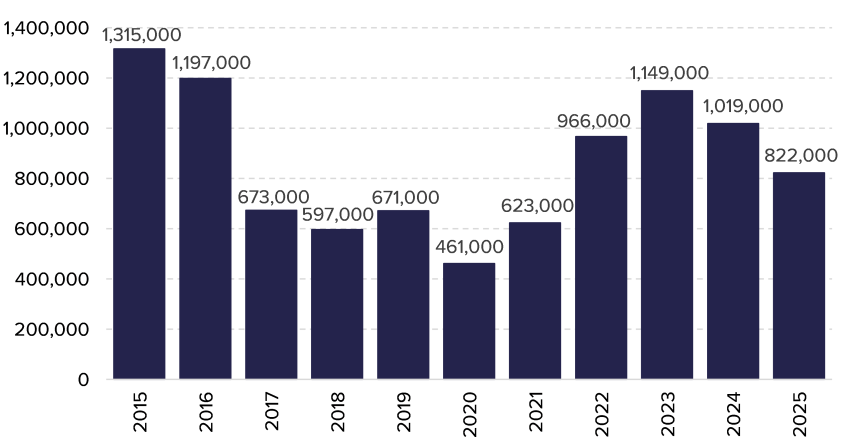
The number of asylum applications lodged in EU+ countries declined for a second year in a row to 822,000 (see Figure 2). This was a drop by one-fifth compared to 2024, the lowest total since 2021. In line with the overall trend, applications dropped in almost all EU+ countries.iii Germany remained the main receiving country (163,000 applications), although at a far lower level than in 2024 (down by almost one-third). The decline in first-time applications was partly counterbalanced by a significant increase in repeated asylum applications. Germany was followed by France (152,000), Spain (143,000) and Italy (134,000). Applications in 2025 were concentrated among a limited number of nationalities. The five largest groups were citizens of Afghanistan (14% of all applications), Venezuela (11%), Syria (5%), Bangladesh (4%) and Türkiye (4%).
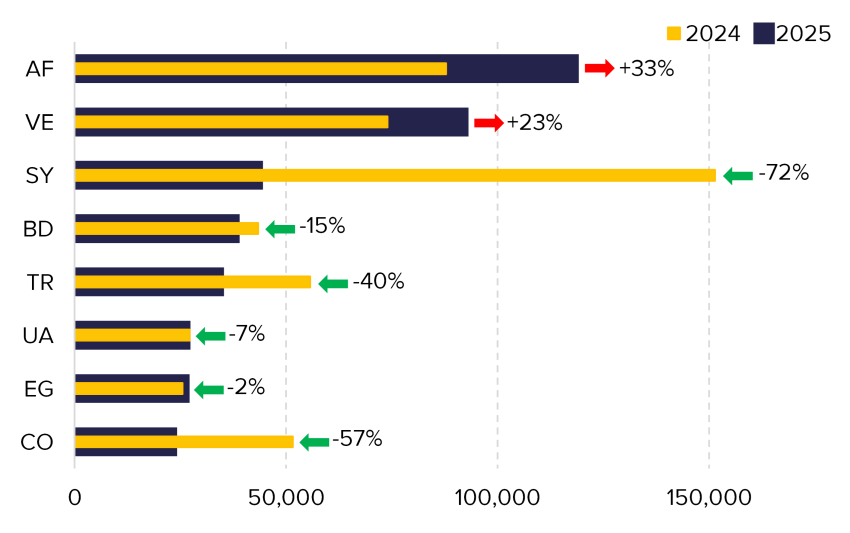
The decline in 2025 can be partly attributed to the decrease in the number of applications lodged by Syrians (42,000), which shrunk by almost three-quarters following the fall of the Assad regime at the end of 2024. Nonetheless, Syrians alone do not account for the significant drop in the number of applications. There were 36 other citizenships that experienced decreases of over 1,000 applications in 2025. Among the citizenships with a decline in applications, Syrians accounted for two-fifths of the decline, while Turks (33,000; -40%) and Colombians (22,000; -57%) combined accounted for one-fifth. Peruvians (20,000; -27%), Bangladeshis (37,000; -15%) and Iraqis (13,000; -33%) also lodged far fewer applications, with declines surpassing 6,000 applications. External cooperation with neighbouring and transit countries to increase their capacity in managing irregular migration likely also contributed to the decline.
Figure 2. Number of applications for international protection in EU+ countries, 2015-2025
At the same time, notable increases were recorded for citizens of Afghanistan (117,000; +33%) and Venezuela (91,000; +23%), where deepening political and economic crises continued to drive large-scale displacement (see Figure 3). Similarly, amid protracted, intense conflicts, the inflow of applicants from Mali (20,000), Sudan (18,000) and the Democratic Republic of the Congo (18,000) reached new highs in 2025. On a smaller scale, the same occurred for South Sudan (880) and Niger (880).
Figure 3. Applications lodged in EU+ countries by top citizenships in 2025, compared to 2024
Repeated applicationsiv rose by 39% compared to 2024, reaching the highest level on record and representing 15% of all asylum applications. The main reason behind this rise was a CJEU judgment in October 2024 that clarified that gender and nationality were sufficient for Afghan women to be at risk of acts of persecution. This led to a surge in repeated applications by Afghans, which quadrupled from the previous year. For instance in Germany, the number of repeated applications in 2025 more than doubled compared to 2024. Around 73% (or nearly three-quarters) of these applications were lodged by Afghan nationals.
Another factor in the inflow of applicants was nationals of visa-exempt countries. While the number of these applications decreased slightly, given the steeper decline in the overall number of applications, they still accounted for one-quarter of all applications lodged in EU+ countries in 2025. The main nationalities within this group were Venezuelans (45% of visa-free applicants), Ukrainians (12%) and Colombians (11%).
Nationals of countries with low recognition rates lodged a growing share of asylum applications in 2025, representing over one-half of the total number of applications. Under the new Pact rules as of June 2026, in certain circumstances defined under APR, Article 43(1), citizens of countries with low recognition rates (falling below 20%) will be subject to the mandatory border procedure.
- iii
The only exceptions, with stable or rising flows, were Croatia, France, Hungary, Latvia, Lithuania and Slovakia.
- iv
A repeated asylum applicant is a person who makes another application for international protection in an EU+ country after a final decision (positive, negative or discontinuation) has been taken on their previous application in the same reporting country. The concept includes subsequent applicants, ‘new applicants’ (after an implicit withdrawal) and applicants who have a re-opened application.