

Section 6. Responsibility for an application for international protection

The objective of the Dublin III Regulation is to guarantee that each person has effective access to the asylum procedure and that each application will be examined by one Member State only. To this end, the regulation establishes a set of hierarchical criteria under Chapter III to determine the Member State which is responsible for the examination of an asylum application.
The AMMR, which will replace the Dublin III Regulation by July 2026, clarifies the responsibility criteria and streamlines the rules for the determination of responsibility for an application for international protection. The criterion of the presence of family members is still emphasised in determining responsibility, and family cases are prioritised while providing applicants with more information and legal support. The regulation also introduces provisions to foster solidarity with Member States that are under disproportionate migratory pressure. The new Solidarity Mechanism foresees mandatory expressions of solidarity to support Member States while offering flexibility in contributions.
In crisis or force majeure situations, the Crisis and Force Majeure Regulation allows for deviations from the rules of the AMMR.
The implementation of Dublin transfers remained largely impacted by the pressure on reception systems in some EU+ countries. While national courts mostly confirmed transfers, one of the main reasons for overturning decisions of national authorities was up-to-date evidence on serious issues in accessing material reception conditions in the responsible state. Courts assessed safeguards for applicants with special needs (for example, the availability of medical care or reliability of age assessments) before taking a decision on the lawfulness of a transfer.
The CJEU clarified the meaning of ‘rejection’ under the Dublin III Regulation, Article 18(1d) and noted that the decision not to renew international protection does not mean that an application was rejected.325 This decision impacts Member States’ obligations to take back a third-country national. Several requests for a preliminary ruling were still pending in front of the court, for example, on the legal consequences of a Member State unwilling to accept responsibility under the Dublin III Regulation,326 the possibility to apply the discretionary clause when responsibility is determined under the Dublin III Regulation, Article 3(2) or it applies only for cases when Article 3(1) applies,327 and the assessment of an applicant’s health conditions to declare the person fit to travel instead of an assessment of the full impact of the transfer on the applicant’s health.328
While waiting for the entry into application of the AMMR, the implementation of the Dublin Roadmap continued throughout 2025. The roadmap was adopted in November 2022 to improve the implementation of Dublin transfers. While fewer new measures were reported for 2025, EU+ countries continued to implement practices established in previous years. See Table 6 for some examples of the new actions initiated by EU+ countries.
Table 6. Examples of national developments in reaching the objectives of the Dublin Roadmap, 2025
| Objective 1 – Limiting absconding | ||

|
Focus on reducing the possibility of absconding |
Establishment of special reception centres for applicants in the Dublin procedure in Finland and Germany. Faster execution of transfers due to a reduced workload in Austria. Shorter notification times for transfer decisions in Luxembourg. Project to locate absconded persons in Norway. |
| Objective 2 – Improving communications between Member States | ||

|
Strengthening bilateral channels and, if necessary, attempt to contact the other Member State outside of DubliNet when urgent action is needed | Bilateral discussions with contacts from other Member States in Austria and Norway. |

|
Use of EU fora | Exchanges in Commission Contact Committees and the EUAA Dublin Network. |
| Objective 3 – Overcoming practical obstacles when implementing transfers | ||

|
Pragmatic coordination |
Flexibility to accept arrivals in Norway, Portugal and Slovakia. Case teams contacting counterparts through DubliNet or phone when specific arrangements are necessary in Denmark. |
| Objective 4 – Ensuring sufficient resources to effectively implement Dublin transfers | ||

|
Strengthening Dublin Unit’s capacity | Recruitment of additional staff in Portugal. |
| Objective 5 – Increasing compliance with EU law, including court rulings | ||

|
Confirmation of existing compliance practices | Confirmation of thorough pre-transfer risk assessments in Norway. |

|
Legislative changes to align with CJEU jurisprudence | Amendment of the Danish Aliens Act extending the right to appeal before the Refugee Appeals Board for unaccompanied minors, in line with C-19/21. |
According to provisional EPS data (which means that due to a subsequent consolidation and validation of the data at the national level, the figures presented here may differ slightly from the national statistics), approximately 18,000 Dublin transfers were implemented in 2025 across EU+ countries, which is similar to 2024. This was the second-most since 2019, but far below the pre-pandemic levels. While most reporting countries carried out fewer transfers than in 2024, there were some exceptions. For instance, notable increases were seen in France (3,400, +34% from 2024) and Greece (1,200, +152%), which implemented the most transfers in several years. Belgium also carried out more transfers, rebounding from the dip of 2024. At lower levels, increases also took place for Hungary and Luxembourg. As in previous years, the top implementing countries were Germany (5,200), France (3,400) and Switzerland (2,100).
Germany also continued to be the top receiving country (4,400), followed by Spain (3,300, surging by over three-fifths from 2024) and France (2,000). At a lower level, transfers to Belgium (920) increased by one-tenth, to a record level. Conversely, those to Austria (780) more than halved, returning to pre-pandemic levels. Similarly, transfers to Italy fell to an all-time low. This was mostly due to the circular issued by the Italian Dublin unit at the end of 2022 that temporarily suspended incoming transfers except for family reunification and unaccompanied minors.
Figure 7. Number of implemented transfers over total accepted Dublin requests in 2025

In 2025, EU+ countries focused on transitioning from the application of the Dublin III Regulation to the new Eurodac Regulation and the AMMR.
Several legal and practical ambiguities were clarified during the year, for example through the European Commission’s Contact Committee meetings and EUAA meetings, workshops and guidance material for the implementation process. Nonetheless, some questions remained pending throughout 2025, for example related to the Solidarity Pool and responsibility offsets, as the Implementing Decision on establishment of the annual Solidarity Pool 2026 was formally adopted on 19 December 2025.329 While some national authorities preferred to wait for the clarifications and then develop a more detailed implementation plan, the majority of administrations started to plan based on different scenarios.
A major challenge for EU+ countries in the transition process was the adaptation of IT systems, including re-configuring case management systems to include new forms, templates and workflows. These adaptions are crucial to ensure that the new AMMR system is operationalised, and they are essential to make the responsibility rules work. For example, authorities in France were developing a new IT system for incoming requests. In Germany, the Federal Office for Migration and Refugees (BAMF) developed a digital laissez-passer for transfers, which can be exchanged more easily with partners than the paper version. The eLaissez-passer was still in the introductory phase.
In several countries, IT projects linked to the application of Eurodac and AMMR form part of a wider digitalisation programme. The Irish International Protection Office launched a 3-year modernisation programme and shifted its focus to ensure compliance with AMMR requirements after several other programme outputs were already delivered (such as a new digital application system and storage platform). Similar programmes were implemented in Luxembourg and Norway. In both countries, the focus was on digitalisation processes related to the asylum unit for the first deliverables, while the Dublin unit was planned to be involved at a later stage.
The shortage of staff in Dublin units remained a major challenge in Greece and Portugal. Both countries mentioned as a key priority the increase of staff members as part of their preparation for the entry into application of the new rules. In other countries, the goal was to ensure that staff is sufficiently trained to work under the new processes and shorter time limits. Managing both the ongoing caseload and undertaking training in parallel were challenging for many Dublin units. In addition, several authorities highlighted that stakeholders outside of Dublin units were also in need of targeted training to ensure they understood the new rules and, for example, could also inform applicants correctly about the procedure.
Dublin units put concerted effort into clearing their backlogs to avoid as much as possible the simultaneous use of former and new rules after the entry into application of the Pact. Nonetheless, many of them noted that completely clearing the backlog may not be a feasible objective. Different solutions were considered to manage cases falling under different rules after July 2026. These included the development of internal guidance, assigning a group of staff to older cases only and adding Dublin and AMMR tracks in case management systems.
The majority of EU+ countries reported a stable workload, which facilitated work on backlog reduction and Pact implementation. Requests for information under the Dublin III Regulation, Article 34 were reported to be higher for example in Bulgaria, France, Ireland and Poland. To manage remaining challenges, the EUAA provided operational support for the implementation of the Dublin III Regulation at various stages of the Dublin procedure in Belgium, Cyprus, Germany, Greece and Italy. In addition, the EUAA supported relocations from Malta, provided administrative support for the implementation of Dublin transfers in Bulgaria and offered support at a strategic level in Romania.
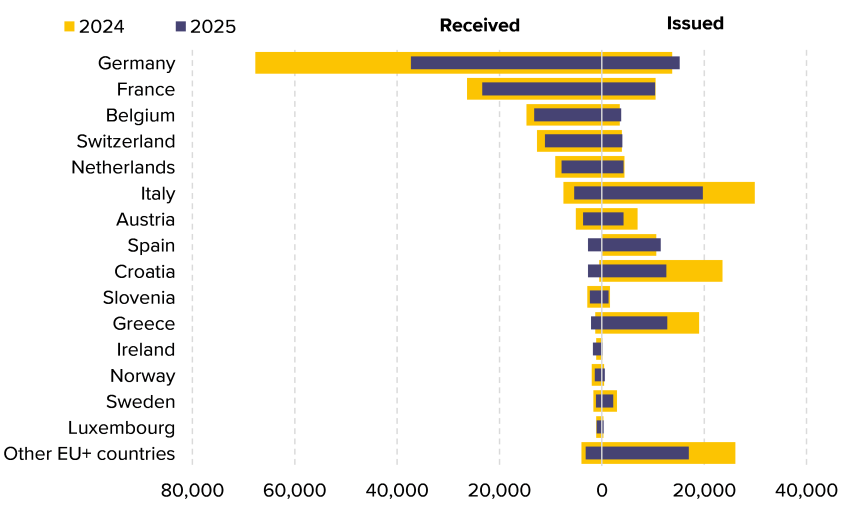
In 2025, 120,000 decisions were issued in response to outgoing Dublin requests. This represented a 24% decrease from 2024 and the lowest level since 2021. The decrease suggests a reduction in the number of asylum seekers moving from the first country of arrival to another to lodge a new application (referred to as secondary movements) and is in line with the overall decrease in asylum applications.
The countries receiving the most decisions on Dublin requests in 2025 all recorded declines compared to 2024 (see Figure 9, left panel). The decreases were the most marked for Germany (more than44%), Italy and Austria (both over one-quarter less). Conversely, decisions on requests received by Croatia rose several times compared to the previous year, to the highest number on record.
For Dublin decisions which were issued, the most notable declines were for countries and nationalities typically associated with the Balkan routes: Croatia and Bulgaria (almost one-half less than in 2024), followed by Austria, Italy and Greece (over one-third less) (see Figure 9, right panel). Conversely, Germany and Spain issued slightly more decisions compared to the previous year, up by around 10%.
As in the past, more decisions were issued than received in Italy, Greece and Croatia, and vice versa in countries in Central and Western Europe.
Figure 8. Top 10 EU+ countries by Dublin decisions issued and received, 2025 compared to 2024 and share of decisions issued in total decisions in 2025
- 325
European Union, Court of Justice of the European Union [CJEU], X. [Qassioun] v Maahanmuuttovirasto, C-790/23, ECLI:EU:C:2025:838, 30 October 2025. Link redirects to the English summary in the EUAA Case Law Database.
- 326
Germany, Federal Administrative Court [Bundesverwaltungsgericht], Federal Office for Migration and Refugees (Bundesamt für Migration und Flüchtlinge‚ BAMF) v Applicants, 1 C 24.24, 28 August 2025. Link redirects to the English summary in the EUAA Case Law Database.
- 327
Czech Republic, Supreme Administrative Court [Nejvyšší správní soud], E.K. v Ministry of the Interior (Ministerstvo vnitra České republiky), 2 Azs 87/2025 - 1, 16 July 2025. Link redirects to the English summary in the EUAA Case Law Database.
- 328
Netherlands, Court of The Hague [Rechtbank Den Haag], Applicant v The Minister for Asylum and Migration (de Minister van Asiel en Migratie), NL23.17939 Reference, ECLI:NL:RBDHA:2025:19325, 22 October 2025. Link redirects to the English summary in the EUAA Case Law Database.
- 329
European Commission. (19 December 2025). Council Implementing Decision (EU) 2025/2642 of 19 December 2025 on the establishment of the Annual Solidarity Pool for 2026.