

2.2. Preparing for the practical implementation of the Pact

The adoption of the Pact on Migration and Asylum in 2024 signalled the end of a complex legislative and political process, and the beginning of an intense collaborative effort to secure and allocate the required resources to turn the Pact into an operational reality. The national implementation plans have served as a compass, while expertise and financial resources were provided by the European Commission and assistance given by relevant EU agencies for EU Member States to ensure that their national asylum and reception systems are ready by June 2026, when the Pact will enter into application.
Ten Member States received targeted support to enact the necessary reforms through the dedicated Technical Support Instrument (TSI) managed by the European Commission.16 Technical support was made available in areas such as asylum procedures, screening, migration management, case management systems and IT infrastructure, resettlement, integration, the external dimension of migration, and the strategic use of EU funds.
The Pact Implementation Platform, established by the European Commission, and the Strategic Committee on Immigration, Frontiers and Asylum (SCIFA) provide guidance on planning and programming at the national level, while dedicated country teams at the European Commission engage bilaterally with national authorities. With this type of support, Member States were also called to develop long-term national strategies on migration and asylum, meant to reflect their comprehensive, strategic approach in these areas for the years to come.
During this period of reforms, transparency and engagement with different stakeholders varied significantly across EU+ countries, with some authorities maintaining open channels of communication with civil society, while in others access to draft laws and information about reforms may have been limited.17
In June 2025 and halfway through the preparations for the implementation of the Pact, the European Commission published a progress report on each of the ten building blocks included in the Common Implementation Plan.18 The report presents an overview of the work accomplished and outlines key challenges and the next steps in each of the building blocks. The second progress report on the implementation of the Pact, published in November 2025,19 follows the same logic and structure, describing progress made and remaining challenges within each of the blocks:
- Building Block 1 – Eurodac: Progress across Member States was reported as uneven, with the majority not at risk of not being ready in time. eu-LISA enabled national authorities to test their systems, which a growing number have begun.
- Building Block 2 – A new system to manage migration at the Union’s external borders: While work has been accomplished in putting asylum and return border procedures in place, several organisational questions remain. This includes, for example, the development of specific standard operating procedures for various aspects, such as practical arrangements for screening. The European Commission and EU agencies have prepared practical tools and provided training to help national authorities in carrying out relevant tasks.
- Building Block 3 – Rethinking reception: Member States have worked toward addressing gaps in their reception systems and improving the quantity and quality of reception capacity. To assist national authorities, the EUAA developed guidance and practical tools to set up and manage arrival and reception centres.
- Building Block 4 – Fair, efficient and convergent asylum procedures: The focus in this area has been on addressing backlogs and increasing the overall efficiency of asylum procedures, including through direct operational support by the EUAA. By reducing existing backlogs to the extent possible, the risk of processing applications under two parallel systems for a prolonged time is minimised. The European Commission has expressly requested Member States to keep ensuring effective access to the asylum procedure while they make adjustments to their systems.
- Building Block 5 – More efficient and fair return procedures: To make return processes more effective, Member States have increased capacity in return counselling (including through Frontex support) and introduced measures to improve inter-institutional cooperation. Work also continued on updating case management systems on returns, while negotiations are ongoing on the proposed Return Regulation (see Section 2.3).
- Building Block 6 – Making responsibility work: With the assistance of tools developed by the European Commission and the EUAA, Member States have advanced reforms in this area, including setting up dedicated facilities, increasing staff and training on the new rules, and updating IT infrastructure. They have also taken steps toward reducing unauthorised movements. To facilitate communication among Member States, eu-LISA is developing new technical and operational measures.
- Building Block 7 – Making solidarity work: The first Annual Migration and Management Cycle was launched in November 2025, and the establishment of a Solidarity Pool followed shortly after.
- Building Block 8 – Preparedness and contingency planning: Most Member States have prepared their national contingency plans on reception and asylum using an EUAA template with comparable criteria. The Commission’s second state-of-play report noted that it would be beneficial for Member States to delve deeper into clarifying certain procedures and test their plans in practice.
- Building Block 9 – New safeguards for applicants for international protection and vulnerable persons, and increased monitoring of fundamental rights: Member States have updated their arrangements for legal counselling and worked to put in place fundamental rights monitoring mechanisms. EU agencies (the EUAA, the European Union Agency for Fundamental Rights (FRA) and Frontex) have updated tools to assist Member States in the identification of vulnerabilities and initiating appropriate responses.
- Building Block 10 – Integration and legal pathways to protection: The first 2-year Union Resettlement and Humanitarian Admission Plan was presented to provide safe and legal alternatives to perilous journeys. In addition, Pact provisions related to the integration of beneficiaries of international protection have been incorporated into national processes and integration strategies.
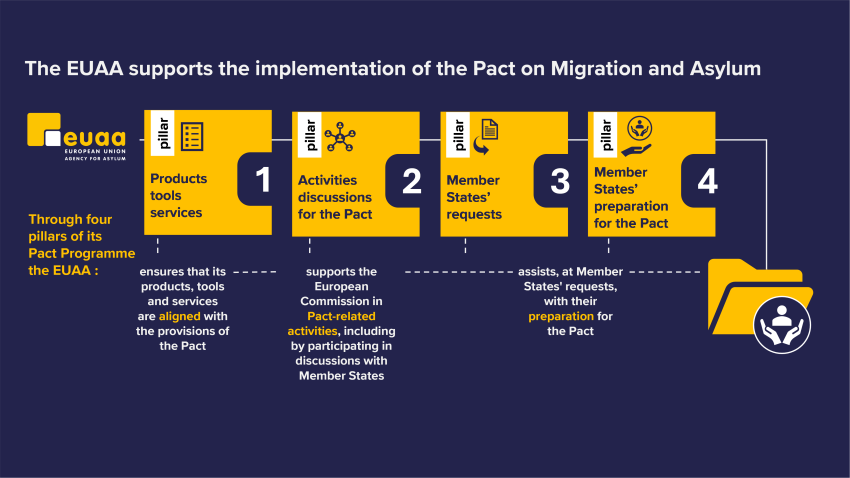
Throughout this preparation process, the EUAA provided support in a number of ways through its Pact Programme (see Figure 1).
On the same day of the publication of the progress report, the European Commission launched the first Annual Migration Management Cycle,20 which comprised the following components:
-
The European Annual Asylum and Migration Report (EAAMR), which provides a situational picture of asylum and migration in the EU, identifies potential trends and developments for the coming year, and assesses the migratory situation in Member States;
-
The European Commission decisions determining Member States’ level of migratory pressure; and
-
The European Commission Proposal for a Solidarity Pool to address the needs of Member States under pressure.
- According to the EAAMR, which covered July 2024-June 2025, the migratory situation in the EU continued to improve, with a significant 35% decrease in illegal border crossings at the EU’s external borders compared to the previous year, plausibly due to the increased cooperation in migration management with countries of origin and transit. Asylum applications also decreased by 21% during the reference period compared to the period July 2023-June 2024. Nonetheless, challenges persisted such as continued pressure from irregular arrivals, unauthorised movement within the EU, the hosting of persons displaced from Ukraine, the weaponisation of migration by Russia and Belarus, and the need for greater cooperation in the area of returns and readmission.21
Figure 1. Highlights of the EUAA Pact Programme

Based on the situational analysis provided in the report, the European Commission found that Cyprus, Greece, Italy and Spain were under migratory pressure and eligible to access the EU’s Solidarity Pool when the Pact enters into application in June 2026.22 The expression of solidarity can take three forms:
- ‘People solidarity’ can be provided through relocations from the Member State experiencing pressure or, when certain conditions are met, through ‘responsibility offsets’, whereby a Member State agrees to take responsibility for applicants already on its territory who would otherwise be the responsibility of the Member State under pressure, according to the responsibility criteria set in the AMMR.
- Financial contributions from other Member States – through the EU budget – to Member States under migratory pressure to improve their asylum and reception capacity, increase effectiveness in border management and support initiatives with third countries meant to reduce irregular arrivals or increase effectiveness in returns.
- Alternative solidarity measures, such as material or in-kind technical assistance.
Another group of countries, comprising Belgium, Bulgaria, Croatia, Germany, Estonia, Finland, France, Ireland, Latvia, Lithuania, the Netherlands and Poland were identified as at risk of migratory pressure. These Member States have priority access to the EU Migration Support Toolbox which offers operational, technical and financial support by European institutions and Agencies.23
Finally, Austria, Bulgaria, Croatia, Czechia, Estonia and Poland were identified as countries facing a significant migratory situation because of the cumulative pressure from the previous 5 years. As such, these countries can request their full or partial exemption from contributing to the Solidarity Pool for the upcoming year.24
The last component of the first Annual Migration Management Cycle was a European Commission proposal to establish the first EU Solidarity Pool, which was submitted to the EU Council. In a subsequent meeting of the High-Level Solidarity Forum on 27 November 2025, Member States pledged their solidarity contributions, and on 8 December 2025, the EU Council reached a political agreement on the annual Solidarity Pool for 2026.25 The Council Implementing Decision on the establishment of the annual Solidarity Pool for 2026 was formally adopted by written procedure on 19 December 2025, setting the needs for 2026 at 21,000 relocations or financial contributions of a total of EUR 420 million.26 The implementation of these measures will start from 12 June 2026.
Drawing on the national migration and asylum strategies developed by Member States throughout 2025, the European Commission prepared a European Asylum and Migration Management Strategy to present a clear vision of European policies in this area. The strategy, published in January 2026, sets out the EU's political objectives on asylum and migration and serves as a compass to pursue the three main objectives of preventing illegal migration, protecting people fleeing war and persecution, and attracting talent to the EU. To achieve these objectives, the strategy has set five priorities:
-
Stepping up migration diplomacy;
-
Strong EU borders to enhance control and security;
-
A firm, fair and adaptable asylum and migration system;
-
More effective return and readmission; and
-
Labour and talent mobility to boost competitiveness.27
- 16
European Commission. (11 June 2025). Communication from the Commission to the European Parliament, the Council, the European Economic and Social Committee of the Regions, State of play on the implementation of the Pact on Migration and Asylum. COM/2025/319 final.
- 17
European Council on Refugees and Exiles (ECRE). (February 2026). Input to the Asylum Report 2026.
- 18
European Commission. (11 June 2025). Pact on Migration and Asylum: Commission report assess progress and next steps halfway through implementation.
- 19
European Commission. (11 November 2025). Communication from the Commission to the European Parliament and the Council, the European Annual Asylum and Migration Report (2025). COM/2025/795 final.
- 20
European Commission. (12 November 2025). Commission launches first Annual Migration Management Cycle under the Pact on Migration and Asylum.
- 21
European Commission. (11 November 2025). Communication from the Commission to the European Parliament and the Council, the European Annual Asylum and Migration Report (2025). COM/2025/795 final.
- 22
European Commission. (11 November 2025). Questions and answers on the First Annual Migration Management Cycle under the Pact on Migration and Asylum.
- 23
European Commission. (11 November 2025). Questions and answers on the First Annual Migration Management Cycle under the Pact on Migration and Asylum.
- 24
European Commission. (11 November 2025). Questions and answers on the First Annual Migration Management Cycle under the Pact on Migration and Asylum.
- 25
Council of the European Union. (8 December 2025). Migration and asylum: Member States agree on solidarity pool
- 26
European Commission. (19 December 2025). Council Implementing Decision (EU) 2025/2642 of 19 December 2025 on the establishment of the Annual Solidarity Pool for 2026. ST/16574/2025/INIT.
- 27
European Commission. (29 January 2026). Commission presents five-year strategy on migration