

Foreword
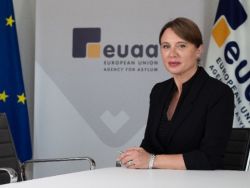
For a second year in a row, the number of applications for international protection in EU+ countries decreased to a total of 0.8 million. This was the result of a series of factors, including political developments in key countries of origin, like Syria, and European cooperation with partner countries which reduced mobility across migration routes to Europe. In parallel, EU+ countries continued to provide temporary protection to about 4.5 million displaced persons from Ukraine, with some countries bearing the greatest shares, while initiatives continued for long-term solutions to facilitate the eventual end of temporary protection in March 2027.
A common mission for all EU+ countries in 2025 was preparations for the activation of the Pact on Migration and Asylum as of June 2026. National implementation plans and national strategies served as a compass for reforms, which will soon set in motion Europe's revamped asylum system.
But countries were not alone in this process. The European Commission, together with EU Agencies, provided guidance and support. Our Agency assisted in these efforts through its dedicated Pact Programme which delivered a range of outputs. The EUAA provided operational support to countries on the ground, trained asylum professionals, including through its accredited EUAA Academy, developed technical material to assists practitioners in applying harmonised processes and produced situational analysis to guide policies.
Indeed, with the changing situation in Syria, for example, the EUAA was quick in collecting information on policies and practices of EU+ countries toward Syrian applicants, while COI research produced high-quality information on developments in the country. By providing an overview of the implementation of the safe country concepts in EU+ countries, the EUAA also supported the legislative process for the adoption of an EU-wide list of safe countries of origin and the revised safe third country concept.
There is no doubt that June 2026 is not a definite end, but a passage to a different evolutionary stage of the Common European Asylum System (CEAS). This stage may require a lot of learning-by-doing. It will be a process through which feedback from the practical application of the new rules will guide adaptations to be made at operational and policy levels. Throughout the process, our Agency will continue to support countries and provide its expertise for the effective functioning of CEAS.
Nina Gregori
Executive Director
European Union Agency for Asylum