

7.1. Resettlement and humanitarian admission at the national level

Under the 2024-2025 EU Resettlement and Humanitarian Admission scheme, 14 EU countries provided 61,000 pledges for resettlement and humanitarian admissions, underpinned by EU financial support.339 However, in 2025 only around 10,000 refugees arrived in those countries (in addition to nearly 14,000 in 2024), raising the question of completing the pending transfers in 2026.
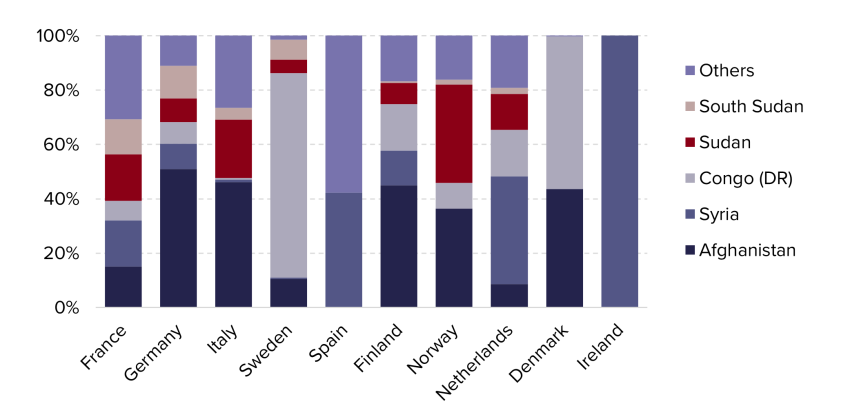
Among citizenships with a decline in resettlements, Syrians accounted for nearly 80%. Thus, after 10 years of Syrians being the most resettled citizenship, Afghans (2,900) ranked the first in 2025, followed by Syrians (1,800), Congolese (DR) (1,600) and Sudanese (1,400).
Few citizenships saw increases in resettlement, mostly Afghans, Sudanese, South Sudanese and Nicaraguans. For instance, Spain resettled over 450 Nicaraguans hosted in Costa Rica, showing a clear interest in the Central America region.340 In contrast, alongside Syria, other notable decreases happened in the resettlement of Congolese (DR) nationals, Eritreans and Somalis.
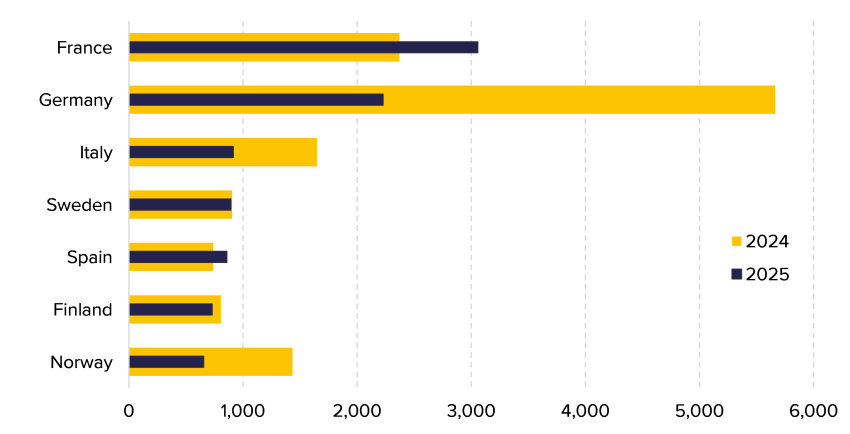
At the end of 2025, only 40% of resettlement pledges for the 2024-2025 period were fulfilled by Member States.vi In 2025, over one-quarter of all resettled refugees were resettled in France, which also explored new geographical areas and carried out its first resettlement selection mission in Côte d'Ivoire. The most resettlements in France was followed by Germany, Italy and Sweden (see Figure 9).
Figure 9. Top EU+ countries receiving resettled persons (through resettlement programmes and humanitarian admission), 2025 compared to 2024
Source: EUAA EPS data as of 3 February 2026.
Figure 10. EU+ countries of resettlement by main citizenship of resettled persons, 2025
Source: EUAA EPS data as of 3 February 2026.
In 2025, Germany stated that the voluntary federal admission programmes will be ended, including the federal admission programme for Afghans, which had been in place since October 2022. No new programmes would be launched for the time being.341
Many countries reacted to the humanitarian situation in the Gaza Strip by evacuating people in need of medical treatment with the support of different stakeholders. Medical evacuations were carried out for example by Norway,342 Romania,343 Spain344 and Switzerland.345 Evacuated individuals and their families were either granted refugee status upon arrival and counted towards the resettlement quota (for example, in Norway) or given the opportunity to undertake the asylum procedure upon arrival in the country of destination. Consequently, long-term support from civil society organisations was of particular importance, notably in the provision of accommodation, legal assistance, healthcare services and language support.346
No new community sponsorship programmes emerged in 2025, but some programmes continued from previous years. For example, the RISE programme continued to be piloted in Belgium, Italy and Lithuania, under which the IOM published an assessment report in February 2025.347 Other programmes came to completion, such as the German community sponsorship programme New Start in a Team (Neustart im Team, NesT).348 Meanwhile, France renewed two protocols with civil society organisations to welcome Syrians and Iraqis residing in Lebanon through humanitarian corridors.
- 339
European Commission. (14 January 2026). Resettlement and humanitarian admission.
- 340
The Ministry of Inclusion, Social Security and Migration (Spain) | Ministerio de Inclusión, Seguridad Social y Migraciones. (19 December 2025). Plan Nacional de Reasentamiento [National Resettlement Plan}.
- vi
The Member States that reported actual arrivals in resettlements and humanitarian admission in 2025 were Belgium, Denmark, Finland, France, Germany, Ireland, Italy, the Netherlands, Norway, Portugal, Romania, Spain, Sweden and Switzerland.
- 341
CDU, CSU and SPD. (5 May 2025). Verantwortung für Deutschland [Responsibility for Germany]; New start in the team (NesT) | Neustart im Team (NesT). (November 2025). Das humanitäre Aufnahmeprogramm "Neustart im Team" [The humanitarian admission programme "New Start in the Team"].
- 342
Directorate of Integration and Diversity | Integrerings- og mangfoldsdirektoratet (IMDi). (December 2025). Migration and Integration 2024 - 2025 Report for Norway to the OECD.
- 343
Romanian National Council for Refugees | Consiliul Național Român pentru Refugiați. (2026). Input to the Asylum Report 2026; Jesuit Refugee Service (JRS) Romania. (2026). Input to Asylum Report 2026.
- 344
The Ministry of Inclusion, Social Security and Migration (Spain) | Ministerio de Inclusión, Seguridad Social y Migraciones. (12 August 2025). El Gobierno de España culmina cuatro operaciones humanitarias de evacuación de menores gazatíes heridos o enfermos y sus familiars [The Government of Spain completes four humanitarian operations to evacuate injured or sick Gazan minors and their families].
- 345
State Secretariat for Migration (Switzerland) | Staatssekretariat für Migration | Secrétariat d’État aux migrations | Segreteria di Stato della migrazione. (24 October 2025). Des enfants blessés évacués de la bande de Gaza pour recevoir des soins médicaux [Injured children to be evacuated from Gaza for medical treatment]; State Secretariat for Migration (Switzerland) | Staatssekretariat für Migration | Secrétariat d’État aux migrations | Segreteria di Stato della migrazione. (28 November 2025). Deuxième opération d’évacuation d’enfants blessés de Gaza [Second operation to evacuate wounded children from Gaza].
- 346
Jesuit Refugee Service (JRS) Romania. (2026). Input to Asylum Report 2026.
- 347
International Organization for Migration (IOM). (n.d.). Reinforcing Integration through Sponsorship Enhancement (RISE).
- 348
New start in the team (NesT) | Neustart im Team (NesT). (November 2025). Das humanitäre Aufnahmeprogramm "Neustart im Team" [The humanitarian admission programme "New Start in the Team"].