

Section 8. Rights of beneficiaries of international protection for inclusion and integration

Recognised refugees are granted certain rights and obligations, as outlined by the Geneva Convention. The recast QD outlines the content of international protection to harmonise what a recognised beneficiary of international protection can expect under national policies. Its provisions shape the integration of beneficiaries of international protection through standards on residence permits, employment, recognition of qualifications, education, social welfare, integration facilities and healthcare. Relevant articles of the directive also outline the criteria for the renewal, cessation and revocation of international protection.
The objective of the new Qualification Regulation is to ensure a common set of rights for all beneficiaries of international protection in all EU Member States. The further harmonisation of the content of protection is expected to limit secondary movements of recognised beneficiaries. The regulation clarifies the information that national authorities must provide to beneficiaries of international protection on the content of protection and it sets a clear deadline for delivering residence permits. Certain forms of social assistance may now be conditional on participation in integration activities, when the integration activities are accessible and free of charge. The grounds when international protection must be withdrawn are expanded.
The recognition rate significantly decreased from 42% in 2024 to 29% in 2025 (see Figure 10). The decline was impacted by the suspension of decision-making for Syrian applicants (who accounted for a large share of positive decisions in recent years).
Figure 10. Recognition rates at first instance by decision outcome, 2015-2025
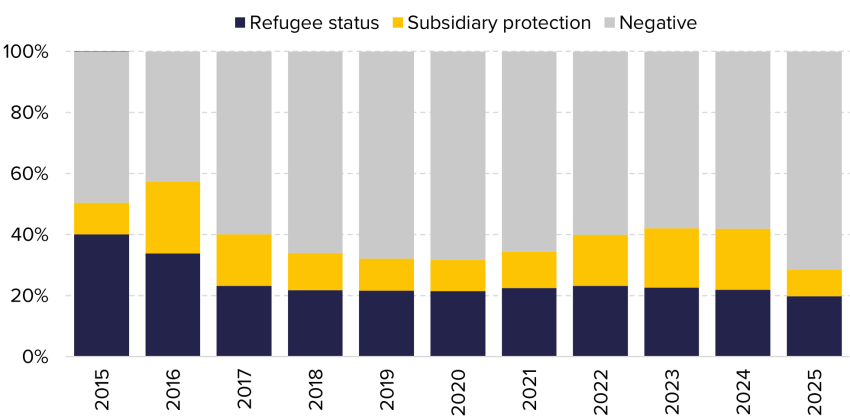
In addition, around 56% of decisions were issued to nationals of countries with a low recognition rate. Considering the 69 citizenships which were issued at least 1,000 decisions in 2025, 42 had a recognition rate of less than 20%. Nationals of Türkiye, Venezuela, Bangladesh and Colombia (in descending order) received one-third of all negative decisions which were issued. However, Venezuelans were often granted a national form of protection.
In Spain, new immigration rules came into force in May 2025 establishing several types of authorisations to stay, but each of them on the condition that the person applying is not an applicant for international protection.376 In addition, at the beginning of 2026 the government proposed a new Royal Decree to grant a 1-year permit to third-country nationals who have lived in Spain without authorisation for at least 5 months before 31 December 2025. Applicants for international protection who have not yet received a decision or had their application rejected can apply for this new permit, as long as the application for international protection was submitted before the end of 2025.377 The government estimated that around 500,000 people would be eligible for this regularisation.378
For rejected international protection applicants, a significant limitation was introduced in Sweden. They can no longer apply for a work-related residence permit from within the country. This exception existed previously for some rejected applicants under certain circumstances.379
The German BAMF published an analysis of the intentions of people with a tolerated stay and underlined the multiple factors influencing the decision to stay in Germany or to return to the home country. The analysis concluded a well-coordinated combination of measures which encourage returns and provide options for legal residence, so that situations of unduly-long tolerated stays are prevented.380
Recognition rates in EU+ countries are usually high for nationals from extreme- and high-conflict countries. In 2025, they ranged between 70%-90% for applicants from Sudan, Mali, Haiti, Ukraine and Myanmar/Burma (in descending order).
Figure 11. Recognition rates for the main citizenships across EU+ countries, 2025
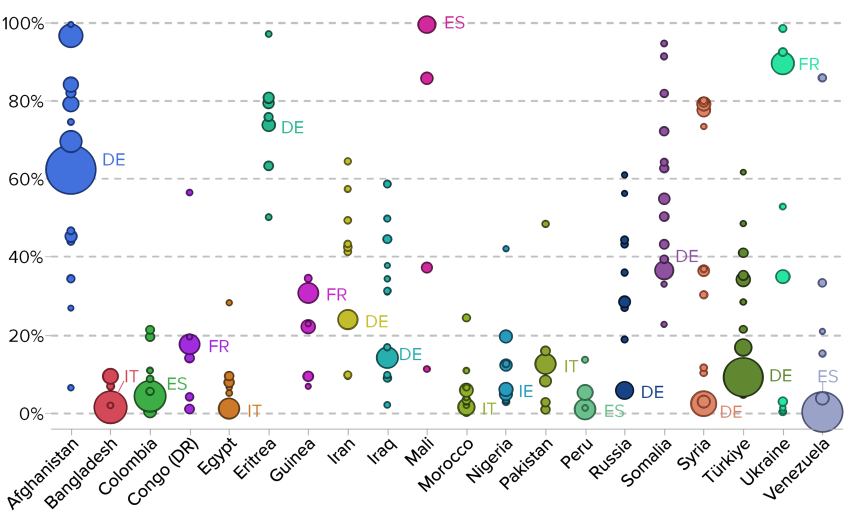
For nationals of the Democratic Republic of the Congo, the recognition rate in the EU+ was 17% as many applicants did not originate from conflict-affected areas within the country. For Somalis, the recognition rate dropped from 60% in 2024 to 49%. It should be noted that Somalis were more often granted national forms of protection in 2025 which are unregulated at the EU level and are therefore considered as negative asylum decisions. Belgium issued many negative inadmissibility decisions to Palestinians with a protection status in another Member State, thus the overall recognition rate for Palestinians decreased from 90% to 49%.
In recent years, UNHCR,381 other international organisations,382 think tanks, academia383 and civil society organisations384 have repeatedly warned about the potential negative impact of stricter rules for family reunification on the integration of beneficiaries of international protection. Nonetheless, national governments continued to limit arrivals by family reunification,385 which was used, among others, as one of the measures to ease pressure on asylum and reception systems,386 and sometimes on national and municipal social systems.387 In Austria, family reunification was halted for beneficiaries of international protection for an initial period of 6 months, which can be extended for a total of 2 years.388 The German government suspended family reunification for this group for 2 years, addressing concerns raised by municipalities due to stretched local social services.389 Similar measures were passed in the Netherlands, clearly distinguishing between refugees and people who were granted protection on other grounds.390
New family reunification rules entered into force in Belgium as well, introducing a 2-year waiting period for beneficiaries of subsidiary protection, who must then fulfil all material conditions without exception.391 In addition, with the aim to combat child and forced marriages, the minimum age for family reunification with a partner was raised from 18 to 21 years. In Norway, family reunification rules were changed to prevent bigamy and to avoid situations where a child was sent alone to the country and requested family reunification with the father and his multiple partners.392
A draft law was submitted to the parliament in Luxembourg, noting that facilitated conditions for family reunification for family members of beneficiaries of international protection would only apply for the nuclear family. The sponsor must provide adequate housing and sufficient financial resources when the request is to reunite with adult children, parents of an adult beneficiary or with a spouse or partner when the relationship is formed after entering Luxembourg.393 UNHCR Luxembourg recommended the urgent reduction of processing times for family reunification requests of unaccompanied children.394
National courts continued to deliberate on the revocation of international protection, in particular when committing a serious crime or travelling back to the country of origin (see here). The CJEU clarified that international protection may be revoked for acts committed prior to entering the country of refuge, even if the acts would not lead to exclusion from international protection. The court also highlighted that a revocation of status is not a decision that implies possible refoulement, and thus the seriousness of the act does not need to reach the threshold of violating the ECHR for authorities to decide on a revocation.395
Legislative changes in Cyprus396 and Finland397 expanded the grounds to withdraw international protection by including cases when the person has committed a serious crime. The Swiss Federal Council proposed a bill banning asylum seekers, temporarily admitted persons and individuals under protection from travelling abroad. SEM would only be able to authorise travel in exceptional cases.398 The proposal comes after legislation was passed on travel restrictions for these groups of people in 2021, which did not enter into force at that time. The Swiss legislator aimed to ensure that Ukrainians under temporary protection are not covered by these restrictions. However, since 1 November 2025 persons with protection status S are allowed to stay in Ukraine for up to 15 days per half-year, rather than 15 days per quarter as before.399
In Denmark, legislative amendments broadened the scope when a residence permit is ended, including cases when a person gives up residence in Denmark or leaves Denmark for more than 6 months (for temporary residence permits) or 12 months (for permanent residence permits). Earlier, the residence permit was ended only when a person took up residence in their home country or in a third country considered to be safe for a return.400 The residence permit must also be revoked – with certain exceptions to respect international obligations – when the holder relies on social assistance for more than 5 years after its issuance.401
For the integration of beneficiaries of international protection, a new Integration Strategy and Action Plan was launched in Malta402 and a new, comprehensive integration strategy was adopted in Cyprus.403 The new Dutch government introduced an action agenda for integration and an open and free society.404 The CJEU delivered its preliminary ruling referred by the Dutch Council of State on the country’s civic integration system,405 and the Dutch court subsequently delivered its judgment in the original case, noting that the finding remained relevant for the new Civic Integration Act that entered into force in the meantime,406 as the civic integration obligation and the possibility to receive a fine remained under the new system as well.407
At the EU-level, the Migrant Integration Policy Index (MIPEX) indicated only a very small increase in results, with most countries implementing only halfway favourable migrant integration measures.408 The index also found a significant difference between the scores of EU-14 compared to the more recently joined EU-13 countries, noting that this indicates important discrepancies in integration opportunities for migrants.409 The index observed gains in the fields of labour market integration and education.410 These areas were prioritised by national authorities in recent years,411 and they remained in focus in 2025 as well.
The French government confirmed that it prioritises integration through employment412 and continued to implement measures with this objective. For example, in July 2025 the AGIR programme for beneficiaries of international protection was fully deployed across the entire metropolitan territory. In addition, the number of territorial reception and integration contracts (CTAI) increased, with 103 contracts concluded in 2025 (including 72 renewals and 31 new contracts) with local authorities in 65 departments. Furthermore, a circular jointly signed by the Ministry of the Interior and the Ministry of Labour on 26 June 2025 was published, in order to strengthen the professional integration of foreigners with legal status, particularly in sectors with recruitment difficulties.413 In order to improve integration through education, the objectives and methods of the Open School to Parents for Children's Success (OEPRE) programme, implemented since 2008 by the Ministry of the Interior and the Ministry of National Education, were revised, with the ambition of making it a comprehensive tool for social, linguistic and professional integration.414
Building on the outcomes of the HELIOS Project (2019-2024), the HELIOS+ programme was launched in Greece to strengthen access to the labour market for beneficiaries of international protection by providing vocational training programmes and housing support for 12 months. Beneficiaries are now expected to participate in at least one individual integration counselling session, one individual employment counselling session, and at least 80% of the Greek language course.415 In addition, an internship programme was established for refugees and migrants.416
In Norway, the integration programme was revised to emphase employment orientation early on. The maximum duration of the introduction programme for participants with upper secondary education or higher was changed from 6 up to 12 months, without the possibility of extension. The introduction programme may be up to 4+1 years to allow beneficiaries to finish their upper secondary education and become skilled workers.417 In addition, the government proposed to establish an integration declaration, which outlines expectations of beneficiaries, such as participating in society and being able to support oneself through work.418
The reform of the general Education Act in Czechia brought important changes for migrant students, including facilitated access to secondary and higher vocational schools and more funding for schools with a higher share of foreign students. Building on lessons learnt with the implementation of temporary protection, the minimum level of proficiency in the Czech language was reduced for certain profiles of teachers, allowing them to start teaching earlier.419
In Switzerland, SEM launched a joint initiative with the association of Swiss higher education institutions to facilitate refugees’ access to higher education and address the country’s shortage in skilled labour.420 A national meeting on labour market integration took place for the second time, bringing together 170 experts and formulating recommendations to enhance employment for refugees, temporarily admitted people and people with S protection status.421
Despite these initiatives, beneficiaries of international protection still faced multiple barriers across EU+ countries when trying to learn the language,422 enrol in education423 or search for a job.424
Challenges in accessing housing continued to impact integration prospects for beneficiaries of international protection.425 The Czech Ministry of Regional Development launched a project in cooperation with the IOM to improve access to affordable and dignified housing for migrants.426 In the Netherlands, the government offered incentives to municipalities to speed up beneficiaries’ placements throughout 2025,427 but then it introduced a ban to cease the prioritisation of beneficiaries of international protection in the distribution of municipal social housing as of January 2026. 428 COA warned that the measure risked destabilising the reception system by prolonging reliance on emergency places, increasing costs, harming residents’ wellbeing and delaying integration, given that many current residents already stay longer than the usual 14 weeks and social housing waiting times are on average 7 years.429 The Norwegian government recommended that municipalities take account of their capacity to rapidly set up services after a settlement agreement is signed, evaluate the share of foreign residents in certain parts of the municipality, and assess labour and educational opportunities when allocating a beneficiary of international protection into a municipality.440
While trends have been shifting towards more centralised provision of services in the asylum procedure, for example national authorities taking over the delivery of legal counselling, civil society organisations remained key in the delivery of support services for the integration of beneficiaries of international protection. Their wide range of projects in 2025 were noted in the European Commission’s Migrant Integration Hub, the EUAA Database on International Protection in Europe and civil society input to the Asylum Report 2026. Projects implemented by local authorities in Italy which participate in the Reception and Integration System were funded by AMIF to develop individual socio-economic integration plans for beneficiaries of international protection, promoting an integrated approach for the social and economic autonomy of refugees. In addition, the Ministry of Labour and Social Policies published a report on the activities of registered organisations which deliver services to migrants. It details the types of projects which have been implemented and their distribution across the country.441
The Norwegian Institute for Social Research, in collaboration with UNHCR, published a new report that examines how civil society in Norway can best support refugee reception and integration.442 The Norwegian government made changes to the funding scheme for civil society organisations to undertake integration projects and increased their budget, with an increased focus on labour market integration and language learning for migrant women.443
- 376
Ministry of Inclusion, Social Security and Migration (Spain) | Ministerio de Inclusión, Seguridad Social y Migraciones. (19 November 2024). El Gobierno aprueba un nuevo Reglamento de Extranjería para mejorar la integración de las personas migrantes a través de tres palancas: trabajo, formación y familia [The government approves a new Immigration Regulation to improve the integration of migrants through three key pillars: employment, training, and family reunification]; The Ministry of Inclusion, Social Security and Migration (Spain) | Ministerio de Inclusión, Seguridad Social y Migraciones. (19 November 2024). Preguntas Frecuentes (FAQS) sobre la autorización por circunstancias excepcionales por razón de arraigo con motivo de la aprobación del Real Decreto 1155/2024, de 19 de noviembre [Frequently Asked Questions (FAQs) on residence permits granted under exceptional circumstances on the grounds of arraigo, following the approval of Royal Decree 1155/2024 of 19 November]; Spanish Commission for Refugee Aid | Comisión Española de Ayuda al Refugiado (CEAR). (3 February 2025). Principales cambios del nuevo Reglamento de Extranjería [Key Changes to the New Immigration Regulations – CEAR].
- 377
Government of Spain | La Moncloa. (27 January 2026). El Gobierno inicia un proceso de regularización extraordinaria de extranjeros que ya viven en España [The government begins an extraordinary regularisation process for foreigners already living in Spain].
- 378
Government of Spain | La Moncloa. Preguntas y respuestas: Tramitación de Regularización Extraordinaria 2026 [Questions and Answers: 2026 Special Regularisation Process].
- 379
Swedish Migration Agency | Migrationsverket (SMA). (13 March 2025). Spårbyte avskaffas och ändrade regler för preskriptionstid [Track replacement abolished and changed rules for limitation period].
- 380
The Federal Office for Migration and Refugees | Bundesamt für Migration und Flüchtlinge (BAMF). (5 February 2025). Bleibe- und Rückkehrabsichten von Geduldeten [Intentions of tolerated persons to stay and return].
- 381
United Nations High Commissioner for Refugees (UNHCR). (12 March 2025). UNHCR warnt vor Folgen des Aussetzens von Familienzusammenführung [UNHCR warns of consequences of suspending family reunification]; United Nations High Commissioner for Refugees (UNHCR). (n.d.). Position von UNHCR - Motionen NR 24.4320 und SR 24.4444 (“Von Dänemark und Schweden lernen: Familiennachzug auf die Interessen der Schweiz ausrichten”) [Position of UNHCR - Motions No. 24.4320 and SR 24.4444 ("Learning from Denmark and Sweden: Aligning family reunification with Switzerland's interests")]; United Nations High Commissioner for Refugees (UNHCR). (19 June 2025). Observations du Haut Commissariat des Nations Unies pour les réfugiés relatives au projet de loi modifiant la loi du 15 décembre 1980 sur l’accès au territoire, le séjour, l’établissement et l’éloignement des étrangers en ce qui concerne les conditions pour le regroupement familial déposé à la Chambre des représentants le 5 juin 2025 [Comments by the United Nations High Commissioner for Refugees on the bill amending the Act of December 15, 1980, on the entry, stay, settlement, and removal of foreign nationals, with regard to the conditions for family reunification, introduced in the House of Representatives on June 5, 2025].
- 382
International Organization for Migration (IOM). (10 April 2025). IOM, UNHCR und UNICEF appellieren an Regierung, die Aussetzung der Familienzusammenführung zu überdenken [IOM, UNHCR and UNICEF call on the government to reconsider the suspension of family reunification].
- 383
Migrant Integration Policy Index 2025. (2025). Family Reunion (2025); Radboud University | Radboud Universiteit. (13 January 2026). Boekpresentatie en podcast: "20 Years of the Family Reunification Directive: Central Themes, Problem Issues and Implementation in Selected Member States” [Book launch and podcast: "20 Years of the Family Reunification Directive: Central Themes, Problem Issues and Implementation in Selected Member States”]; Blog Asyl. (26 September 2025). Aussetzung des asylrechtlichen Familiennachzugs – Ein Blick auf praktische Problemstellungen. [Suspension of family reunification under asylum law – A look at practical problems].
- 384
Save the Children. (2026). Input to the Asylum Report 2026; European Council on Refugees and Exiles (ECRE) (2026). Input to the Asylum Report 2026; Missing Children Europe. (June 2025). Policy Brief EU Pact for Migration and Asylum: Safeguarding Children in Migration at Risk Going Missing; Lithuanian Red Cross | Lietuvos Raudonasis Kryžius. (17 June 2025). Lietuvoje prieglobsčio gavusių asmenų teisės į šeimos susijungimą įgyvendinimo iššūkiai [The challenges of implementing the right to family reunification for individuals who have received asylum in Lithuania (revised and updated edition)]; Greek Council for Refugees | Ελληνικό Συμβούλιο για τους Πρόσφυγες. (July 2025). Family Reunification of Recognised Refugees in Greece.
- 385
European Union Agency for Asylum (EUAA). (June 2025). Asylum Report 2025; European Migration Network (EMN). (October 2025). Family reunification of third-country nationals: State of play of law and practice.
- 386
European Union Agency for Asylum (EUAA). (June 2025). Asylum Report 2025.
- 387
European Union Agency for Asylum (EUAA). (June 2025). Asylum Report 2025.
- 388
Federal Ministry for the Interior (Austria) | Bundesministerium für Inneres. (11 March 2025). BM Karner und BM Plakolm - Expertengespräch zu Familiennachzug und Integration [BM Karner and BM Plakolm - Expert discussion on family reunification and integration]; Federal Ministry for the Interior (Austria) | Bundesministerium für Inneres. (28 March 2025). Familiennachzug – nächster Schritt für nachhaltige Umsetzung [Family reunification – next step for sustainable implementation]; The Parliament of Austria | Parlament Österreich. (1 July 2025). Stopp für Familiennachzug: Hauptausschuss genehmigt Verordnung [Stop for family reunification: Main committee approves ordinance].
- 389
The Federal Ministry of the Interior (Germany) | Bundesministerium des Innern. (6 June 2025). Begrenzung illegaler Migration im Bundestag debattiert [Limitation of illegal migration debated in the Bundestag]; Federal Council | Bundesrat. (11 July 2025). Ausgewählte Tagesordnungspunkte der 1056. Sitzung am 11.07.2025 [Selected agenda items of the 1056th meeting on 11.07.2025].
- 390
Government (Netherlands) | Rijksoverheid. (7 March 2025). Ministerraad: groen licht voor asielplannen minister Faber [Council of Ministers: green light for Minister Faber's asylum plans].
- 391
Belgian Official Gazette | Moniteur belge | Belgisch Staatsblad. (18 July 2025), Loi du 18 juillet 2025 modifiant la loi du 15 décembre 1980 sur l'accès au territoire, le séjour, l'établissement et l'éloignement des étrangers en ce qui concerne les conditions pour le regroupement familial (1) [Law amending the Act of 15 December 1980 on access to the territory, residence, establishment and removal of foreigners with regard to the conditions for family reunification (1)]; Council of Ministers | Ministerraad | Conseil des ministers. (11 April 2025). Asile et migration : paquet de mesures de crise [Asylum and migration: crisis measures package].
- 392
Ministry of Justice and Public Security (Norway) | Justis- og beredskapsdepartementet. (10 April 2025). Regjeringa foreslår endringar i regelverket for familieinnvandring og permanent opphaldsløyve [The government proposes changes to the rules for family immigration and permanent residence permits].
- 393
Chamber of Deputies | Chambre des Députés. (24 September 2025). Des changements en vue pour le regroupement familial [Changes ahead for family reunification]; Official Journal of the Grand Duchy of Luxembourg | Journal officiel du Grand-Duché de Luxembourg. (21 July 2025). Projet de loi portant modification de la loi modifiée du 29 août 2008 sur la libre circulation des personnes et l’immigration [Draft law amending the amended law of 29 August 2008 on the free movement of persons and immigration].
- 394
United Nations High Commissioner for Refugees (UNHCR). (2025). Observations du HCR relatives à l'accès à la réunification familiale des enfants non accompagnés et séparés bénéficiaires d'une protection internationale au Grand-Duché de Luxembourg [UNHCR observations on access to family reunification for unaccompanied and separated children granted international protection in the Grand Duchy of Luxembourg].
- 395
European Union, Court of Justice of the European Union [CJEU], Κ.Α.Μ. v Republic of Cyprus, C-454/23, ECLI:EU:C:2025:114, 27 February 2025. Link redirects to the English summary in the EUAA Case Law Database.
- 396
Nomoplatform. (4 December 2025). Υπερψήφιση προϋπολογισμών, νόμος για απέλαση αιτητών ασύλου που παρανομούν και κύρωση της συμφωνίας οριοθέτησης ΑΟΖ Κύπρου–Λιβάνου [Vote in favor of budgets, law for the deportation of asylum seekers who violate the law and ratification of the agreement on the delimitation of the Cyprus-Lebanon EEZ].
- 397
Finnish Immigration Service | Maahanmuuttovirasto Migrationsverket. (6 May 2025). Ulkomaalaislaki muuttuu 6.5. – yhteistyövelvoite otetaan käyttöön, muutoksia maahantulokieltoon ja oleskeluluvan peruuttamiseen [Amendments to Aliens Act on 6 May: new obligation to cooperate and changes to entry bans and withdrawal of residence permits].
- 398
The Federal Council | Der Bundesrat | Le Conseil federal | Il Consiglio federale. (22 October 2025). Personen aus dem Asylbereich dürfen nur noch ausnahmsweise ins Ausland reisen [Persons from the asylum sector are only allowed to travel abroad in exceptional cases].
- 399
Federal Council | Der Bundesrat | Conseil fédéral | Consiglio federale. (8 October 2025). No lifting of protection status S.
- 400
Retsinformation. (10 June 2025). Lov om ændring af udlændingeloven, repatrieringsloven og lov om fuldbyrdelse af straf m.v. (LOV nr 636 af 10/06/2025) [Act amending the Aliens Act, the Repatriation Act and the Enforcement of Sentences etc., Law No 636 of 10/06/2025)].
- 401
Retsinformation. (20 June 2025). Lov om ændring af udlændingeloven, integrationsloven og danskuddannelsesloven (LOV nr 756 af 20/06/2025) [Act amending the Aliens Act, the Integration Act and the Danish Education Act (LAW No 756 of 20/06/2025)].
- 402
European Commission. (6 March 2025). Malta: Integration strategy and action plan 2025 - 2030.
- 403
Deputy Ministry of Immigration and International Protection | Υφυπουργείο Μετανάστευσης, και Διεθνούς Προστασίας. (2 October 2025). Παρέμβαση του Υφυπουργού Μετανάστευσης και Διεθνούς Προστασίας δρος Νικόλα Α. Ιωαννίδη στο Cyprus Forum 2025 με θέμα «Μεταναστευτική Πολιτική: Προκλήσεις, Ρεαλισμός και Προοπτικές για την Κύπρο και την Ευρώπη» [Intervention of the Deputy Minister of Migration and International Protection, Dr. Nicolas A. Ioannides, at the Cyprus Forum 2025 on "Migration Policy: Challenges, Realism and Prospects for Cyprus and Europe"]; Government Portal, Press and Information Office | Κυβερνητική Πύλη. (7 February 2026). Το Υπουργικό Συμβούλιο ενέκρινε την Εθνική Στρατηγική για την Ένταξη Μεταναστών 2026-2029 [The Council of Ministers approved the National Strategy for the Integration of Migrants 2026-2029].
- 404
European Commission. (7 February 2025). The Netherlands: Action agenda for integration and an open society.
- 405
European Union, Court of Justice of the European Union [CJEU], T.G. v Minister van Sociale Zaken en Werkgelegenheid, C-158/23, ECLI:EU:C:2025:52, 4 February 2025. Link redirects to the English summary in the EUAA Case Law Database.
- 406
European Union Agency for Asylum (EUAA). (12 June 2025). Asylum Report 2025.
- 407
Netherlands, Council of State [Afdeling Bestuursrechtspraak van de Raad van State], Applicant v The Minister for Asylum and Migration (de Minister van Asiel en Migratie), 202107906/2/V6, ECLI:NL:RVS:2025:3087, 9 July 2025. Link redirects to the English summary in the EUAA Case Law Database.
- 408
Migrant Integration Policy Index 2025. (25 September 2025). MIPEX 2025 Results Launch & Policy Forum – Key Insights and Messages.
- 409
Migrant Integration Policy Index 2025. (September 2025). Unlocking Integration – Enabling Participation.
- 410
Migrant Integration Policy Index 2025. (September 2025). EU integration policies stagnate at 54/100, with political participation weakest, new MIPEX 2025 shows.
- 411
European Union Agency for Asylum (EUAA). (12 June 2025). Asylum Report 2025.
- 412
Ministry of the Interior (France) | Ministère de l'intérieur. (30 April 2025). Priorités pour 2025 de la politique d’intégration des étrangers primo-arrivants, dont les personnes réfugiées [Priorities for 2025 of the integration policy for newly-arrived foreigners, including refugees].
- 413
Circulaire du 26 juin 2025 par le ministre de l'intérieur et par la ministre chargée du travail et de l'emploi, INTK2511068J [Circular of 26 June 2026 by the Ministry of the Interior and the Ministry of Labour, INTK2511068J].
- 414
Ministry of National Education (France) | Ministère de l’Éducation nationale. (9 October 2025). Dispositif Ouvrir l’École aux parents pour la réussite des enfants (OEPRE) [Opening the School to Parents for Children's Success (OEPRE) programme].
- 415
Ministry of Migration and Asylum | Υπουργείο Μετανάστευσης και Ασύλου. (7 February 2025). Νέα εποχή για το εμβληματικό πρόγραμμα “Helios+” του Υπουργείου Μετανάστευσης και Ασύλου [A new era for the emblematic "Helios+" program of the Ministry of Migration and Asylum].
- 416
Ministry of Migration and Asylum | Υπουργείο Μετανάστευσης και Ασύλου. (26 August 2025). Κοινή Υπουργική Απόφαση για πρόγραμμα πρακτικής άσκησης προσφύγων και μεταναστών [Joint Ministerial Decision on the internship program for refugees and migrants].
- 417
Ministry of Labour and Social Inclusion | Arbeids- og inkluderingsdepartementet. (19 December 2025). Endringar i lover og reglar som trer i kraft 1. januar frå Arbeids- og inkluderingsdepartementet [Changes to laws and regulations taking effect on January 1 from the Ministry of Labor and Inclusion].
- 418
Ministry of Labour and Social Inclusion | Arbeids- og inkluderingsdepartementet. (13 October 2025). Ny integreringserklæring med tydelige krav og forventninger fra dag én [New integration declaration with clear requirements and expectations from day one].
- 419
European Commission. (1 September 2025). Czechia: Amendment to the Education Act on the education of foreigners.
- 420
State Secretariat for Migration (Switzerland) | Staatssekretariat für Migration | Secrétariat d’État aux migrations | Segreteria di Stato della migrazione. (28 March 2025). Faire accéder les réfugiés à l’enseignement supérieur pour lutter contre la pénurie de main-d’œuvre qualifiée [Bringing refugees to higher education to tackle skills shortages].
- 421
State Secretariat for Migration (Switzerland) | Staatssekretariat für Migration | Secrétariat d’État aux migrations | Segreteria di Stato della migrazione. (13 May 2025). La Confédération et les cantons formulent des recommandations en matière d’intégration professionnelle des réfugiés [The Confederation and the cantons make recommendations on the professional integration of refugees].
- 422
Migrant Integration Policy Index 2025. (September 2025). Unlocking Integration – Enabling Participation; European Migration Network (EMN), Organization for Economic Co-operation and Development (OECD), Council of Europe. (October 2025). Language and literacy support measures for adult beneficiaries of international protection.
- 423
Migrant Integration Policy Index 2025. (September 2025). Unlocking Integration – Enabling Participation; European Migration Network (EMN). (November 2025). Vocational education and training of applicants and beneficiaries of international protection.
- 424
Migrant Integration Policy Index 2025. (September 2025). Unlocking Integration – Enabling Participation; European Migration Network (EMN). (October 2025). Access to education for migrant children; Providus. (12 December 2025). Apkopojums “Migrācijas politika bez kompasa: dati un procedūras ir, stratēģijas nav” [Compendium "Migration policy without a compass: data and procedures are there, there is no strategy"].
- 425
Eurocities. (November 2025). Cities addressing the housing crisis: Innovative and integrated approaches;
Feantsa Position. (June 2025). Feantsa Position on Migration; International Rescue Committee. (17 March 2025). Webinar: "Breaking Housing Barriers: Collaborative Approaches Across Europe"; European Council on Refugees and Exiles (ECRE). (2026). Input to the Asylum Report 2026.
- 426
International Organization for Migration (IOM). (5 June 2025). IOM supports housing contact point staff on working with migrants in the context of the new Housing Support Act.
- 427
Government (Netherlands) | Rijksoverheid. (14 February 2025). Kabinet stimuleert gemeenten voor huisvesting statushouders [Cabinet encourages municipalities to provide housing for status holders].
- 428
Government (Netherlands) | Rijksoverheid. (17 February 2025). Wetsvoorstel schrappen voorrang statushouders bij sociale huur in consultatie [Bill scrapping priority for status holders in social housing in consultation]; The House of Representatives | Tweede Kamer. (11 September 2025). Procedures en brieven [Procedures and letters].
Government (Netherlands) | Rijksoverheid. (14 February 2025). Kabinet stimuleert gemeenten voor huisvesting statushouders [Cabinet encourages municipalities to provide housing for status holders].
- 429
Central Agency for the Reception of Asylum seekers | Centraal Orgaan opvang asielzoekers (COA). (14 March 2025). COA waarschuwt voor gevolgen wetsvoorstel schrappen urgentiemogelijkheid voor statushouders
[COA warns of consequences of bill scrapping urgency option for status holders].
- 440
Ministry of Labour and Social Inclusion (Norway) | Arbeids- og inkluderingsdepartementet. (22 October 2025). Strengere signaler for bosetting av flyktninger i norske kommuner [Stricter signals for the settlement of refugees in Norwegian municipalities].
- 441
The Ministry of Labour and Social Policies (Italy) | Il Ministero del Lavoro e delle Politiche Sociali. (17 October 2025). Online il nuovo report sulle associazioni che operano a favore dei migranti [The new report on associations working in favor of migrants is online].
- 442
United Nations High Commissioner for Refugees (UNHCR). (7 November 2025). Exploring community support for refugees in Norway.
- 443
Ministry of Labour and Social Inclusion (Norway) | Arbeids- og inkluderingsdepartementet. (26 September 2025). Regjeringen endrer tilskuddsordningen til frivilliges arbeid med integrering [The Government is changing the grant scheme for volunteers' work on integration]; Ministry of Labour and Social Inclusion (Norway) | Arbeids- og inkluderingsdepartementet. (13 March 2025). Regjeringen styrker innsatsen til frivillig integreringsarbeid [The Government is stepping up its efforts to promote voluntary integration]; Immigration Appeal Board (UNE) | Utlendingsnemnda. (18 June 2025). Ny praksisbeskrivelse om inntektskravet i familieinnvandringssaker [New description of practice on the income requirement in family immigration cases].