

Box 4. Temporary protection for displaced persons from Ukraine

In response to Russia’s ongoing war against Ukraine, the Council of the European Union434 extended temporary protection for displaced persons from Ukraine until March 2027. This meant that the validity of residence permits was prolonged for eligible beneficiaries across all EU+ countries and their legal rights and obligations were continued. At the same time, the European Commission proposed a Council Recommendation435 to prepare for a coordinated transition, once conditions in Ukraine allow for a gradual phasing out of temporary protection.
With 669,000 registrations in 2025, slightly fewer Ukrainians were granted protection in EU+ countries than in 2024.436 Nonetheless, additional resources were required across Europe as approximately 4.5 million individuals in total were under temporary protection by the end of the year.437 Relative to population size, Czechia, Poland and Slovakia hosted the most displaced Ukrainians per capita (see Figure 13).
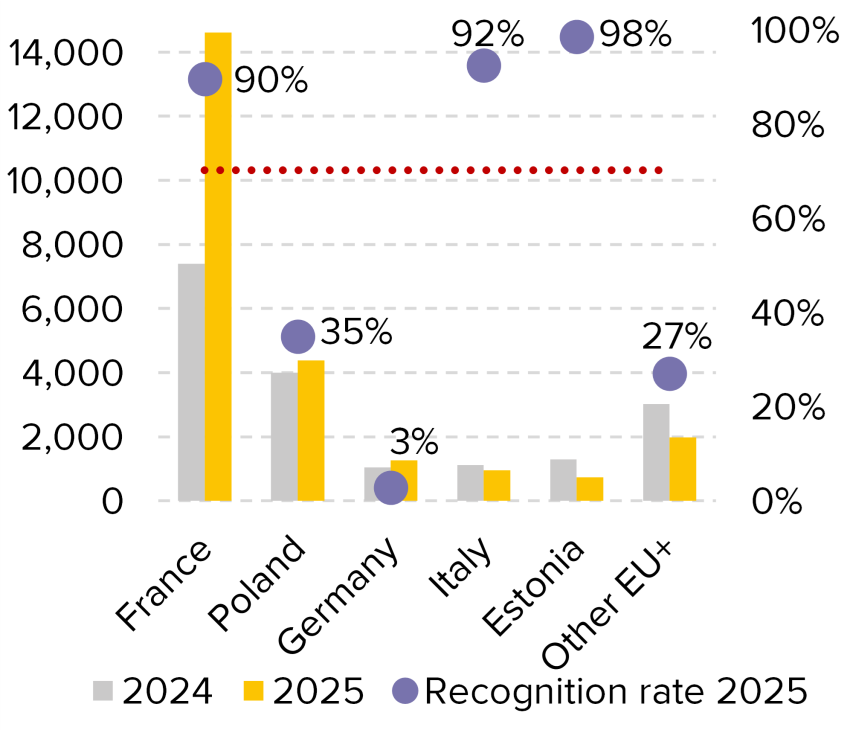
Turning to international protection, Ukrainians lodged slightly fewer applications in 2025, with 25,000 in total. There was great variation in granting protection by national authorities, ranging from an over 90% recognition rate in Estonia and France, to 3% in Germany (see Figure 14). Overall, the EU+ recognition rate for Ukrainian applicants (70%), dropped to the lowest since the beginning of the war. This shift was primarily driven by a change in Polish decision-making, leading to a more rigorous individual assessment of protection needs which takes into account the safety situation in Ukraine.436 Poland issued one-fifth of all decisions to Ukrainian applicants, with nearly all first instance decisions being negative since May 2025, thus impacting the overall EU+ recognition rate.
In several countries (for example Germany), the share of beneficiaries of temporary protection who were accommodated in reception facilities remained significant. This had a notable impact on reception systems overall.
Several EU + countries continued in 2025 to shift policies towards integration and targeted labour market reforms. “Unity Hubs” in Spain437 and Czechia438 provided assistance with employment, language courses, counselling for beneficiaries and, in some cases, support for voluntary returns. A Unity Hub was set up in Germany to provide counselling for beneficiaries on options to return to Ukraine or integrate in Germany, and to support Ukrainian community building. Operations start in April 2026.439 Switzerland440 replaced work permit requirements for S-status holders from Ukraine with a new notification system, enabling inter-cantonal employment mobility. Bulgaria441 adopted a national programme for humanitarian support and integration focusing on access to employment, education and social support.
Figure 13. Number of persons under temporary protection per million inhabitants by receiving country, December 2025

Figure 14. First instance decisions issued to Ukrainians by top EU+ country, 2025 compared to 2024 and recognition rate for 2025
Several countries introduced initiatives to transition beneficiaries of temporary protection to alternative national residence permits. Czechia442 established a special long-term residence permit for financially self-sufficient Ukrainian beneficiaries after 2 years of stay. Similarly, Poland443 introduced a simplified procedure for Ukrainian citizens and their family members to change their status into a temporary national residence permit. Ireland444 and Slovenia445 revised their legal frameworks to enable a clearer transition towards national permits and better define rights and obligations of applicants and beneficiaries of temporary protection.
In parallel, countries such as Finland,446 the Netherlands447 and Spain began narrowing eligibility criteria for granting or renewing temporary protection to third-country nationals previously residing in Ukraine. Norway proposed procedural reforms to streamline the phase-out from temporary collective protection.448 Switzerland449 opted for regional distinction within Ukraine, limiting access to protection status S for applicants from areas deemed to be safe, which triggered concerns by UNHCR450 and the Swiss Refugee Council (OSAR).451
Italy452 and Slovakia procured additional reception places for beneficiaries of temporary protection, with Slovakia reducing the entitlement to a place in collective accommodation and the accommodation allowance to 60 days, except for vulnerable applicants.453 Similarly, in late 2025, Poland limited collective accommodation to only vulnerable beneficiaries and restricted certain benefits and healthcare services,454 while the Netherlands increased beneficiaries’ personal contributions to reception costs and closed a reception centre in Utrecht.455 Some housing schemes which enable beneficiaries of temporary protection to access accommodation outside the reception system were extended, including the “Together for Independence” project in Poland456 and the “Lend a hand” project in Spain.457 Bulgaria458 adopted measures to improve support for vulnerable beneficiaries, Luxembourg maintained projects supporting labour market integration, and Switzerland adopted measures on administrative requirements to access the job market.459

Jurisprudential developments at both the national and EU levels further clarified the interplay between temporary protection and international protection procedures. In November 2025, in response to questions by Sweden’s Administrative Courts, the CJEU ruled that a Member State may not reject as inadmissible an application for international protection on the sole ground that the applicant is under temporary protection. Member States must examine the application on merits to assess whether the applicant qualifies for refugee status or subsidiary protection. The CJEU further noted that national courts must disapply national law that does not effectively implement the TPD, if it is not in conformity with the recast APD (Article 33) and the recast QD (Article 18), so that individuals would still benefit from rights provided under EU law.
In the context of multiple applications submitted in different Member States, the CJEU clarified in A.N. [Krasiliva] v Ministerstvo vnitra (27 February 2025) that national authorities cannot reject an application for temporary protection submitted by a person who has applied for the status in another Member State but has not yet received it. The court also interpreted the TPD (Article 8) as providing an appeal against inadmissible decisions adopted on applications for a residence permit under temporary protection. Subsequently, the Czech Supreme Administrative Court ruled that beneficiaries of temporary protection cannot be denied protection solely because they hold a status in another Member State and national prohibitions on appealing inadmissible decisions violate both the TPD and the EU Charter (Article 47). In contrast, Switzerland’s Federal Administrative Court underlined the subsidiarity principle, denying temporary protection to applicants already registered in Poland.
There are three cases pending before the CJEU for a preliminary ruling on the interplay with asylum, access to social benefits and inaction of the administrative authority on granting a temporary residence and work permit during the validity of temporary protection. In the Netherlands, the Council of State referred questions on the suspension of asylum applications during temporary protection and the adherence to time limits under the recast APD, highlighting the need for legal clarity. The Administrative Court of Varna in Bulgaria questioned if national legislation was compatible with the TPD (Articles 13 and 14) when social assistance authorities repeatedly refused to grant a one-time benefit to Ukrainian children enrolled in school. The Voivodship Administrative Court of Wrocław sought guidance on the possibility for an administrative authority to suspend the processing of a request for a temporary residence and a work permit by a Ukrainian national who was authorised to reside in Poland based on temporary protection.
In Belgium, the Council of State confirmed that temporary protection does not prevent the extradition of a Ukrainian national, finding no violation of the ECHR and no evidence to support the claim that the applicant will be sent back to the war front.
- 434
Council of the European Union. (13 June 2025). EU member states agree to extend temporary protection for refugees from Ukraine.
- 435
European Commission. (4 June 2025). Proposal for a Council Recommendation on a coordinated approach to the transition out of temporary protection for displaced persons from Ukraine.
- 436436
Based on partially available data from Eurostat, Decisions granting temporary protection by citizenship, age and sex – monthly data (last update on 4 February 2026). November 2025 data were used for December 2025 for Switzerland.
- 437437
Based on partially available data from Eurostat, Beneficiaries of temporary protection at the end of the month by citizenship, age and sex – monthly data, at the end of December 2025 (last update on 4 February 2026). Data from earlier months of 2025 were used for Luxembourg and Switzerland.
- 438
Ministry of the Interior (Czechia) | Ministerstvo Vnitra. (5 May 2025). Vít Rakušan jednal s prezidentem Ukrajiny a členy tamní vlády. Podepsal důležitý dokument o vzniku návratového centra Unity Hub v Česku [Vít Rakušan met with the President of Ukraine and members of the government. He signed an important document on the establishment of the Unity Hub return centre in the Czech Republic].
- 439
Federal Ministry of the Interior (Germany) | Bundesministerium des Innern. (16 January 2025). Deutschland und Ukraine vereinbaren die Einrichtung eines „Unity Hubs“in Berlin [Germany and Ukraine agree to set up a "Unity Hub" in Berlin].
- 440
Federal Council (Switzerland) | Der Bundesrat | Conseil fédéral | Consiglio federale. (22 October 2025). Le Conseil fédéral encourage les bénéficiaires du statut S à travailler [Federal Council encourages S status holders to work].
- 441
Bulgaria for Ukraine. (29 April 2025). Министерският съвет прие Програма за хуманитарна подкрепа и интеграция на разселените лица от Украйна с предоставена временна закрила в Република България. [The Council of Ministers adopted a Program for Humanitarian Support and Integration of Displaced Persons from Ukraine Granted Temporary Protection in the Republic of Bulgaria].
- 442
Ministry of the Interior (Czechia) | Ministerstvo Vnitra. (8 September 2025). Ministerstvo vnitra spustilo registrace ke zvláštnímu dlouhodobému pobytu pro ekonomicky soběstačné ukrajinské uprchlíky [The Ministry of the Interior has launched registration for special long-term residence for economically self-sufficient Ukrainian refugees].
- 443
Office for Foreigners | Urząd do Spraw Cudzoziemców. (15 July 2025). Bill amending the Act on Assistance to Citizens of Ukraine in Connection with the Armed Conflict on the Territory of Ukraine and Certain Other Acts.
- 444
Department of Justice, Home Affairs and Migration (Ireland) | An Roinn Dlí agus Cirt, Gnóthaí Baile agus Imirce. (29 April 2025). Minister Jim O’Callaghan secures Cabinet approval for publication of the General Scheme of the International Protection Bill 2025.
- 445
Government of the Republic of Slovenia | Vlada Republike Slovenije. (17 July 2025). Predstavitev sprememb zakona o začasni zaščiti razseljenih oseb [Presentation of amendments to the Act on Temporary Protection of Displaced Persons].
- 446
Finnish Immigration Service | Maahanmuuttovirasto. (8 January 2026). Temporary protection no longer granted to applicants who already hold a residence permit on the basis of temporary protection in another EU Member State.
- 447
Immigration and Naturalisation Service | Immigratie- en Naturalisatiedienst (IND). (5 June 2025). Freeze measure for third-country nationals with temporary Ukrainian residence permit ends on 4 September 2025.
- 448
Ministry of Justice and Public Security (Norway) | Justis- og beredskapsdepartementet. (18 December 2025). Forslag om nye saksbehandlingsregler for midlertidig kollektiv beskyttelse [Proposal for new procedural rules for temporary collective protection].
- 449
State Secretariat for Migration (Switzerland) | Staatssekretariat für Migration | Secrétariat d’État aux migrations | Segreteria di Stato della migrazione. (25 June 2025). Projet de modification du statut de protection S [Proposed amendment of protection status S].
- 450
United Nations High Commissioner for Refugees (UNHCR). (8 October 2025). Le HCR se félicite du maintien du statut de protection S, mais exprime sa préoccupation face à la décision de restreindre le groupe de personnes à protéger [UNHCR welcomes the retention of protection status S, but expresses concern at the decision to restrict the group of people to be protected].
- 451
Swiss Refugee Council | Schweizerische Flüchtlingshilfe | Organisation suisse d’aide aux réfugiés. (8 October 2025). Pas de régions sûres en Ukraine : l’OSAR dénonce une décision erronée du Conseil fédéral [No safe regions in Ukraine: the Swiss Refugee Council condemns a wrong decision by the Federal Council].
- 452
The Reception and Integration System (SAI) | Sistema di Accoglienza e Integrazione. (24 January 2025). Ampliamento posti SAI [Expansion of SAI places]; Ministry of the Interior | Ministero dell’Interno. (29 December 2025). Decreto del 29 dicembre 2025. Ampliamento della capacità di accoglienza della rete SAI, per n. 2.748 posti riferiti a n. 132 progetti categoria “Ordinari” UKR(ex DM 25940) [Decree of 29 December 2025. Expansion of the reception capacity of the SAI network, for 2,748 places referring to 132 UKR "Ordinary" category projects (ex DM 25940)].
- 453
Інформаційне агентство | Interfax-Ukraine News Agency. (7 December 2025). Slovakia to reduce support for Ukrainian refugees from 120 to 60 days starting March 1 – media.
- 454
Ministry of the Interior and Administration (Poland) | Ministerstwo Spraw Wewnętrznych i Administracji. (24 October 2025). Od listopada 2025 r. zmienią się zasady funkcjonowania ośrodków zbiorowego zakwaterowania dla uchodźców z Ukrainy [From November 2025, the rules for the operation of collective accommodation centers for refugees from Ukraine will change]; National Health Fund – Headquarters | Narodowy Fundusz Zdrowia – Centrala. (29 September 2025). Komunikat ws. zmian w dostępie do świadczeń opieki zdrowotnej dla obywateli Ukrainy objętych specustawą [Announcement on changes in access to health care services for Ukrainian citizens covered by the special act]; Ministry of the Interior and Administration (Poland) | Ministerstwo Spraw Wewnętrznych i Administracji. (26 September 2025). Rząd uszczelnia system - świadczenia tylko dla pracujących cudzoziemców - prezydent podpisał ustawę [The government is tightening the system - benefits only for working foreigners - the president has signed a law].
- 455
Government of the Nethelrands | Rijksoverheid. (4 July 2025). Increase in personal contribution as of 1 October 2025.
- 456
Ministry of the Interior and Administration (Poland) | Ministerstwo Spraw Wewnętrznych i Administracji. Projekt “Wspólnie do Niezależności” [Project "Together to Independence"].
- 457
Ministry of Inclusion, Social Security and Migration (Spain) | Ministerio de Inclusión, Seguridad Social y Migraciones. (28 January 2025). El Ministerio de Inclusión y la Fundación “la Caixa” renuevan su colaboración para el programa ‘Tiende una mano. Acoge’ que facilita la inclusión de personas refugiadas [The Ministry of Inclusion and the "la Caixa" Foundation renew their collaboration for the 'Reach out a hand. Welcome' that facilitates the inclusion of refugees].
- 458
Foundation for Access to Rights | Фондация за достъп до права. (23 October 2025). Самостоятелно Заплащане На Престоя В Местата За Настаняване По Програмата За Хуманитарна Подкрепа И Интеграция На Разселени Лица От Украйна – Актуални Проблеми И Предложения [Self-payment for accommodation under the Program for Humanitarian Support and Integration of Displaced Persons from Ukraine – current problems and proposals].
- 459
The Federal Council (Switzerland) | Der Bundesrat | Le Conseil federal | Il Consiglio federale. (22 October 2025). Le Conseil fédéral encourage les bénéficiaires du statut S à travailler [The Federal Council encourages the beneficiaries of the S Statute to work].