


Box 1. Common migration and asylum information systems and digital innovation
in 2024
The digitalisation of asylum processes and migration management is a key element of the EU Pact on Migration and Asylum, which entered into force on 11 June 2024. The revised Eurodac Regulation and the new Screening Regulation rely heavily on the use of EU-wide information systems and databases, as well as national IT infrastructure to facilitate the storing and sharing of data. Throughout 2024, the European Union Agency for the Operational Management of Large-Scale IT Systems in the Area of Freedom, Security and Justice (eu-LISA) continued to work on the new Eurodac system and updating of DubliNet in preparation for the Pact. In addition, eu-LISA continued the development of its interoperability structure,ii which will include Eurodac as an integral part.132
Member States have already started to ramp up their digital capacity and included General Data Protection Regulation (GDPR) considerations of new digitalised systems into amended legislation and policies.133 While requiring substantial financial investment, the digitalisation of asylum procedures has led to simplified processes and faster processing times.
Steps taken by EU+ countries to digitalise international protection procedures in 2024
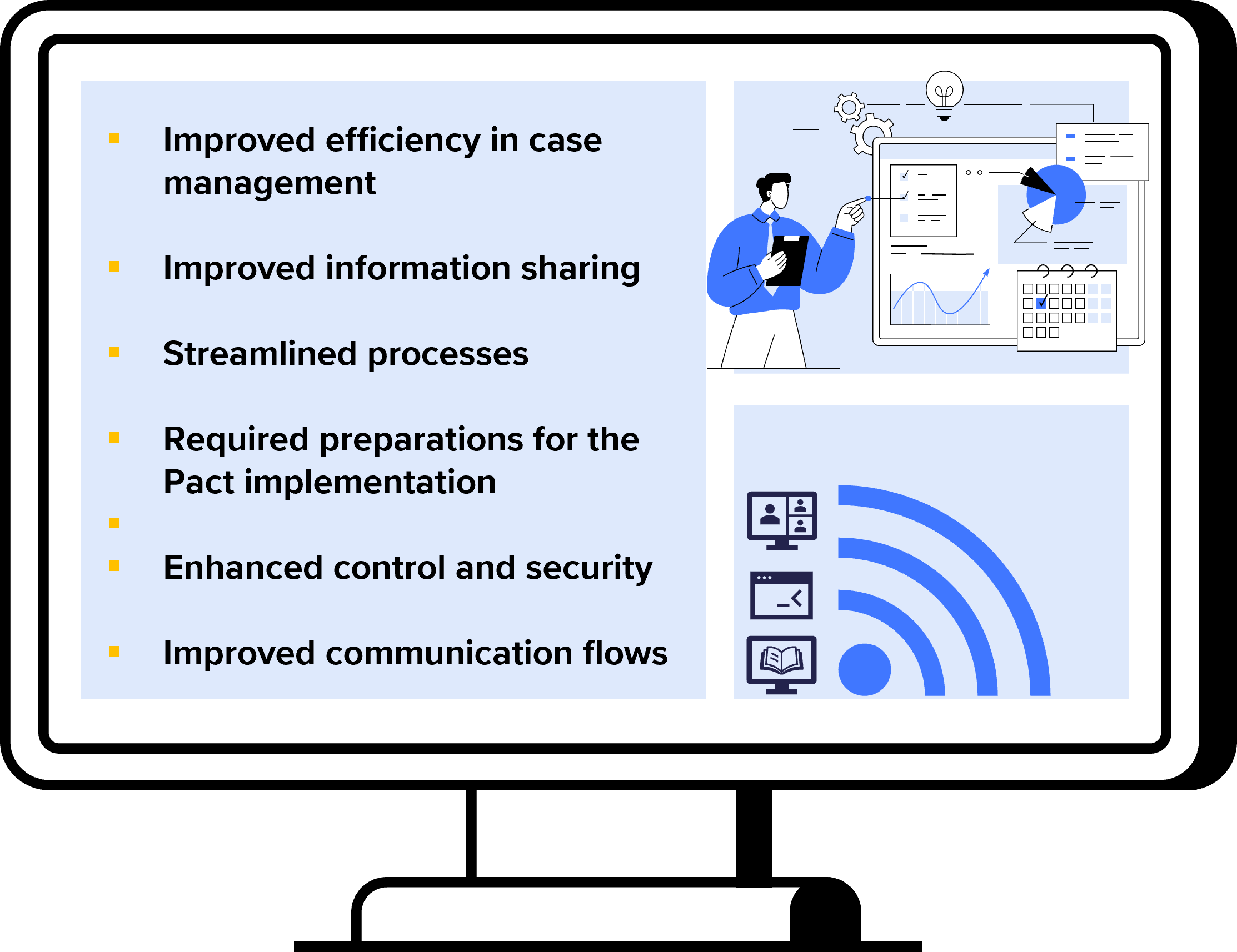
Created or upgraded IT systems to manage resources and services and expand the type of data that can be collected(e.g. Czechia, Finland, Germany and Slovakia).
Use of AI for language assessments to confirm the country of origin (e.g. CELIA project in the Netherlands
Digitalised residence permits and storing of biometric data from residence permits for longer periods of time (e.g. Czechia and Germany)
Online application process (e.g. for family reunification in France)
- ii
Namely the Entry/Exit System (EES), the European Travel Information and Authorisation System (ETIAS), the European Criminal Records Information System on Third-Country Nationals and Stateless Persons (ECRIS-TCN), the central repository for reporting and statistics (CRRS), and interoperability components: European search portal (ESP), shared biometric matching service (sBMS), common identity repository (CIR) and multiple-identity detector (MID).
- 132
European Union Agency for the Operational Management of Large-Scale IT Systems in the Area of Freedom, Security and Justice (eu-LISA) (3 December 2024). Single Programming Document 2025-2027.
- 133
Federal Ministry for the Interior and Community | Bundesministerium des Innern und für Heimat. (2024, December 18). Bundesregierung beschließt Regelungen zur weiteren Digitalisierung der Migrationsverwaltung [Federal government adopts regulations for further digitalisation of migration administration]. Ministry of the Interior of the Czech Republic | Ministerstvo vnitra České republiky. (2024, August 28). Vláda schválila nový zákon upravující pobyt cizinců na území ČR [The government approved a new law governing the stay of foreigners in the Czech Republic]. French Office for the Protection of Refugees and Stateless Persons | Office français de protection des réfugiés et apatrides. (2024, November 26). Règles applicables au traitement automatisé de données à caractère personnel [Rules applicable to the automatic processing of personal data]. French Office for the Protection of Refugees and Stateless Persons | Office français de protection des réfugiés et apatrides. (2024, November 26). Règles applicables au traitement automatisé de données à caractère personnel [Rules applicable to the automatic processing of personal data]. Norwegian Directorate of Immigration | Utlendingsdirektoratet. (2024, October 7). Utlendingsforvaltningen får nytt IT- og saksbehandlingssystem, [The Immigration Service is getting a new IT and case management system]. Government | Regjeringen. (2024, September 30). Utlendingsforvaltningen får nytt IT- og saksbehandlingssystem [The Immigration Service is getting a new IT and case management system]. Finnish Immigration Service | Maahanmuuttovirasto. (2024, September 6). Competitive tendering procedure for IT services related to immigration matters completed.