

4.1.4. Managing caseloads and assessing applications for international protection

In 2024, EU+ asylum authorities issued 795,000 first instance decisions on asylum applications. This is the most since 2017. For the fourth year in a row, the most decisions were issued by Germany and France, together accounting for almost one-half of the EU+ total in 2024. Germany issued 251,000 decisions, which was the most since 2017. This increase mostly comprised negative decisions. France, with 138,000 decisions, issued the most on record. The output was driven by a surge in positive decisions issued to Haitians (7,300) and Ukrainians (6,800).
Italy (85,000) had the largest absolute increase among EU+ countries, almost doubling the number of decisions from the previous year. The increase was driven by positive decisions issued to applicants from Burkina Faso and Mali, and negative decisions issued to applicants from Bangladesh, Egypt, Pakistan, Morocco and Tunisia (in descending order). Greece (55,000) issued the most decisions at first instance in 4 years. Belgium, Switzerland, Ireland and Poland reached record highs.
Figure 5. Disparity between asylum applications and case closures (first instance decisions, discontinuations after withdrawals and otherwise closed cases) in EU+ countries with the largest gaps, 2024
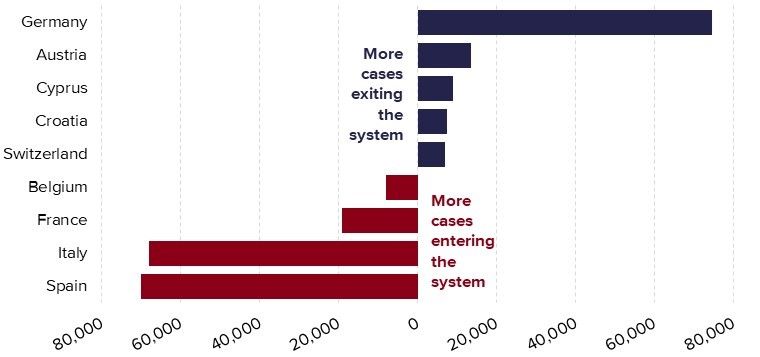
Source: EUAA EPS data as of 3 February 2025.
Despite the increased number of decisions taken in many countries, there were 981,000 pending cases at the end of December 2024 – among the highest on record. As seen in Figure 6, the share of cases which were pending for more than 6 months also increased in 2024.
Three countries jointly accounted for over two-thirds of all pending cases at the end of 2024: Spain (with 252,000 open cases), Italy (227,000) and Germany (213,000). Pending cases at first instance reached unprecedented levels in the Netherlands, Belgium, Ireland, Poland, Luxembourg, Croatia and Portugal (in descending order). However, Croatia and Poland managed to reverse the trend and ended 2024 at a lower level than in the previous year. Indeed, 16 EU+ countries decreased their numbers of pending cases compared to the end of 2023, with the largest absolute decrease reported in Germany.
Figure 6. Pending cases for less than 6 months, for more than 6 months and unknown across EU+ countries, January 2015–December 2024
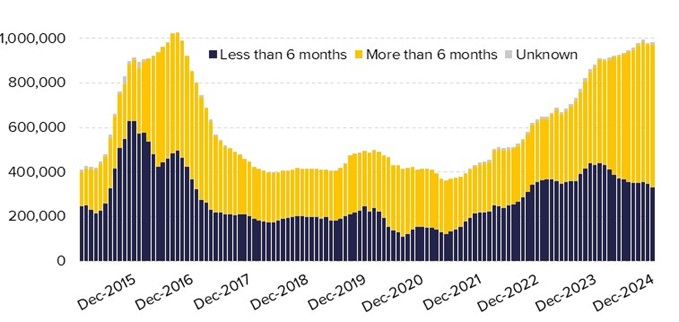
Source: EUAA EPS data as of 3 February 2025.
Against this background, many authorities focused on making the asylum procedure even quicker and more efficient. Authorities aimed to clear out their backlogs as much as possible before the mandatory application of the pact in June 2026 in order to avoid having to apply old and new rules in parallel (depending on the date of the application) for an extensive amount of time. In addition to staff recruitment and digitalisation, authorities applied different case load management methods to increase their efficiency. For example, a new template was piloted in Czechia to support case officers with drafting decisions, while new standard operating procedures were developed in Sweden for case officers for the identification of special needs and the application of exclusion grounds. The Belgian CGRS implemented a specific action plan to process applications from Palestinians more quickly.175 Several countries used prioritisation policies (see Figure 7).
These policies often formed part of a more comprehensive plan to increase efficiency and decrease backlogs, and yielded promising results. The Belgian Tabula Rasa project, which tested new practices such as a preliminary questionnaire before the personal interview and the shortened reasoning of decisions, was finalised at the beginning of 2024176 and found to be very efficient without compromising the quality of decisions. As a result, the procedures have continued in 2025 under the Prisma project. The Dutch IND managed to process 18,000 additional applications within the prioritisation project between May 2023 and mid-July 2024.177
Despite these measures, asylum procedures remained lengthy in some cases. For example, the possibility to extend the asylum procedure to 21 months remained in place in the Netherlands.178 Ombudspersons and courts decided on complaints in individual cases of long processing times.179
Figure 7. Examples of prioritisation policies in 2024
| Belgium | Fast-track procedure for applicants from Georgia, Democratic Republic of the Congo, Western Balkan countries and for applicants who already have a protection status in another EU Member State |
|---|---|
| Ireland | Prioritising applicants from countries with the highest number of applications in the past 3 months (Nigeria, Jordan) |
| Luxembourg | Prioritising older cases by date of lodging |
| Netherlands | Prioritising applicants with high chances of receiving protection (by a specialised project team), applications by nationalities with little chances of obtaining international protection and applicants who cause a nuisance or disturbance |
Sources: Ireland180 and Netherlands.181
Specific policies for applicants from certain countries of origin helped with case load management and assessments. EU-wide responses were triggered by developments in Syria in December 2024, when most EU+ countries suspended decisions on the protection needs of Syrian applicants until there was more clarity on the situation in the country (see Table 2). Typically authorities still continued with decisions on admissibility or Dublin transfers of Syrian applicants, but the caseload is anticipated to grow.
Table 2. Reactions from asylum authorities of EU+ countries on the situation in Syria
| Country | Reactions |
|---|---|
| Austria | According to media sources, Chancellor Karl Nehammer instructed the Minister of the Interior Gerhard Karner to suspend all current Syrian asylum applications and to review all cases in which asylum was granted. Reuters. (9 December 2024). Austria stops processing Syrians' asylum applications after Assad falls. |
| Belgium | The CGRS suspended the examination of applications and personal interviews that were already scheduled. The CGRS maintained personal interviews and decisions for those who already have protection in another Member State. CGRS. (9 December 2024), Suspension temporaire du traitement des dossiers des demandeurs Syrie. |
| Bulgaria | SAR continued with the processing of applications based on its updated policy. SAR. (3 February 2025). Отчетен доклад за проведената процедура за международна закрила за 2024 г. |
| Croatia | The Ministry of the Interior instructed the relevant services to temporarily suspend the processing of applications from Syrian nationals. The ministry still receives applications for international protection by Syrian nationals, and they are accommodated within the reception centres, provided with material reception conditions, and given the necessary medical and psychosocial care. Ministarstvo unutarnjih poslova Republike Hrvatske. (9 December 2024). Ministar Božinović: Hrvatska privremeno obustavlja zahtjeve za azil Sirijcima. |
| Cyprus |
The Ministry of the Interior announced that the examination of cases by Syrian applicants was suspended already in April 2024, as a result of increased arrivals.182 Κυβερνητική Πύλη. (13 April 2024). Ανακοίνωση για την εφαρμογή νέας πολιτικής σε σχέση με τη διαχείριση των Σύρων αιτητών ασύλου. |
| Czechia | The Ministry of the Interior suspended the procedure for applications for international protection and the procedure for the extension of subsidiary protection for Syrian nationals. Ministerstvo vnitra České republiky. (9 December 2024). Ministerstvo vnitra pozastavilo rozhodování o žádostech Syřanů o azyl. |
| Denmark | The Danish Immigration Service suspended the processing of cases by individuals form Syria. The appeals body also suspended cases on appeal, with the Coordination Committee of the Refugee Appeals Board set to review the suspension at its next meeting on 16 January 2025. Danish Immigration Service. (10 December 2024) Suspension of asylum cases regarding individuals from Syria. Refugee Appeals Board. (9 December 2024). Flygtningenævnet berostiller behandlingen af sager vedrørende personer fra Syrien (for cases on appeal and returns) |
| Finland | The Finnish Immigration Service suspended the examination of applications by Syrians (approximately 350 pending applications) and is reviewing its COI on the area to allow decision-making to restart. Finnish Immigration Service. (9 December 2024). Decision-making on asylum applications from Syrians paused by Finnish Immigration Service. |
| France | OFPRA is closely monitoring the situation in Syria. As always, in the event of a changing situation in an asylum seeker's country of origin, this may lead to the temporary suspension of decisions on certain cases lodged by Syrian nationals, depending on the reasons of the application. OFPRA. (9 December 2024). Communiqué de presse – Syrie. |
| Germany | The Federal Office for Migration and Refugees (BAMF) postponed decisions for Syrian applicants, noting that it is not yet possible to predict whether the current developments will lead to refugee movements in or out of the region. It is also not possible to predict what impact the changing situation will have on the opportunities for Syrian refugees to return to their homeland. BAMF. (9 December 2024). Rückstellung von Entscheidungen Syrien. |
| Greece | The Greek government suspended decisions on the merits of asylum applications by Syrians. UNHCR. (14 January 2025). For Syrians in Greece. |
| Italy | According to media sources, the government decided to suspend proceedings on asylum applications from Syria. Reuters. (9 December 2024). Italy pauses asylum applications from Syria. |
| Latvia | According to media sources, the Office of Citizenship and Migration Affairs suspended decisions on granting international protection to Syrian citizens. Latvijas Sabiedriskais medijs. (10 December 2024). Arī Latvijā aptur lēmumu pieņemšanu par starptautiskās aizsardzības statusa piešķiršanu Sīrijas pilsoņiem. |
| Lithuania | According to media sources, the Head of Migration Department noted that only one Syrian asylum request was pending and was not a reason to suspend decisions. Lithuanian National Radio and Television. (11 December 2024). Syrian asylum issue not currently relevant in Lithuania – migration chief. |
| Luxembourg | The Ministry of Home Affairs announced the suspension of the examination of applications from Syrian nationals. The Ministry highlighted that the suspension is temporary, allowing time and consultation with other EU Member States on the situation, and that this does not impact the Dublin procedure. Ministère des Affaires intérieures, Direction générale de l'immigration. (10 December 2024). Suspension de l'examen des demandes de protection internationale des ressortissants syriens. |
| Malta | The International Protection Agency (IPA) temporarily suspended the examination of pending and new asylum applications for international protection by Syrian nationals. IPA. (10 December 2024). Press release by the Ministry for Homa Affairs, Security and Employment. |
| Netherlands | The IND suspended the examination of applications and return decisions. However, the IND will take decisions on applications submitted more than 21 months ago that due to individual circumstances, regardless of the security situation, lead to a positive decision on residence in the Netherlands. Syrians who were previously registered in another EU country (Dublin claimants), Syrians who already have international protection in another EU Member State, and public order and 1F cases are exempted from both the decision and the departure moratorium. IND. (9 December 2024). Voorlopig geen beslissing op asielaanvragen Syrië. |
| Norway | The UDI announced the suspension of the processing of asylum applications lodged by Syrians, while noting that scheduled interviews will still take place. UDI. (9 December 2024). Information regarding the situation in the Middle East and applications for residence in Norway. |
| Poland | According to media sources, the Polish Office for Foreigners will not issue decisions on Syrian citizens' applications for international protection until the situation in Syria is clarified. Reuters. (11 December 2024). European countries halt Syrian asylum applications after Assad's fall. |
| Portugal | According to media sources, the government had no intention to suspend the processing of pending cases. Rádio e Televisão de Portugal. (11 December 2024). Síria. Portugal mantém 1.243 refugiados no país, mas sem decisão sobre futuro. |
| Slovakia | The Ministry of the Interior was monitoring the situation. Ministerstvo vnútra SR (10 December 2024). Vývoj situácie v Sýrii ministerstvo vnútra monitoruje. |
| Sweden | The Swedish Migration Agency (SMA) suspended the examination of asylum applications for Syrians. The suspension was prolonged on 10 March 2025 for a period of maximum 3 months. SMA. (9 December 2024, updated on 12 March 2025). Migrationsverket beslutar om besluts- och verkställighets¬stopp till Syrien. |
| Switzerland | In December 2024, the State Secretariat for Migration (SEM) decided that decisions on asylum application by Syrians would not be taken until further notice. The volatile situation in Syria following the overthrow of the Assad regime does not allow for a thorough examination of the reasons to seek asylum. Nonetheless, Syrians could still apply for asylum. Swiss State Secretariat for Migration (SEM). (9 December 2024). Information regarding Syria. |
At the end of 2024, the highest numbers of pending cases at first instance were recorded for Syrians (109,000 cases), Colombians (97,000) and Venezuelans (93,000). Together they represented close to one-third of the total. More than one-half of all pending cases pertained to 37 nationalities with low recognition rates, i.e. those which had recognition rates of 20% or below in 2024.iii
Court decisions increasingly shaped national authorities’ assessment policies throughout 2024, for example related to Gaza, Syria, military conscription in Russia and westernised lifestyle versus the mere fact of living in Europe.183 The CJEU delivered several significant rulings, for example on women as a whole and women who identify with the value of equality between women and men as a particular social group, UNRWA’s protection and assistance, and the assessment of cases lodged by Afghan women.184
COI units updated their products based on the changing situation in countries of origin, linked with the most common profiles in their national context.185 In line with the new mandate of the Belgian CGRS on the statelessness determination procedure, the country of origin information research unit (CEDOCA) updated its COI on statelessness for Palestinians and Kurds. It also undertook a number of fact-finding missions (Armenia, Burundi, Cameroon, El Salvador, Morocco, Rwanda and Türkiye), while the Austrian BFA went to Syria, the German BAMF organised a mission to Türkiye about Syrian applicants, and the French OFPRA organised a mission to Colombia.
Figure 8. Examples of policies on the assessment of asylum applications in the national context in 2024
| Belgium | New policy on applicants from Somalia Resuming the processing of cases by Russian nationals Resuming the processing of certain cases by Sudanese applicants Suspension of the notification of decisions granting or refusing subsidiary protection for applicants from Lebanon |
|---|---|
| Cyprus | Suspension of the examination of cases by Syrian applicants due to mass arrivals in April 2024 |
| Luxembourg | Guidance on the assessment of applications by Turkish nationals affiliated with the Gülen movement Guidance on the assessment of applications by Syrian applicants at risk of being conscripted into compulsory military service |
| Netherlands | Adjusted policy on applications from Yemen Resumption of decisions on applications from Palestinians, following the Council of State’s ruling that the moratorium was not lawful Decision and departure moratorium on applications from Lebanese nationals New policy on applications by nationals of Sudan |
| Norway | Updated guidelines on processing asylum cases by Ukrainian nationals who are not covered by collective protection |
| Sweden | Update of legal position on the assessment of cases by Afghans Update of the legal position related to the assessment of certain Yemeni homeland passports |
Sources: Belgium,186 Cyprus,187 Netherlands188 and Norway.189
To provide more targeted support to case officers, training initiatives were expanded both in Belgium and Germany. A new project (Consultancy@PO) was launched in Belgium to allow case officers to ask questions and hold consultations with researchers. In Germany, a BAMFGPT was piloted to allow case officers to make inquires via chat. The Irish IPO aimed to increase the efficiency and quality of its decision-making by ensuring a uniform approach to COI research and establishing a separate COI unit.
- 175
Office of the Commissioner General for Refugees and Stateless Persons | Commissariaatgeneraal voor de vluchtelingen en de staatlozen | Commissariat Général aux Réfugiés et aux Apatrides. (2024, May 21). Processing time for Palestinian cases.
- 176
European Union Agency for Asylum. (June 2024). Asylum Report 2024.
- 177
Immigration and Naturalisation Service | Immigratie- en Naturalisatiedienst. (2024, August 1). The IND processed 18,000 additional asylum applications.
- 178
Immigration and Naturalisation Service | Immigratie- en Naturalisatiedienst. (2024, June 23). IB 2024/22 Verlenging beslistermijn asielaanvragen [IB 2024/22 Extension of the decision period for asylum applications].
- 179
EUAA Case Law Database. Length of procedure/timely decision/time limit to decide – 2024. Parliamentary Ombud | Sivilombudet. (2024, June 28). Utlendingsdirektoratets behandlingstid i asylsak, 2024/1515 [The Directorate of Immigration's processing time in asylum cases, 2024/1515].
- 180
Department of Justice | An Roinn Dlí agus Cirt. (2024, April 23). Minister McEntee announces further measure to expedite International Protection application processing. Department of Justice | An Roinn Dlí agus Cirt. (2024, July 29). Minister McEntee announces expansion of accelerated processing of International Protection applications.
- 181
Immigration and Naturalisation Service | Immigratie- en Naturalisatiedienst. (2024, August 1). The IND processed 18,000 additional asylum applications.
- 182
Government Portal | Κυβερνητική Πύλη. (13 April 2024). Ανακοίνωση για την εφαρμογή νέας πολιτικής σε σχέση με τη διαχείριση των Σύρων αιτητών ασύλου [Announcement on the implementation of a new policy in relation to the management of Syrian asylum seekers]
- iii
Nearly 200 citizenships were issued asylum decisions in 2024, but many in very small numbers which can lead to unstable or misleading recognition rates. Of the 200, 65 citizenships were issued at least 1,000 decisions and among them 37 had recognition rates of ≤20%.
- 183
EUAA Case Law Database. Gaza – 2024. EUAA Case Law Database. Syria – 2024. EUAA Case Law Database. Russia – Military service/Conscientious objection/Desertion/Draft evasion/Forced conscription – 2024. EUAA Case Law Database. Westernised – 2024.
- 184
European Union Agency for Asylum. (2025, April 2025). Jurisprudence related to asylum pronounced by the Court of Justice of the EU in 2024. Fact Sheet No 32.
- 185
For example: Danish Immigration Service | Udlændingestyrelsen. (March 2024). Algeria: Entry residence and readmission for Palestinians. Danish Immigration Service | Udlændingestyrelsen. (June 2024). Syria: Military recruitment in North and East Syria. Danish Immigration Service | Udlændingestyrelsen. (August 2024). Syria: Documents and freedom of movement in North and East Syria (NES). Danish Immigration Service | Udlændingestyrelsen. (October 2024). Ethiopia: Security situation in Amhara, Oromia and Tigray regions and return. Swedish Migration Agency | Migrationsverket. (2024, January 24). Landinformation: Officiella syriska handlingar och dokument. Procedurer vid registrering, ansökan och utfärdande (version 1.0) [Country Information: Official Syrian Acts and Documents. Procedures for Registration, Application and Issuance (Version 1.0)]. Swedish Migration Agency | Migrationsverket. (2024, January 29). Etiopien. Id-kort och folkbokföring vid resor, flytt och samhällsservice [Ethiopia. ID cards and population registration for travel, relocation and community services]. Swedish Migration Agency | Migrationsverket. (2024, January 29). UNRWA:s möjligheter att verka i Gaza [UNRWA's opportunities to operate in Gaza]. Swedish Migration Agency | Migrationsverket. (2024, February 20). Landinformation: Belarus. Risker för politiskt oppositionella efter valet 2020, in- och utresor och passutfärdande [Country information: Belarus. Risks for political opposition after the 2020 election, entry and exit and passport issuance]. Swedish Migration Agency | Migrationsverket. (2024, February 27). Landinformation: Tunisien. Statlig och samhällelig behandling av hbtqi-personer [Country information: Tunisia. State and societal treatment of LGBTQI people]. Swedish Migration Agency | Migrationsverket. (2024, March 20). Landinformation: Gazakriget. Civilas utsatthet [Country Information: Gaza War. Civilan vulnerability]. Swedish Migration Agency | Migrationsverket. (2024, April 9). Landinformation: Turkiet: Politisk utveckling, fri- och rättigheter samt situationen för särskilda grupper(version 4.0) [Country information: Turkey: Political developments, freedoms and rights and the situation of specific groups (version 4.0)]. Swedish Migration Agency | Migrationsverket. (2024, April 16). Afghanistan. Restriktioner och begränsningar av personlig frihet under talibanstyret [Afghanistan. Restrictions and limitations on personal freedom under Taliban rule]. Swedish Migration Agency | Migrationsverket. (2024, August 20). Bangladesh - Protester och regeringsfall, [Bangladesh - Protests and government fall]. Swedish Migration Agency | Migrationsverket. (2024, October 14). Västbanken - Lägesbild 2024 [West Bank - Situation 2024]. Swedish Migration Agency | Migrationsverket. (2024, October 21). Landinformation: Georgien. Underlag till bedömning av ursprungsländer (version 2.1) [Country information: Georgia. Basis for assessment of countries of origin (version 2.1)]. Swedish Migration Agency | Migrationsverket. (2024, October 28). Iran. Efterspelet till protesterna 2022 (version 1.1) [Iran. The aftermath of the 2022 protests (version 1.1)]. Office of the Commissioner General for Refugees and Stateless Persons | Commissariaatgeneraal voor de vluchtelingen en de staatlozen | Commissariat Général aux Réfugiés et aux Apatrides. (2024, March 26). Palestijns gebied - Westelijke Jordaanoever: Veiligheidssituatie [Palestinian Territory - West Bank: Security situation]. Office of the Commissioner General for Refugees and Stateless Persons | Commissariaatgeneraal voor de vluchtelingen en de staatlozen | Commissariat Général aux Réfugiés et aux Apatrides (2024, June). Cameroun: Régions anglophones : situation sécuritaire [Cameroon: English-speaking regions: security situation]. Office of the Commissioner General for Refugees and Stateless Persons | Commissariaatgeneraal voor de vluchtelingen en de staatlozen | Commissariat Général aux Réfugiés et aux Apatrides. (2024, September 13). Afghanistan: Corruptie en documentenfraude [Afghanistan: Corruption and document fraude]. Office of the Commissioner General for Refugees and Stateless Persons | Commissariaatgeneraal voor de vluchtelingen en de staatlozen | Commissariat Général aux Réfugiés et aux Apatrides. (2024, October 16). Iran: Treatment by the authorities of family members of dissidents residing abroad. Office of the Commissioner General for Refugees and Stateless Persons | Commissariaatgeneraal voor de vluchtelingen en de staatlozen | Commissariat Général aux Réfugiés et aux Apatrides. (2024, October 14). Cameroun: Corruption et fraude documentaire [Cameroon: Corruption and document fraud]. Office of the Commissioner General for Refugees and Stateless Persons | Commissariaatgeneraal voor de vluchtelingen en de staatlozen | Commissariat Général aux Réfugiés et aux Apatrides. (2024, October 17). Armenië: Politieke situatie [Armenia: Political situation]. French Office for the Protection of Refugees and Stateless Persons | Office français de protection des réfugiés et apatrides. Countries publications – 2024.
- 186
Office of the Commissioner General for Refugees and Stateless Persons | Commissariaatgeneraal voor de vluchtelingen en de staatlozen | Commissariat Général aux Réfugiés et aux Apatrides. (2024, January 2). New Policy Somalia; Office of the Commissioner General for Refugees and Stateless Persons | Commissariaatgeneraal voor de vluchtelingen en de staatlozen | Commissariat Général aux Réfugiés et aux Apatrides. (2024, February 1). Reprise du traitement des dossiers russes [Resuming the processing of Russian applications]; Office of the Commissioner General for Refugees and Stateless Persons | Commissariaatgeneraal voor de vluchtelingen en de staatlozen | Commissariat Général aux Réfugiés et aux Apatrides. (2024, February 5). Reprise du traitement des dossiers Soudan [Resuming the processing of Sudanese cases]; Office of the Commissioner General for Refugees and Stateless Persons | Commissariaatgeneraal voor de vluchtelingen en de staatlozen | Commissariat Général aux Réfugiés et aux Apatrides. (2024, October 2). Processing cases of applicants from Lebanon.
- 187
Asylum Service | Υπηρεσία Ασύλου. (2024, April 15). Νέα και Ανακοινώσεις: Ανακοίνωση για την εφαρμογή νέας πολιτικής σε σχέση με την διαχείριση των Σύρων αιτητών ασύλου [News and Announcements: Announcement on the implementation of a new policy regarding the management of Syrian asylum seekers].
- 188
Immigration and Naturalisation Service | Immigratie- en Naturalisatiedienst. (2024, March 18). IND will assess applications from Yemen individually for the risk of violence; Immigration and Naturalisation Service | Immigratie- en Naturalisatiedienst. (2024, June 26). IND deciding again on asylum applications from Palestinian Territories; Immigration and Naturalisation Service | Immigratie- en Naturalisatiedienst. (2024, November 20). No decisions on applications filed by asylum seekers from Lebanon for now; Immigration and Naturalisation Service | Immigratie- en Naturalisatiedienst. (2024, June 27). IND deciding again on asylum applications from Sudan.
- 189
Norwegian Directorate of Immigration | Utlendingsdirektoratet. (2024, May 2). UDI 2024-004 Asylpraksis for Ukraina [UDI 2024-004 Asylum practice for Ukraine]. Norwegian Directorate of Immigration | Utlendingsdirektoratet. (2024, May 22). Individuell behandling av asylsøknader fra Ukraina, [Individual processing of asylum applications from Ukraine].