

Section 8. Rights of beneficiaries of international protection for inclusion and integration

Recognised refugees are granted certain rights and obligations, as outlined by the Geneva Convention. The recast QD outlines the content of international protection to harmonise what a recognised beneficiary of international protection can expect under national policies. Its provisions shape the integration of beneficiaries of international protection through standards on residence permits, employment, education, social welfare and healthcare. Relevant articles of the directive also outline the criteria for the renewal, cessation and revocation of international protection.
The objective of the new Qualification Regulation is to ensure a common set of rights for all beneficiaries of international protection in all EU Member States. The further harmonisation of the content of protection is expected to limit secondary movements of recognised beneficiaries. The regulation clarifies the information that national authorities must provide to beneficiaries of international protection on the content of protection and it sets a clear deadline for delivering residence permits. Social assistance may now be conditional on participation in integration activities. The grounds when international protection must be withdrawn are expanded.
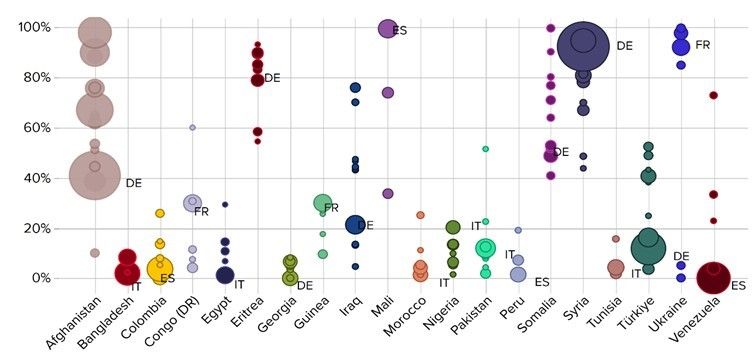
In 2024, the recognition rate remained stable at 42% (see Figure 15). However, this aggregate percentage masks variations across two dimensions. Among positive decisions, the share of decisions granting subsidiary protection has been increasing over the past 2 years. In addition, significant variations in positive decisions are noted across nationalities. Recognition rates at first instance were the highest for Palestinians (91%), Syrians (90%), Burkinabe (85%), Malians (84%), Eritreans (82%) and Ukrainians (80%).
Figure 15. Recognition rates at first instance by decision outcome, 2015-2024
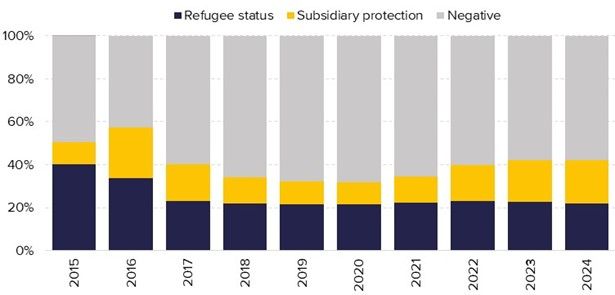
Compared to 2023, there was an increase in the share of applicants from various citizenships who were not likely to receive international protection. For over one-quarter of the citizenships which were issued the most decisions in 2024, the recognition rates were 5% or below. Their share accounted for one-fifth in 2023. When looking at the threshold of 20% or less recognition rate, three-fifths of citizenships accounted for this group, compared to just over one-half in 2023.
Figure 16 illustrates recognition rates across EU+ countries for various citizenships. In each column, individual circles of the same colour represent different issuing countries, with the size of each circle reflecting the number of decisions issued, and their placement on the vertical axis indicating the corresponding recognition rate - the percentage of decisions that granted refugee status or subsidiary protection.
Figure 16. Recognition rates for the main citizenships across EU+ countries, 2024
Besides the EU-regulated forms of international protection and temporary protection, EU+ countries may also grant a national form of protection. Among negative decisions, around 23% granted some form of national protection. As in the past, such national forms were mostly issued in Spain and Germany, followed by Italy. In recent years, there have seen several legislative and policy developments in this field, for example, allowing a stay based on humanitarian considerations or advanced integration of a person due to residing for an extended period in the country.341 In 2024, only a few clarifications were added to existing legislation and policies by national authorities342 or the courts.343 The CJEU held that Member States had no obligation to provide a right to stay on humanitarian grounds for people who cannot be returned.344
The political debate in many national contexts continued to focus on aspects related to the length of residence permits for beneficiaries of international protection, the perspectives for acquiring long-term residence or citizenship, and the grounds for the renewal or withdrawal of international protection. For example, the Citizenship Act was amended in Germany to facilitate naturalisation at the beginning of 2024, aiming to reward special integration efforts with earlier qualification for naturalisation. The amendments also allow the original citizenship to be retained upon naturalisation, which has been a long-debated issue in the country.345 However, in response to a terrorist attack in Solingen in August 2024, two draft laws were adopted by the federal government, including a new ground for revoking international protection, when a beneficiary of international protection travels to the country of origin and this travel is not deemed to be “morally essential” by the authorities.346
As another example, the Finnish government proposed to shorten the length of residence permits for beneficiaries of international protection to the minimum length allowed by the recast QD, instead of the previous long-term approach. Grounds for revoking or terminating international protection were also expanded, for example, to include circumstances when the person is a danger to national security or to the society or commits an aggravated offence.347
In 2024, national courts deliberated on the impact of providing false information or committing a crime and the possibility to revoke international protection.348 The CJEU held that a Member State may not extradite a person to a third country while this person has still international protection in another Member State.349
The conflict between national security considerations based on classified data and a person’s right to know the reasons for the revocation or cessation of the international protection status gave rise to several court cases in recent years.350 The Hungarian Helsinki Committee coordinated the drafting of comparative research on the application of European standards in 25 EU countries, noting that only six countries complied fully with these standards.351 The findings are particularly significant as the new QR makes it obligatory for national authorities to withdraw international protection when the person can be regarded as a danger to the Member State’s security.
The Greek Council of State delivered a ruling underlining that a travel document may only be refused for a refugee after the Asylum Service performs an individual assessment on the specific public order and national security reasons.352
While many beneficiaries of international protection from previous waves of arrivals began to qualify for long-term residence permits, courts were more often faced with unclarities around the starting date for counting the years to qualify for a new permit.353
Following trends from previous years, several EU+ countries aimed to tighten the rules for family reunification.354 Some exceptions included Belgium, where the parents of an accompanied minor with international protection now also have the right to reunite with their child and stateless persons are now entitled to the same rights as beneficiaries of international protection in terms of family reunification. Other amendments were triggered by recent CJEU judgments.355 The Swiss Federal Council launched the process to reduce the waiting period for family reunification for people with temporary admission, following a ECtHR judgment in 2021.356 The Danish Immigration Service drew the attention of the municipalities again to a change based on a court judgment from 2020, as it emerged that several municipalities were still not aware that a child’s maintenance obligation for parents over 60 years ceases when the parent is granted a permanent residence permit.357 UNHCR published its guidelines on international legal standards for family reunification, noting that this is often the only safe pathway to international protection.358
The CJEU ruled on unaccompanied children’s rights to family reunification, concluding that the beneficiary should be considered as a child, even when reaching majority during the family reunification procedure. In the specific case, one conclusion highlighted that the child must be reunited with the adult sister as well since the sister was fully dependent on the parents.359 The court received a new referral for a preliminary ruling, asking for clarifications on the counting of the 3-month period during which refugees may apply for family reunification under facilitated conditions.360
Once granted international protection, beneficiaries continued to face challenges in their successful integration. A main area of concern remained the transition from a reception facility to the mainstream housing market.361 As the joint inform by the European Migration Network (EMN) and the Organisation for Economic Co-operation and Development (OECD) observes, only 12 Member States cover the issue of housing as part of the civic orientation training curriculum.362 The topics of the training remain the norms, values and obligations in a country (including on gender equality and the prevention of violence) and labour market integration.363 Many of the integration initiatives for beneficiaries of international protection presented on the European Website on Integration (EWSI) for 2024 continued to focus on facilitating and speeding up their employment.364 Some of these programmes already start in reception and continue once protection has been granted (see Section 5). An EWSI analysis from 2024 highlighted good practices from Czechia, Denmark and the Netherlands on bridging courses which allow refugees to complement their qualifications acquired prior to arrival and supporting them in finding jobs which match their education and skills.
Municipalities are increasingly at the forefront of the implementation of national integration strategies. For example, communal pacts and a municipal commission are two of the pillars for the application of the new law on intercultural living in Luxembourg, which came into force in 2024.365 In Finland, municipalities have a leading role in the provision of integration services, following the reform of the Integration Act in January 2025.366
Services delivered by civil society organisations remain key, and they often fill gaps in support services. Input by civil society organisations to the EUAA’s Asylum Report 2025 showcases the wide range of services these organisations covered in 2024, while the EUAA’s Who is Who in International Protection in the EU+ presents an up-to-date overview of self-reported organisations directly delivering services within asylum and reception systems, whether on behalf of national authorities or independently.367
- 341
European Union Agency for Asylum. (June 2024). Asylum Report 2024.
- 342
Ministry of Labor and Social Policies | Ministero del Lavoro e delle Politiche Sociali. (2024, October 2). Flussi, sfruttamento e asilo: governo approva decreto legge [Flows, exploitation and asylum: government approves decree law]. Ministry of the Interior | Ministero dell‘Interno. (2024, May 29). Permesso di soggiorno per protezione speciale. Questione di diritto intertemporale inerente al regime applicabile in sede di conversione in permesso di lavoro a seguito del decreto Cutro [Residence Permit for Special Protection: Transitional Legal Issues Regarding the Applicable Regime for Conversion to a Work Permit Following the Cutro Decree]. Act No III of 2025 to amend the International Protection Act, Cap. 420, 18 February 2025.
- 343
For example: Germany, Federal Administrative Court [Bundesverwaltungsgericht], Applicants, 1 C 11.23, 26 September 2024. Link redirects to the English summary in the EUAA Case Law Database. Spain, Supreme Court [Tribunal Supremo], Applicant v Ministry of the Interior (Ministerio del Interior), No 3385/2024, ECLI:ES:TS:2024:3385, 17 June 2024. Link redirects to the English summary in the EUAA Case Law Database.
- 344
European Union, Court of Justice of the European Union [CJEU], LF v State Agency for Refugees (Държавна агенция за бежанците при Министерския съвет‚ SAR), C-352/23, ECLI:EU:C:2024:748, 12 September 2024. Link redirects to the English summary in the EUAA Case Law Database.
- 345
European Website on Integration. (2024, January 19). Bundestag beschließt Erleichterung der Einbürgerung [Bundestag decides to facilitate naturalisation].
- 346
Federal Ministry of the Interior and Community | Bundesministerium des Innern und für Heimat. (2024, August 29). Security package following terrorist attack in Solingen. Federal Government | Bundesregierung. (2024, October 31). The Federal Government presents a security package: Greater security for Germany.
- 347
Ministry of the Interior | Sisäministeriö. (2024, April 18). Government proposes more stringent provisions on international protection.
- 348
Norway, District Court [Noreg Domstolar], Applicant v Immigration Appeals Board (Utlendingsnemnda‚ UNE), TOSL-2024-50497, 23 August 2024. Link redirects to the English summary in the EUAA Case Law Database. Norway, District Court [Noreg Domstolar], Applicant v Immigration Appeals Board (Utlendingsnemnda‚ UNE), TOSL-2024-26977, 7 June 2024. Link redirects to the English summary in the EUAA Case Law Database. Germany, Regional Administrative Court [Verwaltungsgericht], Applicant v Federal Office for Migration and Refugees (Bundesamt für Migration und Flüchtlinge‚ BAMF), A 12 K 2656/23, ECLI:DE:VGKARLS:2024:0603.A12K2656.23.00, 03 June 2024. Link redirects to the English summary in the EUAA Case Law Database. Norway, Court of Appeal [Lagmannsrettane], Applicant v Immigration Appeals Board (Utlendingsnemnda‚ UNE), LB-2023-179207, 17 April 2024. Link redirects to the English summary in the EUAA Case Law Database.
- 349
European Union, Court of Justice of the European Union [CJEU], A. v Generalstaatsanwaltschaft Hamm, C-352/22, ECLI:EU:C:2024:521, 18 June 2024. Link redirects to the English summary in the EUAA Case Law Database.
- 350
European Union Agency for Asylum. (June 2024). Asylum Report 2024.
- 351
Hungarian Helsinki Committee | Magyar Helsinki Bizottság. (2024, April 16). The Right to Know in the European Union: Comparative Study on Access to Classified Data in National Security Related Immigration Cases.
- 352
Greece, Council of State [Συμβούλιο της Επικρατείας], Applicant v Greek Asylum Service (Υπηρεσία Ασύλου), No 1107/2024, 18 July 2024. Link redirects to the English summary in the EUAA Case Law Database.
- 353
Switzerland, Federal Court [Bundesgericht - Tribunal fédéral], Applicant v Service de la population et des migrants du canton de Fribourg, 2C_157/2023, 23 July 2024. Link redirects to the English summary in the EUAA Case Law Database. Netherlands, Council of State [Afdeling Bestuursrechtspraak van de Raad van State], Applicant v The Minister for Asylum and Migration (de Minister van Asiel en Migratie), 202301617/1/V2, ECLI:NL:RVS:2024:4518, 07 November 2024. Link redirects to the English summary in the EUAA Case Law Database. Finland, Supreme Administrative Court [Korkein hallinto-oikeus], Applicant v Finnish Immigration Service (Maahanmuuttovirasto‚ FIS), KHO:2024:87, ECLI:EN:KHO:2024:87, 11 June 2024. Link redirects to the English summary in the EUAA Case Law Database.
- 354
Federal Ministry for Immigration and Asylum | Bundesamt für Fremdenwesen und Asyl. (2024, September 4). Kampf gegen Asylmissbrauch zeigt Wirkung [Fight against asylum abuse is having an effect]. Finnish Immigration Service | Maahanmuuttovirasto. (2024, November 1). Income requirement for family members of a person who has been granted a residence permit in Finland. Government | Rijksoverheid. (2024, September 13). Regeerprogramma - Hoofdstuk 2. Grip op asiel en migratie [Governtment Programme - Chapter 2. Getting a grip on asylum and migration].
- 355
European Migration Network. (2024, September 1). Various changes to family reunification in Belgium come into force on 1 September 2024.
- 356
Federal Council | Der Bundesrat | Conseil fédéral | Consiglio federale. (2024, May 1). Regroupement familial: le Conseil fédéral propose de réduire le délai d’attente [Family reunification: Federal Council proposes to reduce waiting times].
- 357
Danish Immigration Service | Udlændingestyrelsen. (2024, June 24). Nyt fra Udlændingestyrelsen [News from the Immigration Service].
- 358
United Nations High Commissioner for Refugees. (December 2024). UNHCR Guidelines on international legal standards relating to family reunification for refugees and other beneficiaries of international protection.
- 359
European Union, Court of Justice of the European Union [CJEU], CR, GF, TY v Landeshauptmann von Wien, C-560/20, ECLI:EU:C:2024:96, 30 January 2024. Link redirects to the English summary in the EUAA Case Law Database.
- 360
Germany, Higher Administrative Court (Oberverwaltungsgericht/Verwaltungsgerichtshöf), YO, CT v Federal Republic of Germany, 14 May 2024. Link redirects to the English summary in the EUAA Case Law Database.
- 361
European Website on Integration. (2024, April 24). Migrants’ access to medium- and long-term housing in the EU: barriers, governance and good practices. Refugee Council of Lower Saxony | Flüchtlingsrat Niedersachsen e.V. (2024). Input to the Asylum Report 2025. Irish Refugee Council. (2024). Input to the Asylum Report 2025. Greek Council for Refugees | Ελληνικό Συμβούλιο για τους Πρόσφυγες. (2024). Input to the Asylum Report 2025. Nidos Foundation | Stichting Nidos. (2024). Input to the Asylum report 2025.
- 362
European Migration Network, & Organisation for Economic Co-Operation and Development (OECD). (October 2024). EMN inform: Implementation of measures for civic training as an important tool for integration of third-country nationals.
- 363
European Migration Network, & Organisation for Economic Co-Operation and Development (OECD). (October 2024). EMN inform: Implementation of measures for civic training as an important tool for integration of third-country nationals.
- 364
European Website on Integration. 2024 – Asylum – Labour.
- 365
Loi du 23 août 2023 relative au vivre ensemble interculturel et modifiant la loi modifiée du 8 mars 2017 sur la nationalité luxembourgeoise [Law of 23 August 2023 relating to intercultural living together and amending the amended law of 8 March 2017 on Luxembourg nationality], 23 August 2023; European Website on Integration. (2024, January 1). Luxembourg: Paradigmenwechsel in der Integrationspolitik [Luxembourg: Paradigm shift in integration policy].
- 366
European Website on Integration. (2024, February 23). Finland: Comprehensive reform of the Integration Act.
- 367
European Union Agency for Asylum. Who is Who in International Protection in the EU+: Civil Society Organisations.