

Box 6: Temporary protection for displaced persons from Ukraine

As Russia’s military aggression in Ukraine entered its third year, the Council of the European Union decided to prolong temporary protection for eligible beneficiaries until March 2026.368 Consequently, all EU+ countries extended the validity of residence permits for 1 more year.
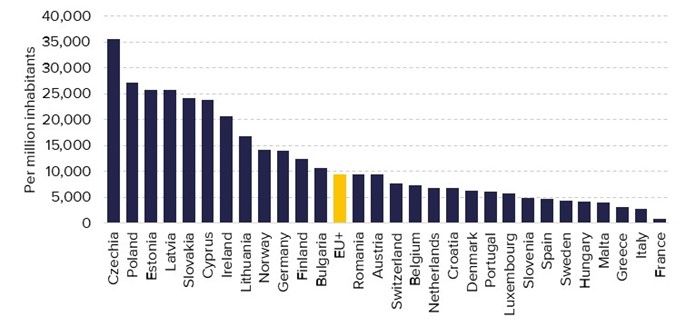
At the end of 2024, approximately 4.4 million individuals were under temporary protection across EU+ countries. This figure has remained relatively stable since early 2023 and continues to significantly contribute to the overall number of people in Europe with protection needs. Nearly one-half of all beneficiaries of temporary protection were in Germany (1.2 million) and Poland (just below 1 million). Relative to population size, Czechia hosted the highest number of beneficiaries per capita (see Figure 17).
Figure 17. Number of persons under temporary protection per 1 million inhabitants by receiving country, 2024
Countries focused more and more on the integration of displaced Ukrainians. For example, several EU+ countries (e.g. Austria,369 Bulgaria,370 Czechia,371 Estonia,372 Finland,373Germany,374 Spain375 and Sweden376) introduced initiatives to support access to the labour market, language acquisition, community activities and obtaining long-term residence permits. Finland377 and Sweden378 commissioned studies to assess future needs and intentions of displaced Ukrainians in order to inform policy changes. UNHCR continued with the implementation of its Regional Refugee Response Plan (RRP) in the Baltics, Poland, Czechia, Slovakia, Hungary, Romania, Bulgaria and Moldova.379 Projects and initiatives continued to support children specifically, while UNICEF highlighted that access to school remained a challenge and approximately one-half of Ukrainian children were not enrolled in national education in hosting countries (although enrolment rates varied greatly across countries and one-half is an estimated average of the situation in different states).380
Some countries tightened rules and procedures for eligible beneficiaries. Norway limited protection for individuals from Ukrainian regions deemed to be safe, such as Lviv and Zakarpattia, and reduced state-provided accommodation.381 The Netherlands introduced a cost-sharing system requiring beneficiaries to contribute to food and accommodation expenses.382
For potential returns to Ukraine, Czechia initiated a pilot programme which offers assistance to those who wish to voluntarily return home, for example for family or health reasons.383 Slovakia and Ukraine signed a readmission protocol for individuals no longer eligible for protection,384 while Italy faced criticism from UNHCR over a court decision allowing the repatriation of Ukrainian minors.385
Many countries began to encourage beneficiaries of temporary protection to leave reception and further integrate into society by acquiring their own housing. To address reception challenges, Spain adopted community sponsorship practices and decentralised reception to reduce urban strain and accelerate integration.386

Based on analysis of over 8,200 responses collected between February 2023 and December 2024 from displaced Ukrainians in EU+ countries, the EUAA’s Survey of Arriving Migrants for Displaced People from Ukraine showed that the intention to return to their country had significantly decreased for Ukrainians, from 52% wanting to return in 2023 to 31% in 2024. The main barrier to employment in the host country was no or low proficiency in the local language, followed at a distance by unrecognised qualifications and a lack of childcare.
Jurisprudence
In Joined Cases C-244/24 and C-290/24, the CJEU ruled that a Member State may withdraw temporary protection from certain categories of displaced persons without waiting for the temporary protection granted under EU law to end. The decision concerned third-country nationals who held temporary residence permits in Ukraine before February 2022 and to whom optional temporary protection was granted. However, according to the judgment, these individuals cannot be the subject of a return decision while the optional protection remains in force.
A judicial decision in Austria clarified the exclusion grounds in Article 28 of the Temporary Protection Directive and “overturned a return order, holding that despite the applicant's conviction for smuggling of persons, he did not pose a danger to national security, as in this specific case the court did not consider the crime to be a particularly serious crime”.


The Federal Administrative Court in Switzerland confirmed a negative decision on the request for temporary protection submitted by an Ukrainian national who had been previously granted protection in Poland.
A Regional Administrative Court in Germany ruled that a spouse of a Ukrainian national from a third country of origin is entitled to temporary protection without prior legal residence.
France's Council of State clarified the emergency condition which is required to suspend the execution of an administrative decision in a case involving a Ukrainian applicant whose request to renew his residence permit based on temporary protection was refused on the grounds that he was a threat to public order. The council recalled that the required emergency condition should, in principle, be regarded as met when the decision was one refusing to renew, revoke or withdraw a residence permit because its execution may harm, in a sufficiently serious and immediate manner, the public interest, the situation of the applicant or the interests of the person it intends to defend.
Sweden’s Migration Board faced criticism from the Parliamentary Ombudsman for the lack of a time limit to freeze the assessment of asylum applications for displaced persons from Ukraine and for the fact that the legal basis was not formulated clearly enough.387
- 368
Council of the European Union. (2024, June 25). Ukrainian refugees: Council extends temporary protection until March 2026.
- 369
City of Vienna | Stadt Wien. (2024, October 1). Application for a Red-White-Red Card plus for displaced persons from Ukraine.
- 370
State Agency for Refugees at the Council of Ministers | Държавната агенция за бежанците при Министерския съвет. (2024, October 14). Актуализиране на списъка с разрешение за пребиваване в Анекс 22 от наръчника за граничните служби [Update of the list of residence permits in Annex 22 of the Border Guard Manual].
- 371
Ministry of the Interior | Ministerstvo Vnitra. (2025, January 17). Zvláštní dlouhodobý pobyt [Special long-term stay]. Ministry of the Interior | Ministerstvo Vnitra. (2024, June 12). Vláda schválila Lex Ukrajina 7. Ekonomicky soběstační uprchlíci z Ukrajiny budou moci získat dlouhodobý pobyt [The government approved Lex Ukraine 7. Economically self-sufficient refugees from Ukraine will be able to obtain long-term residence].
- 372
United Nations High Commissioner for Refugees. (2024, August 23). Estonia 2024 Inter-Agency Mid-Year Report.
- 373
Ministry of Economic Affairs and Employment | Työ- ja elinkeinoministeriö. (2024, August 30). Toimenpideohjelma Ukrainasta paenneiden auttamiseksi on julkaistu nyt myös englanniksi [The action plan to help those who have fled Ukraine has now also been published in English].
- 374
Federal Ministry for the Interior and Community | Bundesministerium des Innern und für Heimat. (2025, January 16). Deutschland und Ukraine vereinbaren die Einrichtung eines „Unity Hubs“ in Berlin [Germany and Ukraine agree to establish a “Unity Hub” in Berlin].
- 375
Ministry of Inclusion, Social Security and Migration | Ministerio de Inclusión, Seguridad Social y Migraciones. (2024, March 26). El Gobierno aprueba el informe con el balance de gestión de la crisis migratoria tras dos años de guerra en Ucrania [The government approves the report assessing the management of the migration crisis after two years of war in Ukraine].
- 376
Swedish Migration Agency | Migrationsverket. (2024, November 1). Nya regler för folkbokföring för personer från Ukraina [New rules for population registration for people from Ukraine].
- 377
Finnish Immigration Service | Maahanmuuttovirasto. (2024, December 19). We will publish instructions concerning the extension of temporary protection early in 2025 – changes are being planned.
- 378
Swedish Migration Agency | Migrationsverket. (2024, April 24). New survey on how people from Ukraine see their future.
- 379
United Nations High Commissioner for Refugees (UNHCR). (2025, January 6). Regional Refugee Response for the Ukraine Situation 2025-2026.
- 380
United Nations Children’s Emergency Fund. (2025, February 20). One in five children in Ukraine has lost a relative or friend since the escalation of war three years ago.
- 381
Norwegian Directorate of Immigration | Utlendingsdirektoratet. (2025, February 14). Information for people fleeing the war in Ukraine. Government | Regjeringen. (2025, February 11). Displaced people from Ukraine may have their residence permit for Norway extended by a further year. Norwegian Organisation for Asylum Seekers | Norsk organisasjon for asylsøkere. (2024, July 16). Nå må alle som søker beskyttelse registrere søknaden på Nasjonalt ankomstsenter! [Now everyone seeking protection must register their application at the National Arrival Center!].
- 382
Immigration and Naturalisation Service | Immigratie- en Naturalisatiedienst. (2024, June 14). Different application process for Ukrainian refugees: collect residence sticker within 4 weeks.
- 383
Ministry of the Interior | Ministerstvo Vnitra. (2024, May 15). Ministerstvo vnitra spustí pilotní projekt dobrovolných návratů na Ukrajinu [The Ministry of the Interior will launch a pilot project of voluntary returns to Ukraine].
- 384
Ministry of the Interior | Ministerstvo vnútra. (2024, October 7). Ministri vnútra Slovenska a Ukrajiny podpísali vykonávací protokol o readmisii osôb [The Ministers of the Interior of Slovakia and Ukraine signed an implementing protocol on the readmission of persons].
- 385
United Nations High Commissioner for Refugees (UNHCR). Rimpatrio minori ucraini, UNHCR: preoccupazione per possibili rischi di protezione [Repatriation of Ukrainian children, UNHCR: concern about possible protection risks].
- 386
Ministry of Inclusion, Social Security and Migration | Ministerio de Inclusión, Seguridad Social y Migraciones. (2024, March 26). El Gobierno aprueba el informe con el balance de gestión de la crisis migratoria tras dos años de guerra en Ucrania [The government approves the report assessing the management of the migration crisis after two years of war in Ukraine].
- 387
Parliamentary Ombudsmen | Riksdagens Ombudsmän. (2024, December 10). Kritik mot Migrationsverket för utformningen av ett beslutsstopp för asylansökningar rörande medborgare i Ukraina och för att inte ha följt ett föreläggande från domstol om att snarast avgöra ett ärende [Criticism of the Migration Agency for the design of a decision-making freeze on asylum applications concerning citizens of Ukraine and for not having followed a court order to decide a case as soon as possible]. Swedish Refugee Law Center | Asylrättscentrum. (2024). Input to the Asylum Report 2025.