

After a decade of deepening political and economic instability, combined with pervasive corruption and an increasingly authoritarian government with controversial international alliances, conditions became highly favourable for the expansion of organised crime.526 As a result, Venezuela has evolved not only into a major transit route for global cocaine trafficking but also into a hub for a wide range of illicit activities,527 including extortion, kidnappings, illegal mining, and drug trafficking.528 Institutions do not apply the Law against Kidnapping and Extortion.529 According to the International Institute for Strategic Studies (IISS), the removal of Maduro would not undo Venezuela’s role as a major hub for transnational organised crime, since illicit economies are deeply embedded in state structures.530 Venezuela’s illicit economies accounted for more than 16 % of GDP in 2024.531
According to the Venezuelan Observatory of Violence (OVV, Observatorio Venezolano de Violencia), the principal driver behind the country’s decline in violence is not improved living conditions or effective public‑safety policy, but rather the collapse of criminal opportunities brought about by economic contraction and widespread poverty.532 As the economy has shrunk, viable activity has become concentrated in a handful of resilient sectors (e.g., technology, food production, and mining) and criminal groups have redirected their operations toward these same areas.533 The same source further indicated that emigration driven by poverty, stagnant wages, and deteriorating public services is reshaping crime dynamics in three significant ways.534 First, some criminals are migrating due to reduced opportunities at home or in search of higher rewards abroad; second, the mass departure of young people, historically the primary victims and perpetrators of violent and territorial crime, has altered the demographic landscape; third, a new youth cohort is emerging to fill the economic and criminal gaps left behind, with some being recruited by major criminal groups as enforcers, while others turn to petty theft, which has become more profitable under dollarisation.535 This shift has resulted in more injuries, even as lethal violence remains comparatively low.536
Extortion is widespread in Venezuela and is carried out by a range of actors, from state officials to criminal groups.537 Although the exact number of cases is unknown, there is a broad perception among the population that extortion is increasing.538 A report by Transparencia Venezuela identified several key sources of extortion, along with common types, methods, and targets:
State security forces – Types: protection fees, payments to avoid fabricated accusations or arbitrary detention; methods: checkpoints, identity checks, threats; targets: citizens, businesses, transport operators.
Armed groups – Types: territorial taxes, roadblocks, kidnapping for ransom; methods: patrols, checkpoints, forced contributions; targets: communities, traders, migrants.
Prison gangs – Types: payments for protection, control of goods and services inside and outside prisons; methods: inmate networks, intermediaries, coercion; targets: detainees, visitors, vendors.
Criminal organisations – Types: commercial taxes, transport levies, protection rackets; methods: collection points, threats, violence; targets: businesses, transport workers, informal sector.539
On 12 March 2026, the national association of farm producers reported a series of violent attacks against Venezuelan farmers to the Prosecutor’s Office, including the murder of a farmer in Guárico, the arson of agricultural machinery, and extortion by organised criminal groups, warning that these incidents are endangering national food security.540 In April 2026, the Scientific, Penal and Criminalistic Investigation Service Corps (CICPC, Cuerpo de Investigaciones Científicas, Penales y Criminalísticas) arrested a member of Los Negritos de San Vicente, a gang based in Aragua state accused of extorting dozens of local businesses.541 Sources indicated that as Venezuela’s economic crisis has reduced domestic criminal opportunities and purchasing power, Venezuelan gangs have increasingly expanded their extortion operations into other Latin American countries, including Argentina, Brazil, Peru, and Colombia.542 SWI swissinfo reported that the groups that remain in Venezuela continue to extort residents in the country’s poorest neighbourhoods 'without mercy', and that authorities seldom intervene, or, when they do, their actions typically have no meaningful consequences.543
Sources indicated that extortion by security forces typically involved detaining individuals on the street or at checkpoints and demanding payment in exchange for not fabricating a violation or infraction that would expose the victim to an uncertain and potentially prolonged process within the justice system.544 Briceño‑León explained that, when an individual refuses to pay an extortion fee to a state security official, false charges are typically filed against the victim and brought before a tribunal, where the person becomes vulnerable to further extortion by multiple actors, including judges, attorneys, and prosecutors. Faced with this prospect, victims often choose to reach an agreement with the security official to avoid escalation. The profiles most frequently targeted for extortion by state security forces are 'vulnerable' individuals, such as young people and older adults, whose relatives are perceived as able to pay amounts that may reach up to 4 000 USD.545 InSight Crime reported that amounts can reach up to 10 000, although through 'negotiations' they can be lowered to as low as 2 000 USD.546 Another common profile includes people in 'vulnerable' situations, such as parents detained at checkpoints while on their way to collect their children from school, who opt to pay immediately to avoid fabricated charges and ensure they arrive on time.547 Regarding extortion by criminal groups, sources indicated that if a payment is not made, criminals usually carry out retaliations, including the destruction of property, theft of merchandise, attacks,548 or kidnapping.549 Briceño-Leon and Amaya indicated that, based on their knowledge, people moving to another city to avoid extortion have not been targeted for that reason.550
Assistance to victims of extortion, particularly from state authorities and the justice system, is minimal.551 Amaya explained that assistance from authorities is unlikely because the criminal group carrying out the extortion has political influence or political affiliation with the local authority, and complaints against officials have rarely resulted in prosecutions.552 State efforts to combat extortion remain severely constrained due to pervasive corruption and the collusion of state actors at multiple levels of government with criminal organisations.553 InSight Crime indicated that '[s]ome of these local initiatives include programs to prevent young people from joining gangs, education campaigns, independent data collecting and reporting mechanisms, applications to identify phone numbers linked to extortion, and community building, among others'.554 The de facto dollarisation of the economy has further incentivised criminal groups to shift from robberies and theft to more lucrative forms of extortion.555 InSight Crime also reported that, in a context of high corruption and institutional fragility, some public servants engage in bribery and extortion to advance files within the public administration, practices that criminal groups then exploit by impersonating or supplanting officials to carry out extortion schemes.556
Reliable statistics on violent deaths in the country are difficult to obtain, as the government does not publish official data and several local NGOs that previously monitored violence have been shut down.557 OVV estimated that 6 884 violent deaths occurred in 2024; including 1 554 homicides, 767 police‑related violent deaths, and 4 563 deaths classified as 'under investigation', a category marked by limited institutional transparency.558 OVV calculated an overall rate of 26.2 violent deaths per 100 000 inhabitants for 2024.559 The five most violent federal entities in 2024 were Aragua (58.8 violent deaths per 100 000 inhabitants), Distrito Capital (48.2), La Guaira (34.7), Miranda (34.6), and Bolívar (34.2).560 Regionally, Venezuela was the second most violent country in Latin America in 2024, behind Ecuador (38.8) and over Colombia (25.4) and Honduras (25.3).561 For 2023, OVV reported 6 973 violent deaths, including 4 064 classified as 'deaths under investigation', 1 956 as 'homicides', and 953 as police‑related violent deaths.562 The violent death rate for 2023 was 26.8 deaths per 100 000 inhabitants.563
Criminal activity in the mining sector is extensive, particularly in the states of Bolívar and Amazonas, where a diverse range of criminal organisations operate amid weak regulation and collusion with state security forces.564 Armed actors present in these areas include Colombian groups such as the National Liberation Army (ELN, Ejército Nacional de Liberación)565 and Revolutionary Armed Forces of Colombia (FARC, Fuerzas Armadas Revolucionarias de Colombia) dissidents;566 colectivos;567 and pranes and sindicatos, which, according to International Crisis Group, are also collectively known as sistemas in mining areas in Bolívar.568 Illegal mining has resulted in mass displacement of Indigenous communities, severe environmental degradation, and, in the Guayana region, the emergence of a major malaria hotspot.569
Indigenous communities face discrimination, exploitation, and extortion by armed groups, alongside sex trafficking and land seizures linked to illegal mining, all of which have gravely damaged the natural resources on which they depend.570 Criminal groups controlling the mines impose arbitrary rules, and workers who disobey face harsh punishment; accidents are frequent, and child labour is widespread.571 These groups also extend their control beyond the mining sites, where sexual exploitation and human trafficking are common in surrounding settlements.572
Members of the armed forces have reportedly appropriated some mines for personal gain, charging workers 'taxes' to extract minerals or forcing them to sell at below‑market prices.573 State security forces also establish checkpoints to collect payments from miners and Colombian guerrilla groups, such as in Yapacana, Amazonas state.574 International Crisis Group reported that many miners and local residents view Venezuelan security forces as predatory.575 The same source also reported on allegations that SEBIN personnel have transported high‑ranking guerrilla members in official vehicles, and that ELN fighters pass through GNB checkpoints without interference.576 Additional allegations suggest that security forces provide Colombian armed groups with advance information on upcoming military operations.577
Informal mines are frequently taken over by military units for their own profit, often through violent operations.578 International Crisis Group indicated that in one instance, soldiers beat and detained displaced miners in harsh conditions; in another, during a 2023 operation, military‑grade weapons were used, turning mining pits into battle zones, causing fatalities, and forcing many wounded miners to flee to Puerto Inírida, Colombia.579
Drug trafficking remains highly prevalent in Venezuela, particularly along its borders with Colombia and Brazil and across the Atlantic coast.580 The vast Amazon region is difficult to police, and Brazilian authorities have criticised weak control over river routes and airspace in both Colombia and Venezuela.581 Small aircraft frequently depart from the Orinoco region and from illegal airstrips in Amazonas, while semi‑submersible vessels constructed in Guyana transport narcotics down the Orinoco River to larger ships operating in international waters.582
Insight Crime provides a map from May 2025 indicating the presence of criminal groups in the 'Mining Arch' and Essequibo:
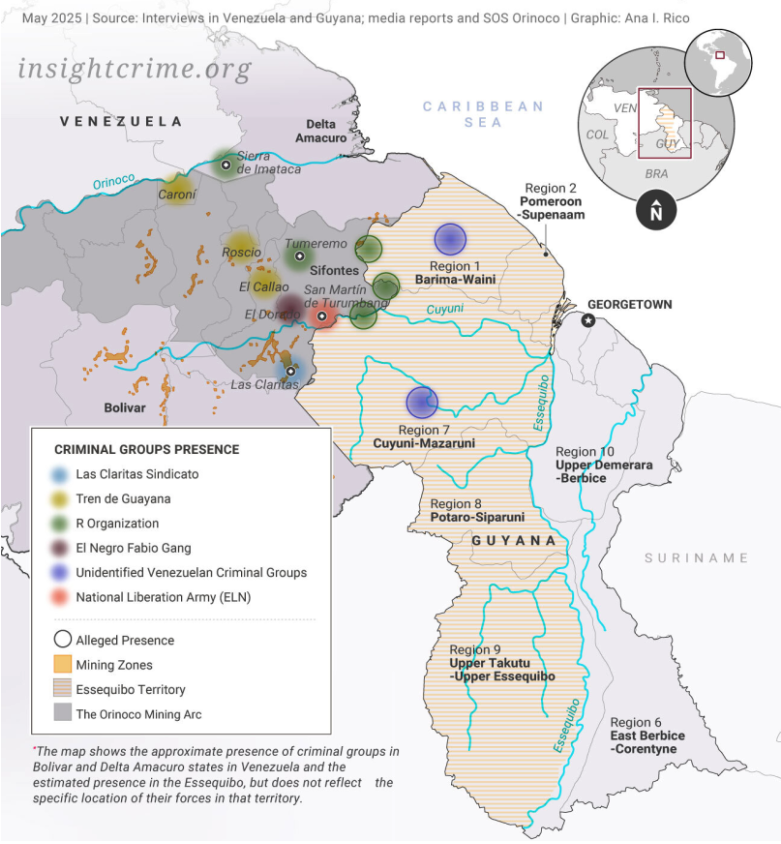
Map 1: Criminal presence in Venezuela's Mining Arch and Essequibo, May 2025.583
- 526
IISS, After the fall: what Maduro’s capture means for criminal geopolitics, 7 January 2026, url; InSight Crime, Venezuela profile, 9 January 2026, url
- 527
IISS, After the fall: what Maduro’s capture means for criminal geopolitics, 7 January 2026, url; InSight Crime, Venezuela profile, 9 January 2026, url
- 528
InSight Crime, InSight Crime’s 2025 Homicide Round-Up, 11 March 2026, url; Transparencia Venezuela, The faces of extortion in Venezuela 2024, March 2025, url, p. 3
- 529
Transparencia Venezuela, The faces of extortion in Venezuela 2024, 2025, url, p. 4
- 530
IISS, After the fall: what Maduro’s capture means for criminal geopolitics, 7 January 2026, url
- 531
IISS, After the fall: what Maduro’s capture means for criminal geopolitics, 7 January 2026, url
- 532
OVV, Annual report: Violence 2024, December 2024, p. 5
- 533
OVV, Annual report: Violence 2024, December 2024, p. 5
- 534
OVV, Annual report: Violence 2024, December 2024, p.
- 535
OVV, Annual report: Violence 2024, December 2024, p.
- 536
OVV, Annual report: Violence 2024, December 2024, p. 6
- 537
Transparencia Venezuela, The faces of extortion in Venezuela 2024, March 2025, url, p. 3; InSight Crime, Venezuela profile, 9 January 2026, url
- 538
Transparencia Venezuela, The faces of extortion in Venezuela 2024, March 2025, url, p. 17; SWI swissinfo.ch, Más extorsión y menos homicidios, la inseguridad se transforma en Venezuela, 11 July 2024, url
- 539
Transparencia Venezuela, The faces of extortion in Venezuela 2024, March 2025, url, pp. 6-7
- 540
Agencia EFE, Gremial denuncia en la Fiscalía violencia y extorsión contra agricultores en Venezuela, 12 March 2026, url
- 541
Primera Edición Col, Desmantelan parte de la banda “Los Negritos de San Vicente” en Aragua y recuperan más de 4 mil dólares, 13 April 2026, url
- 542
InSight Crime, Beyond Tren de Aragua: Venezuelan Gangs Spread Across Latin America, 25 August 2025, url; SWI swissinfo.ch, Más extorsión y menos homicidios, la inseguridad se transforma en Venezuela, 11 July 2024, url
- 543
SWI swissinfo.ch, Más extorsión y menos homicidios, la inseguridad se transforma en Venezuela, 11 July 2024, url
- 544
Amaya, telephone interview, 27 May 2026; Briceño-Leon, telephone interview, 28 May 2026
- 545
Briceño-Leon, telephone interview, 28 May 2026
- 546
InSight Crime, Security Forces in Venezuela Extort Detainees Amid Political Repression, 24 September 2024, url
- 547
Briceño-Leon, telephone interview, 28 May 2026
- 548
Amaya, telephone interview, 27 May 2026; Briceño-Leon, telephone interview, 28 May 2026
- 549
Briceño-Leon, telephone interview, 28 May 2026
- 550
Amaya, telephone interview, 27 May 2026; Briceño-Leon, telephone interview, 28 May 2026
- 551
Amaya, telephone interview, 27 May 2026; Briceño-Leon, telephone interview, 28 May 2026
- 552
Amaya, telephone interview, 27 May 2026
- 553
Transparencia Venezuela, The faces of extortion in Venezuela 2024, March 2025, url, pp. 14, 16; InSight Crime, Es tanta la corrupción en Venezuela, que hasta los criminales se hacen pasar por funcionarios, 19 September 2025, url
- 554
InSight Crime, Venezuela Security Policy: Combating Gang and Police-Driven Extortion, 18 October 2023, url
- 555
Transparencia Venezuela, The faces of extortion in Venezuela 2024, 2025, url, p. 13
- 556
InSight Crime, Es tanta la corrupción en Venezuela, que hasta los criminales se hacen pasar por funcionarios, 19 September 2025, url
- 557
InSight Crime, InSight Crime’s 2025 Homicide Round-Up, 11 March 2026, url
- 558
OVV, Annual report: Violence 2024, December 2024, pp. 2, 19
- 559
OVV, Annual report: Violence 2024, December 2024, pp. 2, 19
- 560
OVV, Annual report: Violence 2024, December 2024, p. 8
- 561
InSight Crime, InSight Crime’s 2024 Homicide Round-Up, 26 February 2025, url
- 562
OVV, Annual Report Violence 2023, 28 December 2023, url
- 563
OVV, Annual Report Violence 2023, 28 December 2023, url
- 564
Bertelsmann Stiftung, BTI 2026 Country Report — Venezuela, 2026, url, pp. 27-28; International Crisis Group, A Curse of Gold: Mining and Violence in Venezuela’s South, 29 July 2025, url, p. 2
- 565
Bertelsmann Stiftung, BTI 2026 Country Report — Venezuela, 2026, url, p. 28; Freedom House, Freedom in the World 2026, Venezuela, March 2026, url
- 566
International Crisis Group, A Curse of Gold: Mining and Violence in Venezuela’s South, 29 July 2025, url, p. 4
- 567
HRW, World Report 2026: Venezuela, 2026, url
- 568
International Crisis Group, A Curse of Gold: Mining and Violence in Venezuela’s South, 29 July 2025, url, p. 2
- 569
Bertelsmann Stiftung, BTI 2026 Country Report — Venezuela, 2026, url, p. 28. See also: HRW, World Report 2026: Venezuela, 2026, url
- 570
Bertelsmann Stiftung, BTI 2026 Country Report — Venezuela, 2026, url, p. 28. See also: HRW, World Report 2026: Venezuela, 2026, url
- 571
International Crisis Group, A Curse of Gold: Mining and Violence in Venezuela’s South, 29 July 2025, url, p. 2; Transparencia Venezuela, Explotación de oro en Venezuela 2024: Devastación, caos y corrupción, March 2025, url, p. 111
- 572
International Crisis Group, A Curse of Gold: Mining and Violence in Venezuela’s South, 29 July 2025, url, p. 2; Transparencia Venezuela, Explotación de oro en Venezuela 2024: Devastación, caos y corrupción, March 2025, url, p. 111
- 573
International Crisis Group, A Curse of Gold: Mining and Violence in Venezuela’s South, 29 July 2025, url, p. 2; Infobae, Denuncian que las fuerzas de seguridad del régimen de Maduro permiten la explotación de oro en zonas protegidas de Venezuela, 9 November 2025, url
- 574
International Crisis Group, A Curse of Gold: Mining and Violence in Venezuela’s South, 29 July 2025, url, p. 13; InSight Crime, Redes de contrabando abastecen la minería desenfrenada en Venezuela, 6 July 2023, url
- 575
International Crisis Group, A Curse of Gold: Mining and Violence in Venezuela’s South, 29 July 2025, url, p. 13
- 576
International Crisis Group, A Curse of Gold: Mining and Violence in Venezuela’s South, 29 July 2025, url, p. 13
- 577
International Crisis Group, A Curse of Gold: Mining and Violence in Venezuela’s South, 29 July 2025, url, p. 13
- 578
International Crisis Group, A Curse of Gold: Mining and Violence in Venezuela’s South, 29 July 2025, url, p. 16; Infobae, Denuncian que las fuerzas de seguridad del régimen de Maduro permiten la explotación de oro en zonas protegidas de Venezuela, 9 November 2025, url
- 579
International Crisis Group, A Curse of Gold: Mining and Violence in Venezuela’s South, 29 July 2025, url, p. 16
- 580
International Crisis Group, A Curse of Gold: Mining and Violence in Venezuela’s South, 29 July 2025, url, p. 12; USDOS, Country Reports on Human Rights Practices for 2023: Venezuela, 22 April 2024, url
- 581
International Crisis Group, A Curse of Gold: Mining and Violence in Venezuela’s South, 29 July 2025, url, p. 12
- 582
International Crisis Group, A Curse of Gold: Mining and Violence in Venezuela’s South, 29 July 2025, url, p. 12
- 583
InSight Crime, 5 Crime Groups You Need to Know to Understand Post-Maduro Venezuela, 8 January 2026, url