

2.1. Recent security trends
Following the Taliban takeover in 2021, levels of armed violence539 and civilian harm declined significantly compared to previous years of conflict.540 UN sources have described the subsequent period as marked by a ‘relative absence of armed conflict’541 and a ‘virtual halt of active conflict’.542 In 2022, UCDP assessed that the intensity of the conflict in Afghanistan no longer met its threshold to be classified as a ‘war’.543 Similarly, Bertelsmann Stiftung reported in 2024 that there was ‘no indication of systematic or scattered combat’.544
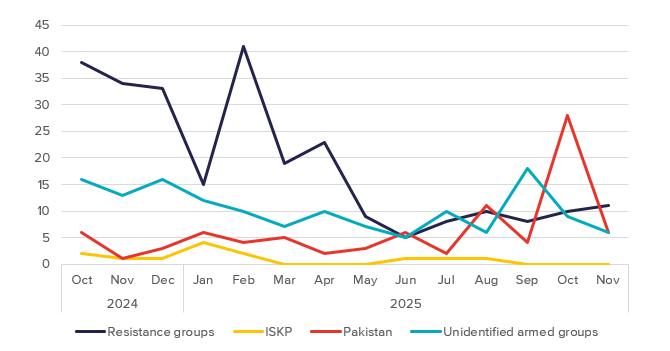
Nevertheless, the de facto government has faced armed opposition from resistance groups (see section 2.2.1) and the ISKP.545 While violence from such groups has generally decreased546 after peaking in 2022,547 resistance groups have continued to carry out low-intensity attacks,548 targeting mainly the de facto authorities.549 Until 2024, dozens of explosions and suicide attacks were reported annually,550 targeting the de facto authorities551 and civilians.552 Many attacks were claimed by the ISKP,553 while some remain unattributed.554
De facto security forces have also clashed with Pakistani border forces, causing casualties on both sides.555 Pakistan has faced recurring attacks that they attribute to Tehreek-e-Taliban (TTP, ‘the Pakistani Taliban’), and they accuse the Afghan de facto authorities of harbouring this organisation. In December 2024, tensions resurged as Pakistan carried out airstrikes in Paktika Province. While Pakistan claimed to target the TTP, the Afghan de facto authorities stated that nearly 50 civilians were killed in the attack.556 Following a TTP attack against the Pakistani military in a border area on 9 October 2025,557 Pakistan carried out an airstrike against Kabul City.558 In the following days the de facto security forces fired at Pakistani posts along the shared border, and Pakistan responded with mortar fire and drone strikes,559 including airstrikes against Kabul City,560 the border town of Spin Boldak in Kandahar Province,561 and in Paktika Province.562 On 19 October 2025, Pakistan and the Afghan de facto authorities agreed on a ceasefire,563 but negotiations ended without a long-term settlement,564 and sporadic cross-border incidents continued to be reported in November 2025.565
There are conflicting assessments of Al-Qaida’s presence in Afghanistan.566 The UN Sanctions and Monitoring Team noted reports of Al-Qaida maintaining presence, although it had limited resources and ‘drastically downsized’. It also noted reports of Al-Qaida training camps across the country, although ‘small and rudimentary’, as well as alleged links with the TTP.567 Some sources have questioned some of the reports noted by the UN Sanctions and Monitoring Team, in particular claims of Al-Qaida running overt training camps in Afghanistan.568
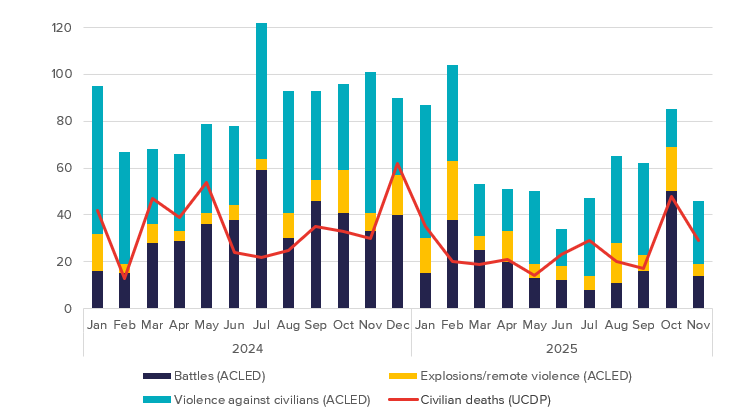
A comparison of ACLED data covering the same January–November period in 2024 and 2025 suggests a decrease in violence levels, from 958 events down to 684 events. The same trend could be noted as regards events codified as ‘battles’ (from 371 down to 222 events) and ‘violence against civilians’ (from 493 down to 337). In contrast, the number of events codified as ‘explosions/remote violence’ increased from 94 to 125 events, and was mainly driven by Pakistani airstrikes, but also increased activity of the Afghanistan Freedom Front (AFF) and the National Resistance Front (NRF).569 As regards violence against civilians, UCDP data covering 2025 (as of November), compared to data covering the same period in 2024 suggest a 33 % decrease in civilian deaths (down to 287 from 426 deaths).570 Rawadari also noted a decrease in civilian casualties from ‘explosive and suicide attacks’, with 11 civilian deaths and 35 injured recorded in the first six months of 2025, respectively constituting a 33.3 % and 50 % decrease from the same period in 2024 and 2023.571
Figure 1. Conflict data covering 1 October 2024–30 November 2025
| Source | Total no. events | Battles | Explosions and remote violence |
Violence against civilians | Civilian deaths |
|---|---|---|---|---|---|
| ACLED | 971 | 336 (35 %) | 168 (17 %) | 467 (48 %) | N/A |
| UCDP | 682 | N/A | N/A | N/A | 412 |
Source: EUAA table based on ACLED and UCDP data. ACLED, Curated Data Files, Afghanistan covering the period
1 October 2024–30 November 2025, as of 10 December 2025, url; UCDP, data covering the period 1 October 2024–30 November 2025, provided by courtesy of UCDP in an email, 8 December 2025.
It should be noted that within the reference period of this report (1 October 2024–30 November 2025) ACLED codified 467 events as ‘violence against civilians’. Event details suggest that at least 80 % of events involved de facto security forces as the perpetrating actor; this included arrests based on various motives, and the use of excessive violence in various situations, including in combatting crime but also situations where de facto officials exploited their position to exert violence. Moreover, about 104 cases were related to the enforcement of sharia, including floggings, and in addition, 92 events were related to arrests and killings of former government officials and their family members, although the motive was often unclear. A handful of cases concerned arrests of individuals suspected of being affiliated with opposition groups, and in one case the de facto security forces assaulted and beat up civilians in Nahreen District in Panjsher Province, following clashes with the NRF.572
Afghanistan is moreover highly contaminated with landmines and explosive remnants of war573 especially in the countryside.574 Children make up the majority of victims,575 and in the period 9 September 2024–5 September 2025, the UN recorded 49 civilian deaths due to unexploded ordinances (UXOs), and injuries to 29 boys, 8 girls, and 12 men, and 151 civilians, including 76 boys, 28 girls, 32 men, and 15 women.576
Figure 2. Events and civilian deaths by month, 1 January 2024–30 November 2025
Source: EUAA table based on ACLED and UCDP data. ACLED, Curated Data Files, Afghanistan covering the period 1 January 2024–30 November 2025, as of 10 December 2025, url; UCDP, data covering the period 1 January 2024–30 November 2025, provided by courtesy of UCDP in emails, 8 December 2025 and 3 October 2024.
Figure 3. Events by actor (as ‘actor 1’), 1 October 2024–30 November 2025
Source: EUAA table based on ACLED data. ACLED, Curated Data Files, Afghanistan covering the period
1 October 2024–30 November 2025, as of 10 December 2025, url
- 539
UN General Assembly and UN Security Council, The situation in Afghanistan and its implications for international peace and security, 28 January 2022, url, para. 3
- 540
UNAMA, Human Rights in Afghanistan 15 August 2021–15 June 2022, July 2022, url, p. 3
- 541
UN General Assembly and UN Security Council, The situation in Afghanistan and its implications for international peace and security, 20 June 2023, url, para. 1
- 542
UN OCHA, Afghanistan Humanitarian Needs and Response Plan 2025 (December 2024), 19 December 2024, url, p. 5
- 543
UCDP, Afghanistan, [2024], url
- 544
Bertelsmann Stiftung, BTI 2024 Country Report, Afghanistan, 19 March 2024, url, p. 5
- 545
International Crisis Group, Afghanistan’s Security Challenges under the Taliban, 12 August 2022, url, p. 11
- 546
ACLED, Curated Data Files, Afghanistan covering the period 1 October 2024–30 November 2025, as of 10 December 2025, url
- 547
ACLED, Curated Data Files, Afghanistan covering the period 1 October 2024–30 November 2025, as of 10 December 2025, url; BBC News, What happened to IS in 2023, 26 December 2023, url
- 548
UN General Assembly and UN Security Council, The situation in Afghanistan and its implications for international peace and security, 6 December 2024, url, para. 3
- 549
UNAMA, Update on the human rights situation in Afghanistan: October-December 2024, 27 January 2025, url, pp. 4–5; UNAMA, Update on the human rights situation in Afghanistan: January-March 2025, 1 May 2025, url, p. 4
- 550
BBC News, Suicide bomb kills Taliban minister in Kabul, 11 December 2024, url
- 551
New York Times (The), Suicide Bombing in Afghanistan Targets Taliban Heartland, 21 March 2024, url; Centre on Armed Groups, Drivers of ISKP Recruitment in Afghanistan, August 2024, url, p. 5; HRW, World Report 2025, Afghanistan, Events of 2024, 16 January 2025, url
- 552
AOAV, Explosive Violence Monitor 2024, 21 May 2025, url, pp. 31, 47; AOAV, Explosive Violence Monitor 2023, 19 April 2023, url, pp. 43–44, 48; HRW, World Report 2025, Afghanistan, Events of 2024, 16 January 2025, url
- 553
New York Times (The), Suicide Bombing in Afghanistan Targets Taliban Heartland, 21 March 2024, url ; BBC News, Suicide bomb kills Taliban minister in Kabul, 11 December 2024, url; AOAV, Explosive Violence Monitor 2024, 21 May 2025, url, pp. 43, 47; AOAV, Explosive Violence Monitor 2023, 19 April 2023, url, pp. 44, 48
- 554
Centre on Armed Groups, Drivers of ISKP Recruitment in Afghanistan, August 2024, url, p. 5; UNAMA, Update on the human rights situation in Afghanistan: October-December 2024, 27 January 2025, url, pp. 4–5; UNAMA, Update on the human rights situation in Afghanistan: April-June 2025, 24 July 2025, url, p. 6; UNAMA, Update on the human rights situation in Afghanistan: January-March 2025, 1 May 2025, url, p. 4
- 555
TOLOnews, Security Situation Considered at Three-Year Mark of Islamic Emirate Rule, 15 August 2024, url
- 556
Chatham House, What the West can do now in Taliban-ruled Afghanistan, 5 February 2025, url; Al Jazeera, As Pakistan, Afghanistan attack each other, what’s next for neighbours?, 30 December 2024, url
- 557
Times of India (The), Pakistan: Ambush by TTP near Afghanistan border claims lives of 11 soldiers, 9 October 2025, url
- 558
UN General Assembly and UN Security Council, The situation in Afghanistan and its implications for international peace and security, 3 December 2025, url, para. 20
- 559
BBC News, Taliban and Pakistan agree to ceasefire after days of deadly clashes, 19 October 2025, url
- 560
TOLOnews, Pakistan Airstrike Hits Kabul, Civilians and School Damaged, 16 October 2025, url
- 561
Reuters, Pakistan, Afghanistan agree to temporary truce after fresh fighting, airstrikes, 15 October 2025, url
- 562
UN General Assembly and UN Security Council, The situation in Afghanistan and its implications for international peace and security, 3 December 2025, url, para. 20
- 563
BBC News, Taliban and Pakistan agree to ceasefire after days of deadly clashes, 19 October 2025, url;
- 564
Al-Monitor, Explainer-Why are tensions flaring again between Afghanistan and Pakistan?, 25 November 2025, url
- 565
International Crisis Group, Crisis Watch, Latest Updates, Asia-Pacific, November 2025, url
- 566
CFR, The Taliban in Afghanistan, 14 August 2025, url
- 567
UN Security Council, Thirty-sixth report of the Analytical Support and Sanctions Monitoring Team submitted pursuant to resolution 2734 (2024) concerning ISIL (Da’esh), Al-Qaida and associated individuals and entities, 24 July 2025, url, paras. 85, 90–91
- 568
Obaidullah Baheer [X], posted on: 2 February 2024, url; Afghan analyst, online interview, 1 October 2024. The interview was carried out by the EUAA in cooperation with the Austrian, Norwegian, and Swedish COI units.
- 569
EUAA analysis based on ACLED data. ACLED, Curated Data Files, Afghanistan covering the period 1 October 2024–30 November 2025, as of 10 December 2025, url
- 570
EUAA analysis based on UCDP data. UCDP, data covering the period 1 October 2024–30 November 2025, provided by courtesy of UCDP in an email, 8 December 2025; UCDP, data covering the period 1 October 2023 - 30 September 2024, provided by courtesy of UCDP in an email, 3 October 2024
- 571
Rawadari, Afghanistan Mid-Year Human Rights Situation Report: January-June 30, 2025, August 2025, url, p. 12
- 572
EUAA analysis based on ACLED data. ACLED, Curated Data Files, Afghanistan covering the period 1 October 2024–30 November 2025, as of 10 December 2025, url
- 573
UN OCHA, Afghanistan: Unearthing hope from a legacy of mines, 3 April 2024, url
- 574
Britannica, Afghanistan, Political process, 4 December 2025, url
- 575
Rawadari, Afghanistan Mid-Year Human Rights Situation Report: January-June 30, 2025, August 2025, url, p. 14
- 576
UN General Assembly and UN Security Council, The situation in Afghanistan and its implications for international peace and security, 6 December 2024, url, para. 27; UN General Assembly and UN Security Council, The situation in Afghanistan and its implications for international peace and security, 21 February 2025, url, para. 34; UN General Assembly and UN Security Council, The situation in Afghanistan and its implications for international peace and security, 11 June 2025, url, para. 32; UN General Assembly and UN Security Council, The situation in Afghanistan and its implications for international peace and security, 5 September 2025, url, para. 26