

COMMON ANALYSIS
Last update: October 2025
The analysis below is based on following EUAA COI report and query
: Security 2025, 1.1.; COI Update 2025, 1, 2.; Country Guidance should not be referred to as a source of COI.Between April 2023 and July 2025, Somalia experienced a volatile and complex security environment marked by persistent conflict, political fragmentation, and humanitarian crises. Al-Shabaab remained the most significant threat, controlling large swathes of South-Central Somalia and maintaining strongholds in the north. The group intensified operations and reversed previous government gains, retaking towns in Hiraan, Middle Shabelle, and Lower Shabelle, while consolidating control over key routes. In Mogadishu, Al-Shabaab conducted high-profile attacks with mortars, IEDs, and suicide bombings targeting the airport, military facilities, and civilians, causing heavy casualties and instability.
The Federal Government of Somalia (FGS) faced internal divisions, with Puntland and Jubbaland suspending ties over political disputes. The emergence of the SSC-Khatumo administration in contested northern regions further complicated the federal landscape. The major conflict, which led to the official recognition of SSC-Khatumo as the sixth federal member state of Somalia with the name ‘Northeastern State’, continued throughout the reference period, causing casualties and fatalities from both sides, loss of civilian lives and resulting in the displacement of more than 200 000 people.
Military operations, such as Operation Black Lion, targeted Al-Shabaab, but the group demonstrated resilience, aided by forced recruitment and clan alliances.
Security incidents totalled more than 7 000, with over 18 000 fatalities. Clan conflicts also surged, particularly in Gedo, Bay, and Mudug, contributing to over 1 200 deaths between 1 April 2023 and 21 March 2025. ISS expanded its presence in Puntland, while inter-clan and political violence persisted across regions.
International actors, including the US, AU forces (AUSSOM), and regional militaries, remained engaged.
The analysis below is based on the following EUAA COI report and query
: Security 2025, 1.2.3.; COI Update 2025, 2.; Country Guidance should not be referred to as a source of COI.Somalia’s security landscape remains dominated by a complex array of armed actors, with Al-Shabaab continuing to pose the most significant threat. Al-Shabaab’s control is marked by the establishment of checkpoints, taxation systems, and parallel governance and justice structures.
Al-Shabaab’s tactics include a mix of guerrilla warfare, complex urban attacks, and targeted assassinations. The group frequently uses IEDs, suicide bombings, and mortar attacks, particularly in Mogadishu and other urban centres. In 2024–2025, it launched a major offensive, reversing many of the government’s earlier territorial gains. The group has demonstrated increasing operational sophistication, including the use of drones and coordinated assaults on military bases and strategic towns. It also engages in forced recruitment, including of children, and uses propaganda to mobilise support.
ISS has conducted IED attacks, assassinations, and drone strikes. A major offensive by Puntland forces in early 2025, supported by the U.S. and UAE airpower, disrupted ISS operations but did not eliminate the group.
The SNA, supported by elite units like Danab (U.S.-trained) and Gorgor (Turkish-trained), remains the core of the FGS military apparatus. However, the SNA suffers from fragmentation, clan-based recruitment, and limited operational capacity. FMS maintain their own forces, such as the Jubbaland Dervish and Puntland Security Forces, often operating independently or in competition with federal forces.
Clan militias, including the Macawisley, have played a growing role in anti-Al-Shabaab operations, particularly in Hirshabelle and Galmudug. These militias are often mobilised along clan lines and have been both a source of local security and inter-clan conflict. Over 100 clan militias were active during the reporting period, contributing to over 1 200 fatalities from inter- and intra-clan violence. In mid-June 2025, over 150 members of Macawisley, along with SNA fighters, defected to Al-Shabaab.
The AUSSOM continues to provide critical support, though its sustainability is challenged by funding issues. AFRICOM and other international actors (e.g., Kenya, Ethiopia, UAE) conduct airstrikes and provide training and logistical support.
The analysis below is based on the following EUAA COI report and query: Security 2025, 1.4.1.; COI Update 2025, 2.; Country Guidance should not be referred to as a source of COI.
Data concerning this indicator are primarily based on ACLED reporting from 1 April 2023 to 31 July 2025.
Relevant reporting from other sources, including the UNSG and INSO CHDC, is also noted.
It should be noted that different sources use different methodologies for the recording of incidents, therefore some discrepancies on data are to be expected. For more information on the methodologies of data collection, see the COI report Security 2025, Sources. Concerns with regard to underreporting, especially pertinent to the quantitative indicators, should be taken into account.
According to the ACLED dataset, between 1 April 2023 – 31 July 2025 there were 7 269 security incidents recorded in Somalia. Most security incidents were recorded in Lower Shabelle (1 655), Benadir/Mogadishu (955) and Bay (756) regions.
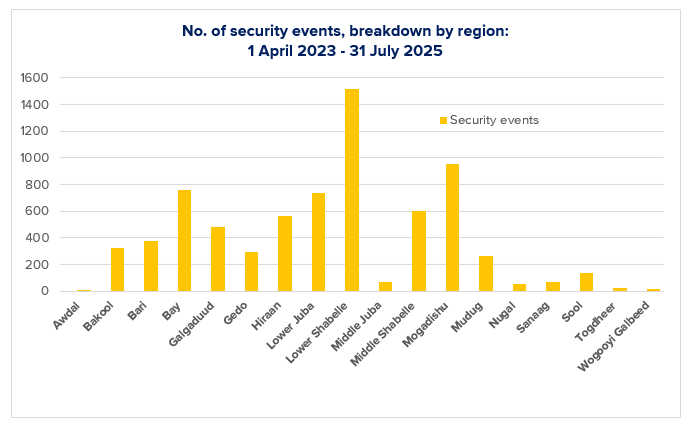
Source: EUAA elaboration based on ACLED data as of 31 July 2025.
The UNSG reports covering the period 8 February 2023 – 20 September 2024, recorded in total 3 145 security incidents. It should be noted that for the period 25 January 2024 – 23 May 2024, an unspecified number of incidents was recorded according to this source.
For the period April 2023 – March 2025, INSO CHDC data – the Conflict and Humanitarian Data Centre of the International NGO Safety Organisation, which adopts a methodology with a stronger focus on NGO security, recorded 6 861 security incidents in Somalia.
The analysis below is based on the following EUAA COI reports: Security 2025, 1.4.1.; COI Update 2025, 2.; Country Guidance should not be referred to as a source of COI.
Data concerning this indicator are primarily based on ACLED reporting from 1 April 2023 to 31 July 2025.
Note on ACLED methodology: Data primarily come from secondary sources such as media reports. All ACLED fatality figures provided here are estimates based on ACLED’s methodology. ACLED’s database does not distinguish between civilian and non-civilian fatalities and only provides figures of direct deaths or fatalities per event, not of injured persons and casualties; indirect deaths resulting from security events are also not taken into consideration. Concerns with regard to underreporting, especially pertinent to the quantitative indicators, should be taken into account.
Figure 3: Breakdown by region of number of casualties recorded by ACLED between 1 April 2023 and 31 July 2025.
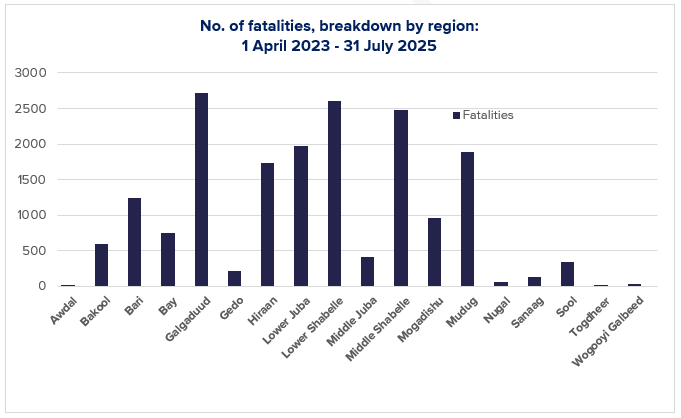
Source: EUAA elaboration based on ACLED data as of 31 July 2025.
According to ACLED, all types of events had or potentially had an impact on the civilian population; the total number of fatalities recorded in Somalia was 18 163 . Most fatalities were recorded in Galgaduud (2 719), Lower Shabelle (2 601) and Middle Shabelle (2 480).
Based on ACLED data, further calculations on fatalities per 100 000 inhabitants in each region for the period are also provided in the sub-section 4.3.3.b) Assessment of indiscriminate violence and of real risk per region.
The analysis below is based on the following EUAA COI report and query
: Security 2025, 1.4.2.; COI Update 2025, 2.; Country Guidance should not be referred to as a source of COI.Data concerning this indicator are primarily based on UNHCR PRMN data reporting from 1 April 2023 to 16 March 2025. For more information on the methodologies of data collection, see the COI report Security 2025, Sources.
Between April 2023 and July 2025, Somalia experienced significant conflict-related displacement, with approximately 711 355 people forced to flee due to insecurity and violence out of about 2 788 000 newly displaced (as of March 2025). This displacement was driven by escalating inter-clan conflicts, armed confrontations between federal and regional forces, and militant activity, particularly by Al-Shabaab. Many displaced individuals remained within their home regions, although thousands relocated to neighbouring areas. The majority settled in informal IDP sites in urban and peri-urban zones, often lacking tenure security and access to basic services As of June 2025, there were about 3.5 million IDPs in Somalia, who depended on humanitarian aid for survival,, with Mogadishu and Baidoa being the most densely populated. Displacement patterns were compounded by limited humanitarian access, infrastructure damage, and ongoing insecurity. The situation remains fluid, with displacement continuing into 2025, exacerbated by political fragmentation, armed group offensives, and climate-related shocks.
The analysis below is based on the following EUAA COI report:
Security 2025, 1.4.3.; Country Guidance should not be referred to as a source of COI.Infrastructure damage is widespread, and attacks both on schools and hospitals were recorded between 8 February 2023 to 20 September 2024. Humanitarian access was severely restricted, with aid workers facing threats, detentions, and killings, particularly in Gedo, Lower Juba, and Sanaag. The humanitarian crisis persisted, with 6 million people needing assistance in 2025, including 1.7 million children suffering from acute malnutrition. Access to water, healthcare, and shelter remained inadequate, especially in IDP settlements. Forced evictions affected over 192 000 people in 2024 alone (see also 4.2.4. Forced evictions).