

1. Country overview
1.1. Historical background and state structure
The current territorial configuration of the Nigerian state is the result of British colonial rule in the 19th century. The country gained independence in 1960 and experienced a civil war between 1967 and 1970, following the declaration of independence by the secessionist state of Biafra. The war officially ended on 15 January 1970 with Biafra’s surrender. In the years that followed, Nigeria underwent a series of military regimes and civilian administrations, before transitioning to a more stable democratic system with the 1999 presidential elections.6
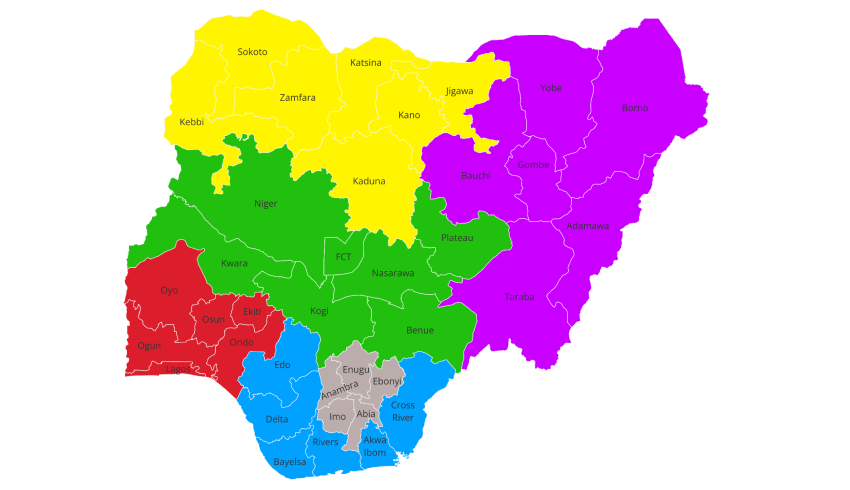
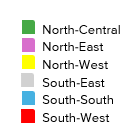
Map 2. EUAA visualisation based on publicly available information by Federal Government of Nigeria7 and publicly available data on administrative boundaries sourced from the Office for the Surveyor General of the Federation of Nigeria (OSGOF), Ehealth, United Nations Cartographic Section (UNCS) on UN OCHA and The Humanitarian Data Exchange (HDX).8 The visualisation has been generated using QGIS 3.44.9
Nigeria is a federal republic with three levels of government: federal, state, and local.10 It is administratively divided into 36 states and the Federal Capital Territory (FCT), Abuja. The 36 states and the FCT are grouped into six geopolitical regions:
-
North-Central (Benue, Kogi, Kwara, Nasarawa, Niger, Plateau and the FCT)
-
North-East (Adamawa, Bauchi, Borno, Gombe, Taraba, Yobe)
-
North-West (Kaduna, Kano, Katsina, Jigawa, Kebbi, Sokoto, Zamfara)
-
South-East (Abia, Anambra, Ebonyi, Enugu, Imo)
-
South-West (Lagos, Ekiti, Ogun, Ondo, Osun, Oyo)
-
South-South (Akwa Ibom, Bayelsa, Cross River, Delta, Edo, Rivers).11
The bicameral National Assembly in Nigeria is composed of the Senate, with 109 members, and the House of Representatives, with 360 members. All members are elected for four-year terms.12 The president is limited to two four-year terms and is elected through a qualified majority vote.13
Although the local government system is constitutionally recognised, it remains largely under the administrative and financial control of state governments.14 Each state has its own legislation. The basic functions of local government are outlined in the Constitution; however, states can expand these duties further through their own laws.15 Key challenges at local government level include limited autonomy, irregular revenue allocation, corruption, and political interference. These issues have undermined service delivery, slowed decision-making, deepened societal divisions, and contributed to public dissatisfaction.16 In July 2024, the Supreme Court affirmed the autonomy of Nigeria’s 774 local governments, confirming their right to manage budgets without state interference.17
- 6
BBC News, Nigeria Country Profile, 28 July 2023, url; LSE blog, Navigating Nigerian Politics: Democratisation and Development, 23 April 2024, url; BBC News, Remembering Nigeria's Biafra war that many prefer to forget
- 7
Nigeria, About Nigeria, States, n.d., url
- 8
OSGOF, UNCS, UN OCHA, HDX, n.d., latest modified 4 April 2023, url
- 9
QGIS 3.44, n.d., url
- 10
Ata-Agboni, J. U. et al., Federalism and Local Government System in Nigeria: A Critical Assessment, January 2023, url, p. 1
- 11
UNFCCC, Nigeria’s First Biennial Transparency Report under the United Nations Framework Convention on Climate Change (UNFCCC) 26 December 2024, url, p. 2; Nigeria, About Nigeria, States, n.d., url
- 12
Freedom House, Freedom in the World 2025 – Nigeria, 26 February 2025, url
- 13
World Bank, The World Bank in Nigeria, last updated 10 April 2025, url
- 14
Ata-Agboni, J. U. et al., Federalism and Local Government System in Nigeria: A Critical Assessment, January 2023, url , pp. 23-25
- 15
CLGF, Local Government System in Nigeria, 2019, url, p. 161
- 16
Ata-Agboni, J. U. et al., Federalism and Local Government System in Nigeria: A Critical Assessment, January 2023, url, pp. 23-25
- 17
Freedom House, Freedom in the World 2025 – Nigeria, 26 February 2025, url