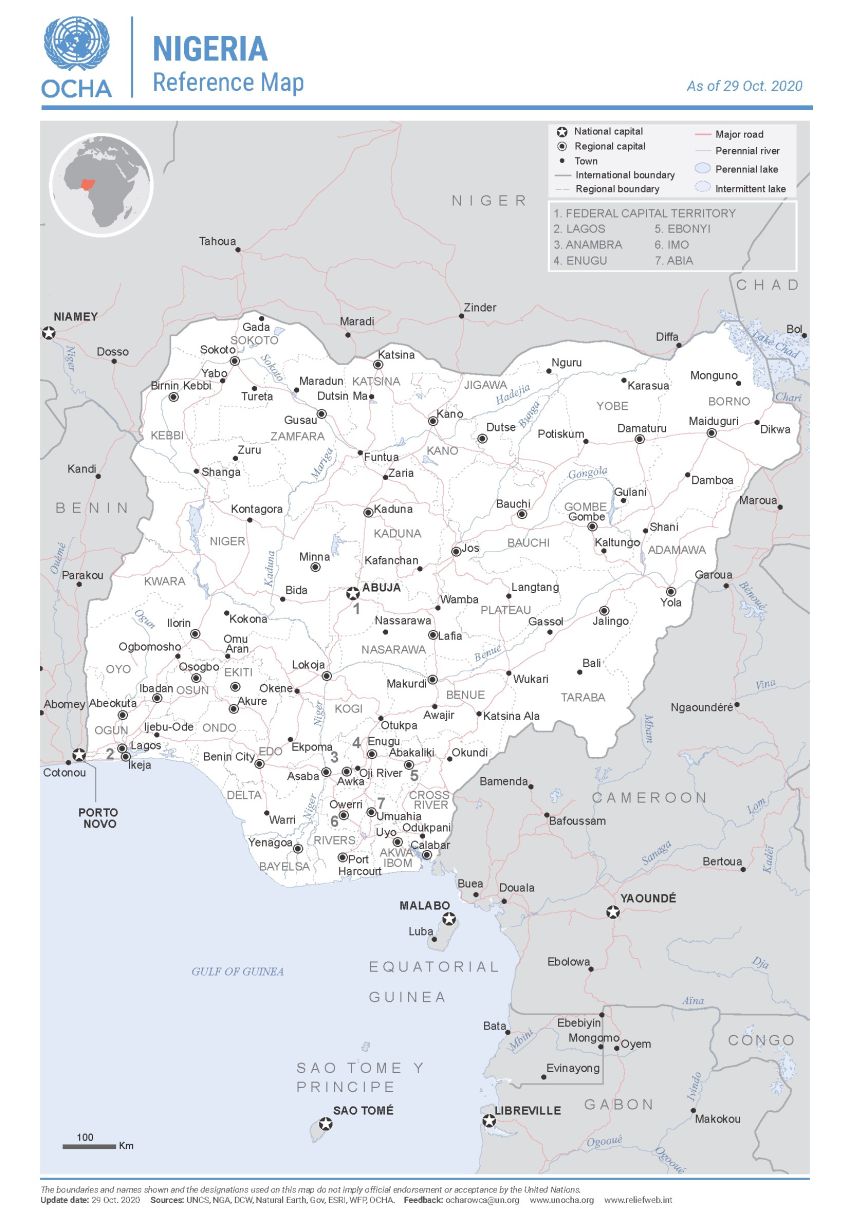
Home COI Report - Nigeria: Country Focus Map Table of contents Search within COI Report - Nigeria: Country Focus Search in this publication Search Table of Contents Acknowledgements Disclaimer Glossary and abbreviations Introduction Methodology Defining the terms of reference Collecting information Quality control Sources Structure and use of the report Terminology Map 1. Country overview 1.1. Historical background and state structure 1.2. Functioning of government and political situation 1.3. Demographics 2. Human rights and treatment of specific profiles 2.1. General situation 2.1.1. Blasphemy laws 2.1.2. Death penalty 2.1.3. Prison conditions and treatment of detainees 2.2. Victims of Trafficking in Human Beings (THB) 2.2.1. Legal framework and prevalence 2.2.2. Domestic and cross-border trafficking 2.2.3. Traffickers, recruitment and modus operandi 2.2.4. Women victims of trafficking 2.2.5. Children victims of trafficking 2.2.6. Men victims of trafficking 2.2.7. Return and long-term reintegration of victims of trafficking 2.2.8. Social attitude towards returnee victims of trafficking 2.2.9. Re-trafficking 2.2.10. State response in combating THB 2.3. Women and girls 2.3.1. Legal and social status 2.3.2. Situation of unmarried, widowed, divorced women and women without support network 2.3.3. Violence against women and girls 2.4. Children 2.4.1. Legal and social status 2.4.2. Access to education 2.4.3. Violence against children 2.5. LGBTIQ individuals 2.6. Journalists and media workers 2.7. Protesters 2.8. Human rights defenders and activists 2.9. Members and perceived supporters of political parties and separatist movements 2.9.1. Treatment by authorities of pro-Biafran separatists and perceived pro-Biafran supporters 2.9.2. Treatment by pro-Biafran armed groups of Igbos in the South-East perceived as non-supporting the cause 2.10. Individuals targeted by Boko Haram 2.11. Christians in areas where they are a minority 2.12. Muslims in areas where they are a minority 2.13. Perceived Boko Haram members or supporters 2.14. Individuals targeted by student cults 2.15. Individuals refusing chieftaincy titles 2.16. Individuals with disabilities, especially mental health illness 2.17. Individuals accused of witchcraft 2.18. State response towards human rights violations 2.18.1. Justice system 2.18.2. Overview of legal framework and mechanisms in place 2.18.3. Law enforcement 3. Key socio-economic indicators 3.1. Economic situation 3.1.1. Infrastructure 3.2. Employment 3.2.1. Informal employment 3.2.2. Unemployment 3.2.3. Employment for specific groups 3.2.4. Lagos and Abuja 3.3. Poverty 3.3.1. Children, women, IDPs 3.3.2. Lagos, Abuja and other regional differences 3.4. Food security 3.4.1. Refugees, asylum seekers, and IDPs 3.5. Housing and living conditions 3.5.1. Refugees, asylum seekers and IDPs 3.5.2. Lagos and Abuja 3.6. Education 3.6.1. Higher education 3.6.2. Refugees, asylum seekers and IDPs 3.6.3. Lagos and Abuja 3.7. Healthcare 3.7.1. Women 3.7.2. Refugees, asylum seekers and IDPs 3.7.3. Lagos and Abuja 3.8. Availability of state support mechanism for individuals without social network 3.8.1. Women and children 3.8.2. Refugees, asylum seekers and IDPs 3.9. Mobility and freedom of movement 3.9.1. International flights 3.9.2. Domestic flights Annex 1: Bibliography Oral sources, including anonymous sources Public sources Annex 2: Terms of Reference Country overview Human rights overview and treatment of specific profiles Key socio-economic indicators Citation Please cite as: EUAA, 'Map' in COI Report - Nigeria: Country Focus, January 2026. Copy Print Map Map 1. Nigeria UN OCHA5 5 UN OCHA, Nigeria: Reference Map, 29 October 2020, url Book traversal links for COI Report - Nigeria: Country Focus Previous Parent Next