

INTRODUCTION
Last updated: June 2025
The country guidance documents provide country-specific common analysis and guidance in relation to the assessment criteria established in the recast Qualification Directive (QD)1 and in the newly adopted Qualification Regulation (QR)2, which will repeal the QD with its entry into application on 1 July 2026. They are developed by the European Union Agency for Asylum (EUAA) together with a network of senior-level policy officials from EU+ countries and represent their joint assessment of the situation in main countries of origin, in accordance with current EU legislation and jurisprudence of the Court of Justice of the European Union (CJEU). The European Commission and the United Nations High Commissioner for Refugees (UNHCR) also provide valuable input in this process.
The aim of the country guidance documents is to assist decision-makers and policy-makers in their daily work and to foster convergence in the assessment of applications for international protection and the type of protection granted in the context of the Common European Asylum System.
The development, review and update of country guidance is regulated under Article 11 of the EUAA Regulation3.
In accordance with Article 11(3) EUAA Regulation, Member States have the obligation to take into account the common analysis and guidance notes when examining applications for international protection, without prejudice to their competence to decide on individual applications.
For more details on the process of producing country guidance documents and the exact role of stakeholders involved, see ‘Country Guidance: Methodology’ (November 2024).
This document encompasses the development, review and update of country guidance and regulates the work of the EUAA Country Guidance Network and all related processes.
This common analysis is based on country of origin information (COI) covering the period 15 April 2024 – 30 November 2024. Some additional information on major political, security, humanitarian and human rights developments covering the period 1 December 2024 – 21 March 2025 has also been reflected. Each section of the country guidance documents also clearly states the timing of its last update.
The analysis and guidance within this document should be considered valid as long as current events and developments in the country fall within the trends and patterns described within the COI on which the assessment at hand is based on.
The analysis and guidance provided within this document are not exhaustive.
Common analysis, guidance note and methodological approach
The country guidance document consists of two components: the guidance note and the common analysis. These two parts focus on the situation in the country of origin and provide analysis and guidance on the assessment of relevant international protection needs.
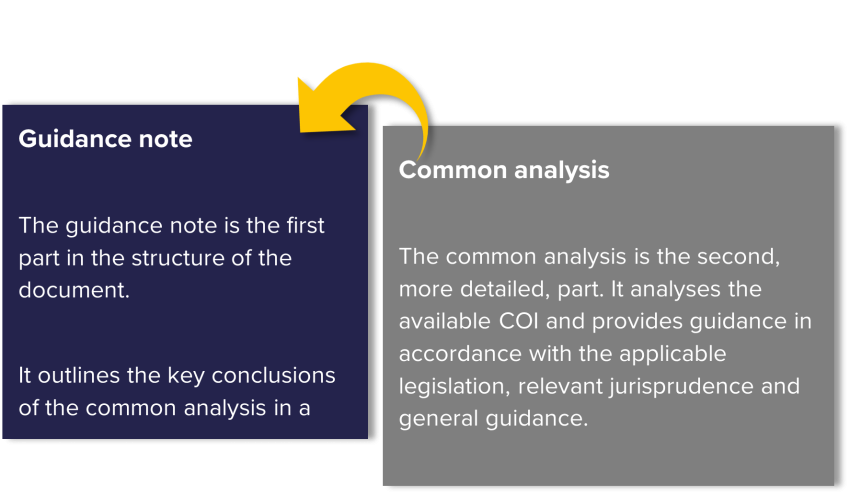
The Country Guidance documents should be read in conjunction with the separate document ‘Country Guidance: explained’ (February 2025).
This document outlines the general guidance relied upon in this analysis, as well as the methodological framework, approach and indicators used to assess the different elements of qualification for international protection.
Scope of this development
This development focuses on the international protection needs of the most encountered profiles of applicants for international protection in the caseload of EU+ countries. It covers the situation of Sudanese nationals belonging to main ethnic groups; individuals fearing forced recruitment by the Rapid Support Force (RSF); individuals perceived as political opponents such as members of the Resistance Committees (RCs) and Emergency Response Rooms (ERRs), political party members, community leaders, journalists and humanitarian and healthcare workers; women and girls; children; and persons with diverse Sexual Orientation, Gender Identity and Expression, and Sex Characteristics (SOGIESC). Additionally, this development covers the international protection needs of Sudanese applicants under the meaning of Article 15 QD/QR, as well as the potential availability of an Internal Protection Alternative (IPA). The main actors in Sudan are covered by the sections on actors of persecution or serious harm and actors of protection. Finally, general exclusion considerations to take into account when assessing international protection needs of Sudanese applicants are also dealt with in the present development. This development is mainly based on the following recent COI:
EUAA COI Query: Sudan - Major political, security, humanitarian and human rights developments (April 2025)
Annex: Country of origin information references provides further details and links to all COI documents used as a basis for the analysis within this document. References within this document are to the respective sections of these COI documents.
- 1
Directive 2011/95/EU of the European Parliament and of the Council of 13 December 2011 on standards for the qualification of third-country nationals or stateless persons as beneficiaries of international protection, for a uniform status for refugees or for persons eligible for subsidiary protection, and for the content of the protection granted (recast).
- 2
Regulation (EU) 2024/1347 of the European Parliament and of the Council of 14 May 2024 on standards for the qualification of third-country nationals or stateless persons as beneficiaries of international protection, for a uniform status for refugees or for persons eligible for subsidiary protection and for the content of the protection granted, amending Council Directive 2003/109/EC and repealing Directive 2011/95/EU of the European Parliament and of the Council.
- 3
Regulation (EU) 2021/2303 of the European Parliament and of the Council of 15 December 2021 on the European Union Agency for Asylum and repealing Regulation (EU) No 439/2010.