

COMMON ANALYSIS
Last update: June 2025
In armed conflicts, the targeting of civilians may have a nexus to one of the reasons for persecution according to the refugee definition. Therefore, refugee status may be granted. Such targeted violence, furthermore, would not be considered ‘indiscriminate’.
In Sudan, mass killings of civilians and other large-scale attacks may have a targeted nature due to the perceived ethnic and/or political affiliation of the individuals or community affected. In such cases a nexus to refugee status may be substantiated. See in particular 3.1. Ethnic groups, 3.2. Individuals fearing forced recruitment by the RSF and 3.8. Civilians from areas associated with the opposing warring party. In other circumstances, mass killings of civilians and other large-scale attacks are conducted in the context of the fighting for the territorial control in areas held by the opposing warring party. In such cases, the existence of a serious and individual threat to a civilian’s life or person by reason of indiscriminate violence in situations of international or internal armed conflict should be assessed.
a) Reference period
The following assessment is based on the EUAA COI reports, namely: Country Focus 2024 (April 2024), Country Focus 2025 (February 2025), and Security 2025 (February 2025) covering the reference period 15 April 2023 – 30 November 2024. Limited information has been added during the finalisation of the document until 21 March 2025 based on the COI Update 2025, concerning the reference period 1 December 2024 – 21 March 2025, unless differently specified. Background information prior to April 2023, particularly regarding the origins of the SAF-RSF conflict, previous security trends, and structural vulnerabilities, is also taken into account in order to provide a comprehensive analysis of the situation.
This guidance should be considered valid as long as current events and developments fall within the trends and patterns of violence observed within the reference period of the mentioned COI report. New events and developments that cause substantial changes, new trends or geographical shifts in the violence, may lead to a different assessment. The security situation in a given territory should always be assessed in light of the most up-to-date COI available.
b) Legal framework
All of the elements under Article 15(c) QD/QR (Figure 1) have to be fulfilled in order to grant subsidiary protection in accordance with this provision.
Figure 1. Article 15(c) QD/QR: Elements of the legal assessment.
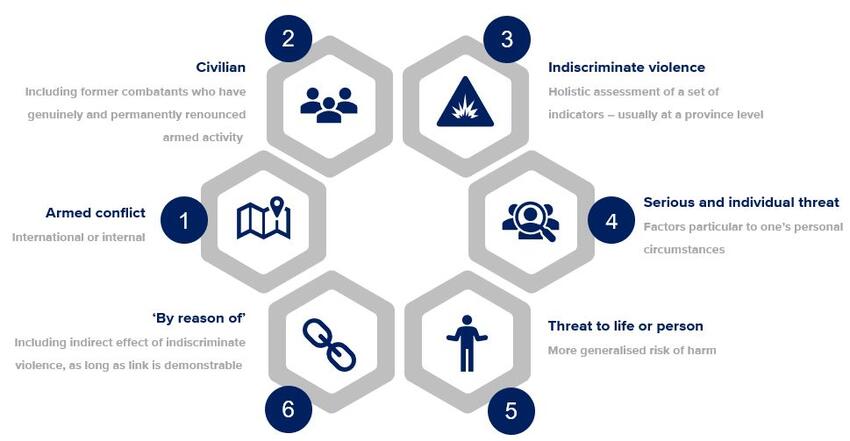
Source: ‘Country Guidance: explained’ (February 2025).
Common analysis of the factual preconditions and guidance for the possible application of Article 15(c) QD/QD with regard to the situation in Sudan are provided below.

For general guidance on the country guidance approach to the assessment of subsidiary protection needs under Article 15(c) QD/QR, see Country Guidance: explained.