

COMMON ANALYSIS | Last update: June 2026
The analysis below is based on the following EUAA COI report and query: COI Update 2026, 3.; Country Focus 2026, 1.1.1., 1.2.1., 2.1., 2.2.1., 2.2.2., 2.2.3.; Country Guidance should not be referred to as a source of COI.
This section should be read in conjunction with 1. Recent developments
UN sources have described the situation in the country following the Taliban’s power seizure in 2021 as marked by a ‘relative absence of armed conflict’. A comparison of ACLED data covering the same January-November period in 2024 and 2025 suggests a further decrease in violence levels. More specifically, violence related to insurgence groups, such as the NRF and the AFF, has generally decreased, after peaking in 2022. With regard to the ISKP, it is reported that its capabilities have weakened after operations of the de facto authorities against the group. The number of ISKP attacks decreased significantly since 2023.
Cross-border clashes, including airstrikes, with Pakistan have taken place along the shared eastern and southeastern border, and both sides have significantly increased troop presence along the border. In March 2026, the situation escalated significantly, as hostilities intensified and spread geographically. At least 10 provinces, including major urban centers, were affected by Pakistani attacks.
The analysis below is based on the following EUAA COI report and query: COI Update 2026, 3.; Country Focus 2026, 1.2., 2.1., 2.2.1., 2.2.2., 2.2.3., 2.3., 2.4.. Country Guidance should not be referred to as a source of COI.
For a general overview of the main actors of persecution or serious harm please refer to 2. Actors of persecution or serious harm.
Armed conflicts in Afghanistan involve a range of state and non-state actors employing distinct but sometimes overlapping tactics. The Taliban, as the de facto authorities, primarily rely on conventional security operations, such as checkpoints, intelligence-led arrests, targeted raids, and the use of specialised units. Their methods also include intimidation, detention, as well as restrictions on movement and communication in areas of interest. In the ongoing conflict, the Taliban have carried out retaliatory operations against Pakistani military positions, conducted airstrikes and engaged in armed clashes with Pakistani military forces.
Resistance groups in Afghanistan, primarily the AFF and the NRF, generally operate through asymmetric tactics, including hit-and-run attacks, ambushes, small-arms fire, improvised explosive devices (IEDs), and targeted assassinations, conducted both in urban and rural areas. Their attacks are directed against the de facto security forces; nevertheless, these groups have been involved also in events in which civilians were harmed. Their presence is typically fragmented and geographically limited, and they rely on local support networks rather than sustained territorial control.
The ISKP, in its sporadic attacks, has mainly targeted the de facto authorities, but also religious minorities, including the Hazara community. It employs high-impact asymmetric violence aimed at maximising casualties and publicity. Typical tactics include suicide bombings, targeted killings, and attacks against civilian gatherings, religious minorities, and symbolic or high-profile locations.
Pakistan’s involvement is primarily cross-border and state-based, centred on air and artillery capabilities rather than sustained ground presence inside Afghanistan. Reported tactics include airstrikes, drone strikes, mortar and artillery fire, and border-area shelling in response to security incidents or perceived militant threats. Armed confrontations, although usually concentrated near the eastern and southeastern border, have also affected targets further into Afghanistan. Amid heightened hostilities, in March 2026, Pakistan has launched multiple airstrikes across the country, including on Kabul City (for more information see 4.3.3. (b) Assessment of indiscriminate violence per province).
The analysis below is based on the following EUAA COI reports and query: COI Update 2026, 3., Annex 1.; Country Focus 2026, 2.1., 2.2.1., 2.2.2., 2.2.3., 2.3.; Country Focus 2024, 2.1.; Country Guidance should not be referred to as a source of COI.
Data concerning this indicator are based on ACLED reporting from 1 October 2024 to 20 March 202626. For more information on the methodologies of data collection see Afghanistan: Country Focus 2026, Sources.
According to ACLED data, in total 971 security incidents occurred across Afghanistan during the 14 months period 1 October 2024 – 30 November 2025 (compared to 799 incidents during the previous 12-months). Of these incidents, 336 were coded as battles, 168 as explosions/remote violence and 467 as instances of violence against civilians. In this last category, it is noted that at least 80 % of incidents involved de facto security forces as the perpetrating actor (e.g. arrests and use of excessive violence).
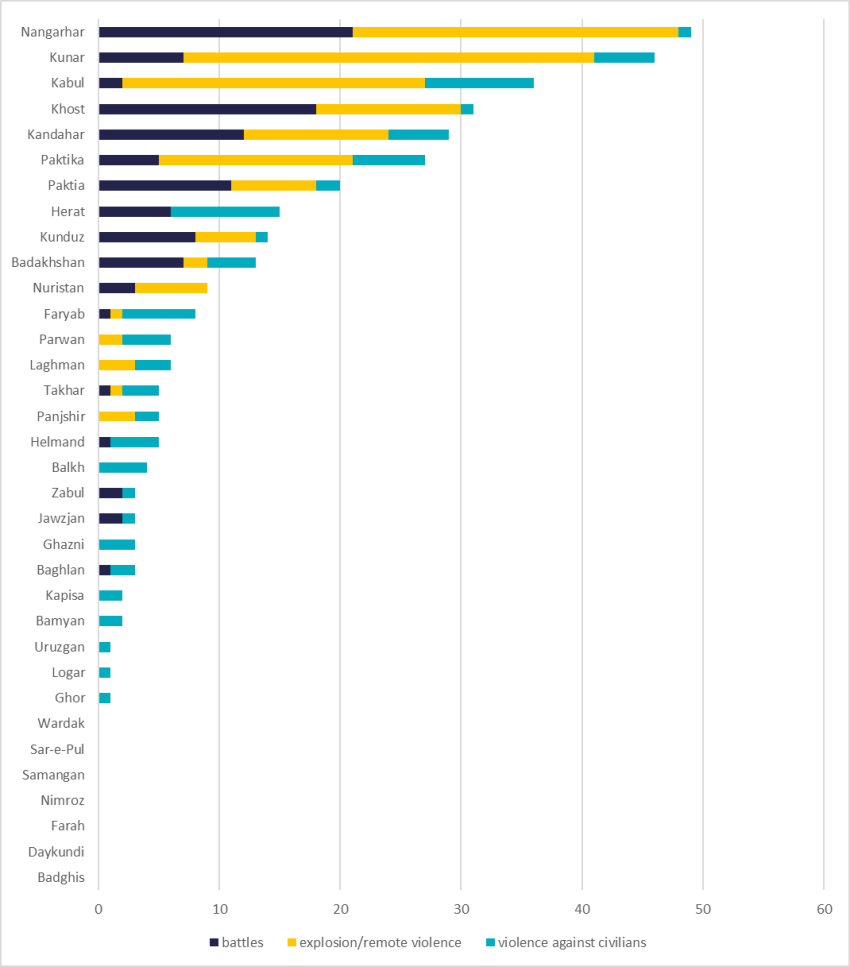
Additionally, according to ACLED, in total 347 security incidents occurred across Afghanistan during the period 1 December 2025 – 20 March 2026: 108 were coded as battles, 156 as explosions or remote violence, and 83 as instances of violence against civilians.
- 1 October 2024 – 30 November 2025:
The highest numbers of security incidents were recorded by ACLED in Kabul province (155), followed by Kunduz (71), Herat (69), Takhar (65), Nangarhar (63) and Badakhshan (54).
Armed resistance groups were featured as perpetrating actors in ‘battles’ and ‘explosions/remote violence’ across several provinces, including Kabul (61), Kunduz (59), Herat (33), and Takhar (25). Sources, including UNAMA, indicate that in a few incidents some civilians were injured and killed, while ACLED reports that resistance groups were only targeting the de facto security forces.
Within the same reference period, the ISKP was the apparent perpetrating actor in 13 events, most of which involved the provinces of Baghlan (3), Nangarhar (3), and Kabul (2).
Moreover, ACLED recorded 107 events involving Pakistani and Afghan de facto security forces - almost half of which took place in October 2025 - mainly along the eastern and southeastern border.
According to ACLED the de facto security forces were the main perpetrator of acts of ‘violence against civilians’. These incidents are not necessarily linked to an armed conflict.
- 1 December 2025 – 20 March 2026:
By contrast, in the most recent reference period, the majority of the security incidents, according to ACLED, were recorded in provinces bordering Pakistan along the Durand line, as well as in Kabul. Event details suggest that the Pakistani and Afghan de facto military forces were behind the majority of recorded events (105 out of 115), and in 94 events civilians were being targeted.
Perpetrating actors included also unidentified armed groups (30 events), as well as the AFF (15), and the NRF (13). The above-mentioned actors were responsible for events categorised as ‘battles’ and ‘explosion/remote violence’ in various provinces, including Kunduz (13), Kabul (6), Herat (5), Nangarhar (2), Badakhshan (2), and Takhar (2). They were also involved in acts of ‘violence against civilians’, particularly in Kabul (4), Badakhshan (3), and Kandahar (3).
Within the same reference period, six or seven civilian deaths were attributed to an attack involving the ISKP. This entailed an explosion at a restaurant in Kabul City on 19 January 2026.
Figure 2: Breakdown by province of number of security events recorded by ACLED, between 1 October 2024 – 30 November 2025
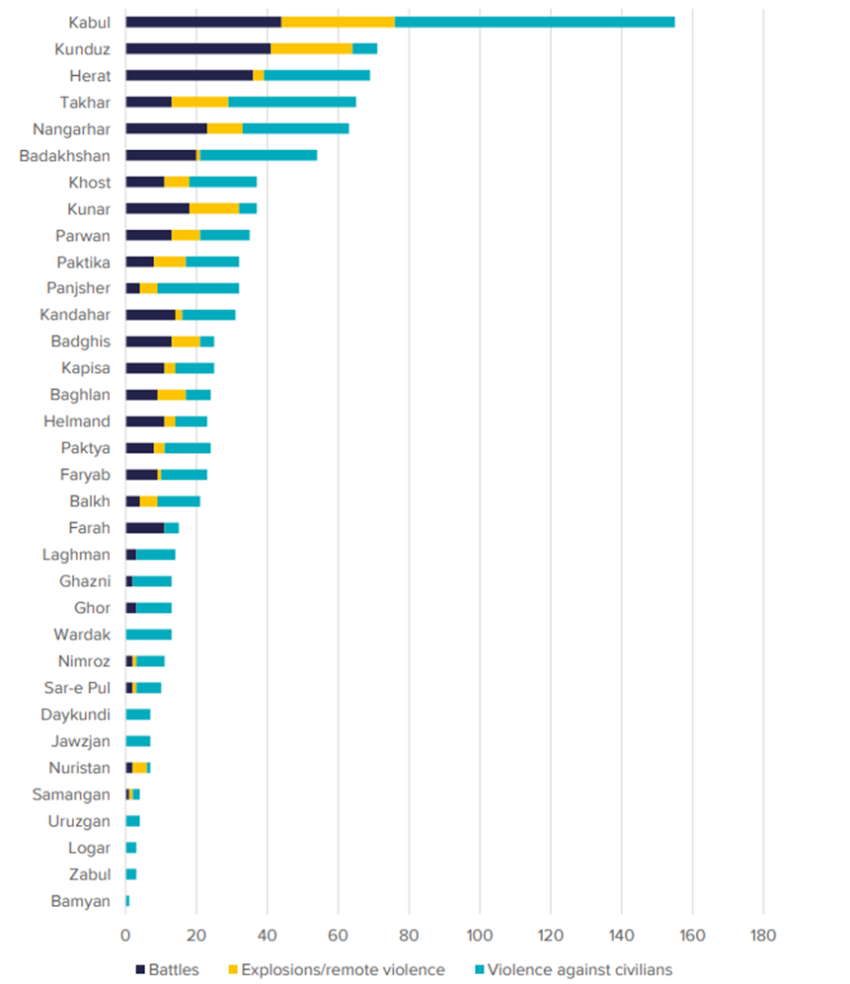
Figure 3: Breakdown by province of number of security events recorded by ACLED, between 1 December 2025 – 20 March 2026
The analysis below is based on the following EUAA COI report: COI Update 2026, 3., Annex 1.; Country Focus 2026, 2.1., 2.2.1., 2.2.2., 2.2.3., 2.3.; Country Guidance should not be referred to as a source of COI.
Data concerning this indicator are primarily based on UCDP (data collection project for civil war) reporting from 1 October 2024 to 20 March 2026.
UCDP provides an estimate of the number of civilian deaths. According to UCDP, ‘it is quite likely that there are more fatalities than given in the best estimate, but it is very unlikely that there are fewer’. For more information on the methodologies of data collection see Country Focus 2026, Sources.
Amid the ongoing conflict with Pakistan, and regarding the data for the period 1 December 2025 to 20 March 2026, as referenced in the COI Update 2026, caution should be given to the fact that the data is preliminary and that the records of civilian deaths recorded during this period might increase.
During the period 1 October 2024 – 30 November 2025, UCDP recorded in total 412 civilian deaths (including 13 which could not be attributed to a specific province), caused by security incidents across Afghanistan. The highest numbers were recorded in Paktika (67), Kandahar (48), Badakhshan (37) and Kabul (26).
As regards violence against civilians, UCDP data covering 2025 (as of November), compared to data covering the same period in 2024 suggest a 33 % decrease in civilian deaths (down to 287 from 426 deaths).
Another source similarly noted a decline in civilian casualties from ‘explosive and suicide attacks’, with 11 civilian deaths and 35 injured recorded in the first six months of 2025, constituting respectively a 33.3 % and 50 % decrease from the same period in 2024 and 2023.
During the period 1 October 2024 - 30 November 2025, UCPD documented 37 civilian deaths caused by events involving Pakistan, 32 of which were recorded in Kandahar province. UN sources further noted 503 civilian casualties, with 50 killed and 453 injured due to air strikes and cross-border shelling.
Moreover, UCDP attributed 20 civilian deaths to events involving the ISKP, and five civilian deaths to events involving the de facto government and resistance groups.
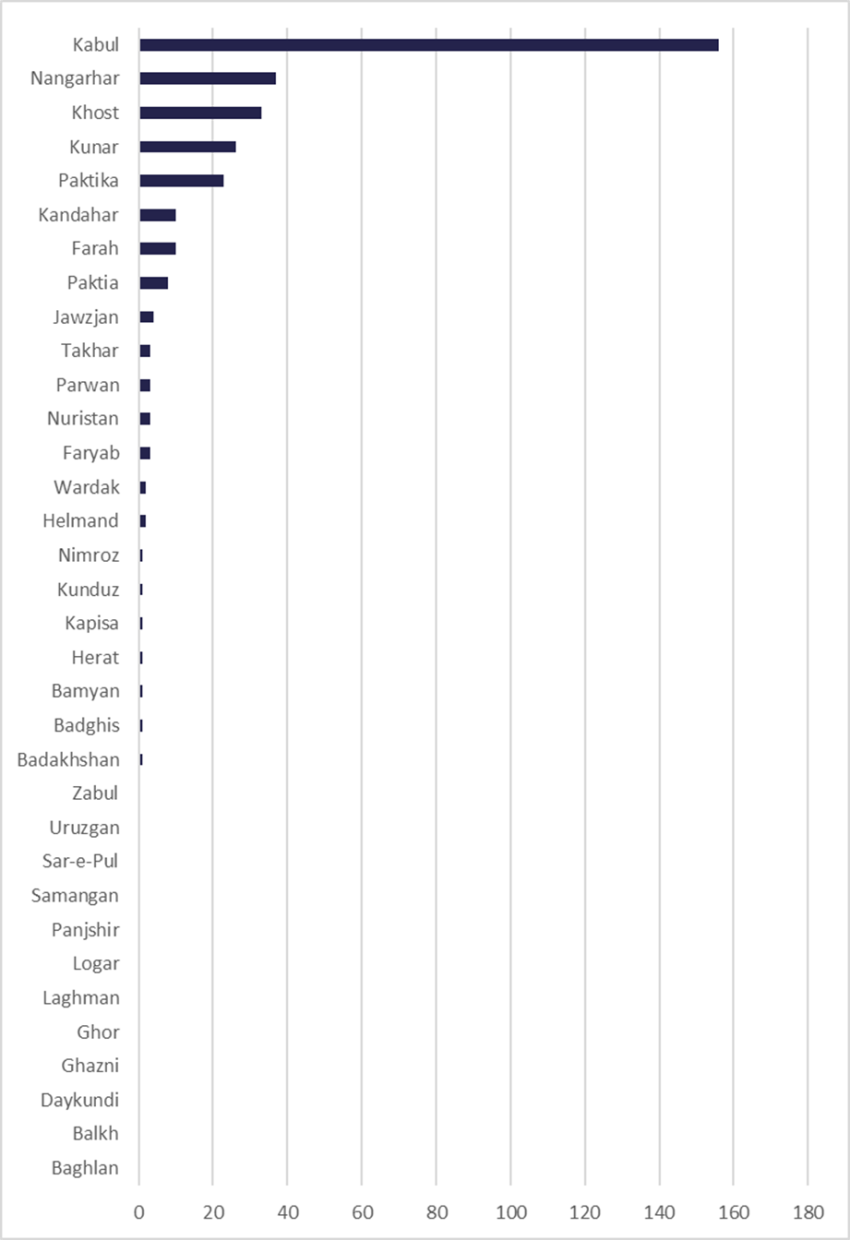
In comparison, during the period 1 December 2025 to 20 March 2026, UCDP recorded in total 360 civilian deaths, mainly as a result of the renewed conflict with Pakistan which included, inter alia, some high-casualty attacks such as the attack in Kabul City’s drug rehabilitation center on 16 March 2026. Additionally, 33 civilian deaths were caused by events involving resistance groups and unidentified armed groups. Six civilian deaths were attributed to an attack involving the ISKP.
Figure 4: Breakdown by province of number of civilian deaths recorded by UCDP, between 1 October 2024–30 November 2025
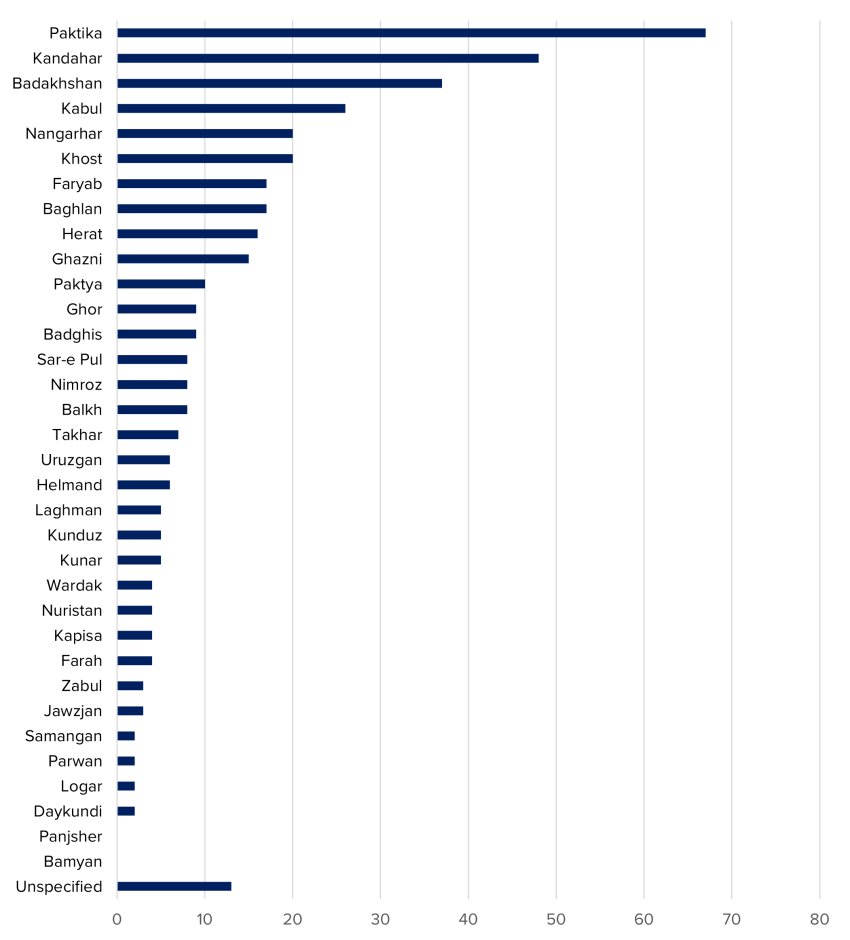
Figure 5: Breakdown by province of number of civilian deaths recorded by UCDP, between 1 December 2025 - 20 March 2026
The analysis below is based on the following EUAA COI report: COI Update 2026, 3.; Country Focus 2026, 2.2.3., 2.3., 2.3.1.; Country Guidance should not be referred to as a source of COI.
The conflict between the Taliban and the former government has caused large displacements. Following the Taliban takeover, many of the internally displaced persons had returned to their place of origin, although an estimated 4.2 million people were still living in internal displacement in 2024. According to IDMC (Internal Displacement Monitoring Centre), conflict-induced displacement almost entirely stopped. Although most displacement taking place after 2021 has been induced by climate change and natural disasters, 3 200 displacement movements were recorded in 2024 due to violence along the border with Pakistan, mainly in Khost province. In 2025, UNOCHA recorded 7 467 conflict-induced displacements in the provinces of Nangarhar and Kunar. It was also stated that 20 000 families have been displaced from Spin Boldak (Kandahar) following Pakistani airstrikes in October 2025.
Amid hostilities between Pakistan and the Afghan de facto authorities, in the period 26 February–3 March 2026, UN OCHA recorded families being displaced in the following provinces: Paktia (7 000), Kunar (3 000), Khost (2 500), Nangarhar (2 500), Paktika (470), and Nuristan (400). Approximately 163 590 people lived in displacement in the provinces of Paktia, Kunar, Khost, Nangarhar, Paktika, and Nuristan, including 7 000 families that were displaced after the earthquake in Kunar in late August 2025. According to IOM, nearly 66 000 people were displaced in eastern and southeastern Afghanistan due to the conflict with Pakistan. In the following weeks, UN OCHA further noted that displacement continued, as reports indicated that 115 000 people had been displaced.
The analysis below is based on the following EUAA COI report: COI Update 2026, 3., 4.; Country Focus 2026, 2.1., 3.1.; Country Guidance should not be referred to as a source of COI.
Years of conflict have resulted in significant damage to infrastructure. Despite reconstruction efforts, the need for humanitarian assistance persists in Afghanistan, particularly for those returning to their home villages.
Afghanistan is highly contaminated with landmines and explosive remnants of war, especially in the countryside. Children account for the majority of victims. In the year preceding 5 September 2025, the UN recorded 49 civilian deaths due to unexploded ordnances.
The ongoing conflict with Pakistan has further damaged civilian infrastructure, including health facilities, humanitarian sites, an IOM transit centre, a telecommunications tower, border crossings and shops in their proximity. The closing of the border between Afghanistan and Pakistan in October 2025 has halted trade exchanges and prevented many Afghans from buying ‘basic medicine’, as over 70 % of medicines used in Afghanistan was imported from Pakistan.
Furthermore, movement restrictions and the ongoing conflict with Pakistan have suspended humanitarian operations providing food assistance in Helmand, Kandahar, Khost, Kunar, Laghman, Nangarhar, Nuristan, Paktika, Paktia and Zabul. Analogously, education as well as health and nutrition services have been disrupted or suspended.
- 26
Country Focus 2026 provides data for the reference period 1 October 2024 to 30 November 2025.
COI Update 2026 provides data for the reference period 1 December 2025 to 20 March 2026, as well as data on events codified as ‘violence against civilians’ in the provinces of Kabul, Badakhshan, Baghlan, Kunduz, and Takhar within the longer reference period 1 October 2025 to 20 March 2026.