

COMMON ANALYSIS | Last update: June 2026
The current version of the document supersedes the one issued in May 2024.
The guidance note on Afghanistan is produced by the EUAA together with EU+ countries4 in accordance with Article 11 of the EUAA Regulation5. It is based on and summarises the conclusions of the comprehensive common analysis. The aim of the guidance note and the common analysis is to assist EU+ countries in the examination of applications for international protection, thereby fostering convergence of asylum practices and decisions across the EU.
The guidance note is part of the ‘Country Guidance: Afghanistan’ and should be read in conjunction with the Common analysis.
The Taliban de facto government, which is currently the sole entity exercising effective control over all parts of Afghanistan, remains the main actor of persecution and serious harm in the country. In addition, several non-State actors continue to be active. Notably, these include the Islamic State Khorasan Province (ISKP) and other armed groups, such as the National Resistance Front (NRF) and the Afghanistan Freedom Front (AFF). Clans, tribes, (locally) powerful individuals, family members, and criminal groups may also be relevant non-State actors of persecution or serious harm in the context of Afghanistan. Finally, in light of the civilian casualties caused by the Pakistani security forces in the context of the ongoing clashes with Afghanistan, Pakistan is also included among the actors of serious harm (see 2. Actors of persecution or serious harm).
In light of the current situation, for Afghan women and girls a well-founded fear of persecution would in general be substantiated. This is without prejudice to granting refugee status to female applicants also on account of additional circumstances which may substantiate further grounds for persecution.
Among the most commonly encountered profiles of applicants for international protection, the following would have a well-founded fear of persecution in general and would highly likely qualify for refugee status:
-
Judges, prosecutors, and court personnel of the former government
-
Critics of the Taliban including protesters, activists, human rights defenders, and human rights lawyers publicly advocating for human rights
-
Journalists and other media workers perceived as critical of the Taliban
-
Humanitarian workers whose activities are perceived as non-neutral or in violation of cultural or religious norms
-
Further guidance is provided on the risk-impacting circumstances which may affect the probability of granting refugee status for the following profiles:
-
Public officials and servants of the former government and judicial system other than judges, prosecutors and court personnel of the former government
-
Critics of the Taliban other than protesters, activists, human rights defenders, and human rights lawyers publicly advocating for human rights
-
Individuals perceived to have transgressed religious, moral and/or societal norms other than those perceived to have committed zina
-
Individuals involved in land disputes
The following profiles would likely not qualify for refugee status:
In the absence of reported cases of forced recruitment during the reference period, a well-founded fear of persecution would generally not be substantiated for related profiles.
The mere fact of being a Turkmen or an Uzbek would in general not substantiate a well-founded fear of persecution. Should an individual falling under this profile be targeted, it would be related to other circumstances than the mere fact of being a Turkmen or an Uzbek.
For individuals involved in blood feuds the individual circumstances of the applicant need to be taken into account to determine whether or not a nexus to a reason for persecution can be substantiated.
The treatment faced by Afghans who were born in Iran or Pakistan and/or who lived there for a long period of time in general would not amount to persecution. Should an individual falling under this profile be targeted, it would be related to other circumstances than the mere fact of being an Afghan returning from Iran or Pakistan.
If an applicant is not considered eligible for refugee status, the assessment should proceed with the examination of subsidiary protection.
If there is a real risk for the applicant to face death penalty or execution, and no nexus to a reason for persecution can be substantiated, subsidiary protection under Article 15(a) QR may be granted. All de facto judges have been ordered to issue so-called hudud and qisas punishments which include, inter alia, execution. In some cases, executions have been carried out in public. Extrajudicial killings have also been documented in several cases.
Article 15(b) QR relating to the risk of torture, or inhuman or degrading treatment or punishment, may be applicable in certain cases. Arbitrary arrests and illegal detention by the de facto authorities have been documented for numerous groups of persons. Floggings and other forms of corporal punishments are enforced, including in public, and torture and other forms of ill-treatment are reportedly common practice in detention facilities. Article 15(b) QR may also apply in the case of violent crimes and forced evictions.
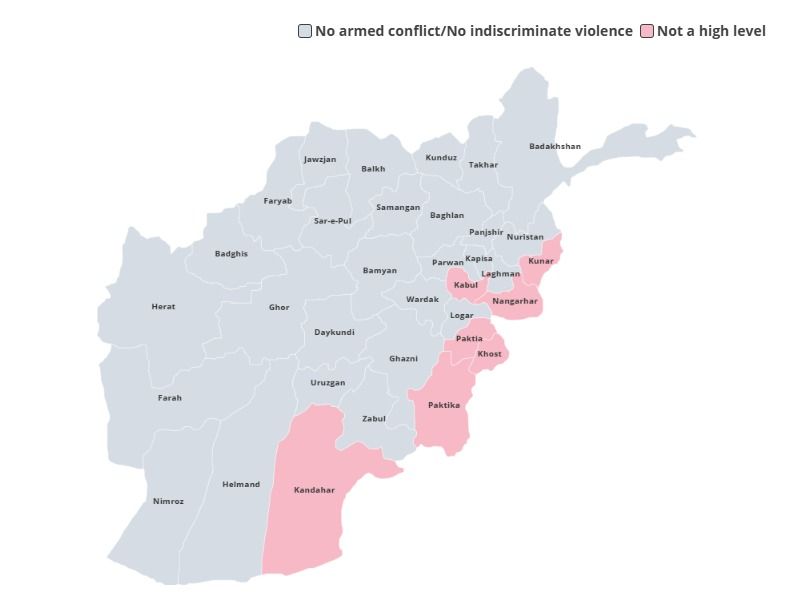
With regard to subsidiary protection under Article 15(c) QR, the guidance provides an assessment of the level of indiscriminate violence in each province as per the following map:
The protection needs of Afghan applicants are further compounded by the general lack of protection in the country, since the Taliban de facto government, currently the sole entity exercising effective control over all parts of Afghanistan, is not considered an actor of protection fulfilling the requirements of Article 7 QR. See Actors of protection.
Furthermore, it is assessed that Internal protection alternative (IPA) would in general not be applicable to any part of Afghanistan in accordance with Article 8 QR.
Finally, Exclusion considerations may be relevant in a number of cases concerning applicants from Afghanistan, such as members of the Taliban de facto authorities and affiliated groups, members and supporters of the ISKP, members of armed groups opposing the Taliban, members of the security institutions of the former government, persons affiliated with foreign forces, as well as individuals involved in blood feuds and land disputes.
- 4
The assessment and guidance reflect the conclusions of the EUAA Country Guidance Network, which consists of EU Member States, Iceland, Norway and Switzerland. The guidance note has been endorsed by the EUAA Management Board.
- 5
Regulation (EU) 2021/2303 of the European Parliament and of the Council of 15 December 2021 on the European Union Agency for Asylum and repealing Regulation (EU) No 439/2010.