

4.1.2. Homicides and massacres
The homicide rate in Colombia has remained relatively stable during the past ten years, and remains less than half of what it was in the 1990s.449 The national homicide rate in 2024 was 25.4 per 100 000 people, which is approximately the same as it was in 2015, though it remains among the highest in the region.450 There was a slight decline in the murder rate in 2024 to 13 393 murders; which coincided with the government's attempts to negotiate ceasefires through the 'Total Peace' policy.451 However, some regions experienced an increase in murders by organised criminal groups, and there was renewed violence especially in the Catatumbo region along the Venezuelan border in 2025, a hotspot for cocaine production.452 Here, for example, the monthly average homicide rate increased from 10 in 2024, to 39 in the first two months of 2025, according to HRW.453 Below are the homicide rates and figures illustrated by various sources:
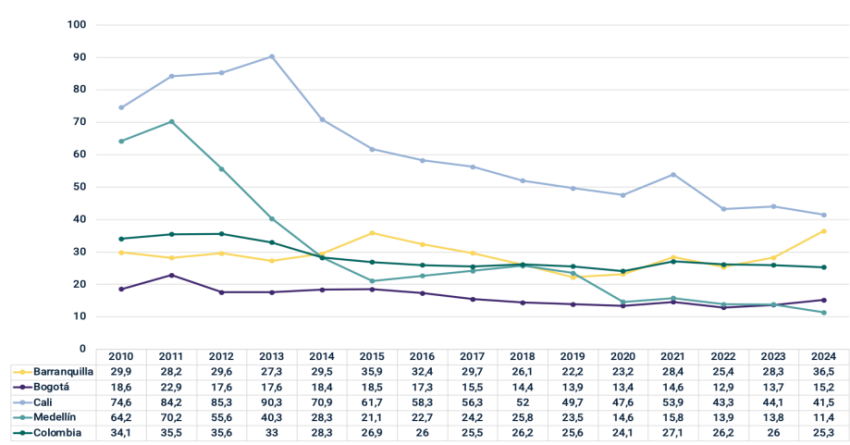
Figure 8: Homicide rates in major Colombian cities 2010-2024 based on SIEDCO/national police statistics454
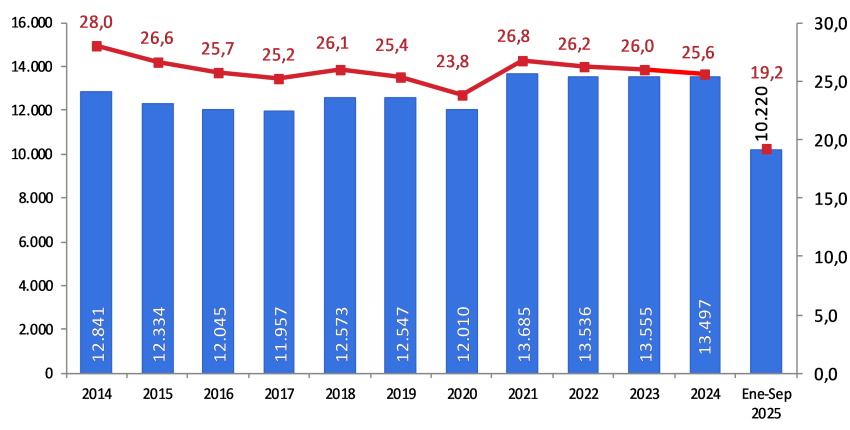
Figure 9: National trends for intentional homicide 2014-September 2025 (Observatorio de Derechos Humanos y Defensa Nacional)455
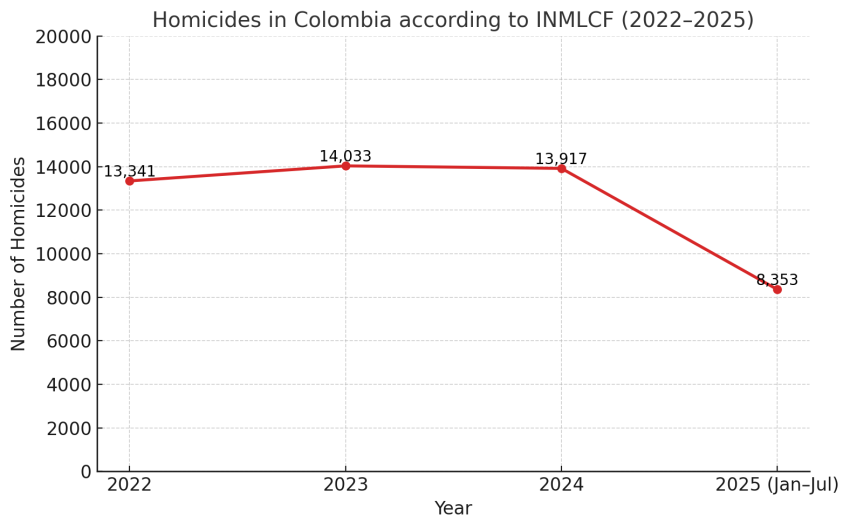
Figure 10: Number of recorded homicides, 2022-2025, based on INMLCF statistics456
FIP emphasised that the reduction in 'lethal or mass violence' is not necessarily an indication that the situation for civilians has improved as other types of violations then occur that are unnoticed or difficult to measure. For example, threats, confinement, forced displacement are difficult to detect and quantify, and these actions are also used to control territory and enforce governance. While organised crime groups do not perceive the state as an existential threat, they do consider that their sources of income can be disrupted by the state, and therefore try to avoid the 'most visible forms of violence' (such as homicides) in order to avoid becoming a target of the state's action.457 Colombian think tank DeJusticia similarly reported that although the 2016 FARC-EP Peace Agreement reduced overall homicide rates, violence has increasingly targeted populations seen as obstacles to the expansion or control of illegal armed groups—such as social leaders, rural communities, and public officials. These violent groups navigate a tension between displaying violence to assert dominance and maintaining a low profile to preserve local social control and pursue parallel negotiations with the government's demobilisation efforts.458 ACLED similarly observed that fewer events recorded can suggest that there is an increase in control over territory.459
Massacres refer to the simultaneous extra-judicial killing of three or more civilians in one incident and have continued to be reported in recent years. Tabulation of massacres varied between UN, NGO, and state sources. According to OHCHR, there were 123 alleged massacres (98 verified) in 2023, which was a 6 % increase from 2022,1116F460 and 29 alleged massacres (25 verified) between September and December 2024 as reported by UNVMC.461 In the first several months of 2025, between 1 January and 30 April, the Ombudsman's Office recorded 22 massacres, totalling 67 victims, mainly occurring in Norte de Santander, Valle del Cauca, Antioquia, Santander, and Cauca.462 As of June 2025, OHCHR received 13 allegations of massacres, and verified cases involved a total of 6 victims during the first half of 2025.463 In contrast, the Institute for Development and Peace Studies (Instituto de Estudios para el Desarrllo y la Paz, Indepaz), a Colombian NGO that researches on the Colombian conflict, recorded 679 massacres between 2016-2025, including 94 in 2023, 76 in 2024, and 63 massacres in 2025 as of October.464 The Human Rights Observatory of the Ministry of Defense reported a slight reduction in the number of massacres and victims between 2022 (93 cases, 340 victims, and 2025 (71 massacres, and 250 victims).465
- 449
US, CRS, Colombia: Background and U.S. Relations, 30 May 2025, url, p. 7
- 450
US, CRS, Colombia: Background and U.S. Relations, 30 May 2025, url, p. 7; Insight Crime, Homicide Round up 2024, 26 February 2025, url
- 451
Insight Crime, Homicide Round up 2024, 26 February 2025, url
- 452
Insight Crime, Homicide Round up 2024, 26 February 2025, url
- 453
HRW, Colombia: Armed Groups Batter Border Region, 26 March 2025, url
- 454
FIP and El Diálogo, Tasa en Homicidios de Principales Ciudades Capitales, 2010-2024, in: FIP, Colombia, Mutaciones del crimen organizado, September 2025, url, p. 17
- 455
Colombia, Seguimiento a indicadores y resultados operacionales (16 October 2025), September 2025, url
- 456
EUAA, Table of Homicides based on INMCLF statistics 2022-2025
- 457
FIP and El Diálogo, Colombia, Mutaciones del crimen organizado, September 2025, url, p. 16
- 459
ACLED, Data on political violence and demonstrations in Colombia, October 2025. Unpublished information provided to EUAA.
- 460
OHCHR, Situation of human rights in Colombia (A/HRC/55/23), 12 July 2024, url, para. 11
- 461
UNVMC, Report of the Secretary-General, 26 December 2024, url, para. 39
- 462
Colombia, Defensoría del Pueblo, Preocupante panorama de violencia en Colombia en los primeros cuatro meses de 2025, 20 May 2025, url
- 463
UNVMC, Report of the Secretary-General (S/2025/419), 27 June 2025, url, para. 38
- 464
Indepaz, Masacres en Colombia (2016-2025) [consulted 13 October 2025], url
- 465
Colombia, Seguimiento a indicadores y resultados operacionales (16 October 2025), September 2025, url