

3. Security situation
The security situation and conflict dynamics vary widely in Colombia. This report provides a brief, high-level overview of the main areas of dispute, key groups involved, and overview of types of violence occurring in the reference period. It is not possible to provide an exhaustive picture of the conflict dynamics in every dimension of Colombia.
Sources indicated that illegal armed groups have increased their presence in the country, including in remote areas.118 The expansion is closely related to the profit-seeking of these groups from illegal economies such as drug trafficking and illegal mining.119 Sources reported that, according to a July 2025 military intelligence report, illegal armed groups have expanded territorial presence in recent years and, in some areas, they also forge alliances to control profits from illegal economies such as drug trafficking, illegal mining, and extortion,120 as well as to coordinate to evade authorities and security operations.121 There were also examples of high profile attacks in urban areas in 2025 such as in August 2025 with two large attacks attributed to FARC dissident factions: a car bomb attack in Cali that killed 6 and injured 60 people and a drone attack on a police helicopter outside of Medellín, that killed at least 12 people.122
In July 2025, Reuters reported that, according to a government internal security report, illegal armed groups have increased the number of combatants and expanded their territorial control in the last three years, despite government efforts to negotiate ceasefires under the 'Total Peace' plan.123 According to the report, combatants increased from around 15 000 in mid-2022 to over 21 950 in June 2025.124 In November 2025, El Tiempo reported that according to another intelligence report, the number of combatants of illegal armed groups increased to over 25 200.125
Illegal armed actors are accused of committing human rights violations against civilians, including forced displacement, land dispossession, restrictions on the freedom of movement, killings, targeted killings, threats, forced recruitment, and use of antipersonnel mines.126 In a number of areas of the country, illegal armed groups have established forms of social and territorial control that resemble parallel governance schemes, with the monopoly of justice, authority, and local economies, through the use of systematic violence, including threats, targeted killings, forced displacement, and massacres.127 According to Pares, illegal armed groups are creating social organisations to coopt community programs and drive away community organisations and human rights defenders.128 Sources reported that illegal armed groups conduct surveillance via electronic communications and community networks, and plan armed actions with information collected through these channels.129 Members of the security forces have also been assassinated in the course of their duties, with 146 cases reported between January-September 2025, an increase from 64 in 2024 and 69 in 2023.130
The UN reported in September 2025 that attacks by armed groups have been increasing in recent months.131 Violence in areas such as Catatumbo (Norte de Santander), Bolívar, Cauca, and Arauca remained complex.132 According to the United Nations Office for the Coordination of Humanitarian Affairs (UNOCHA), between January and August 2025, it recorded over 1 200 attacks against civilians, affecting over 85 000 civilians; 659 armed actions, affecting 7500 people; and 342 instances of use of explosive devices, affecting over 6 500 people.133
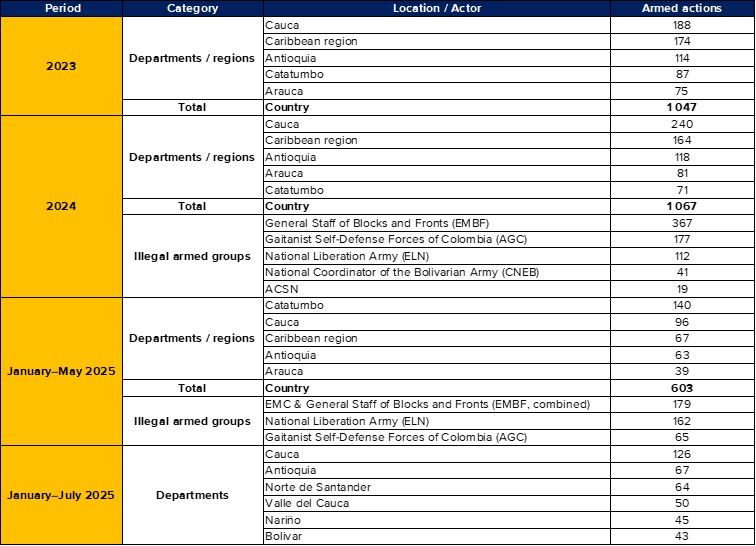
Table 1: Armed actions by illegal armed groups in Colombia (2023-2025), 18 June 2025134
The areas most affected by violence tended to be those formerly controlled by the FARC-EP,135 with a significant presence136 and contested resources such as coca crops and illegal mining.137 These areas include Antioquia, Norte de Santander, Bolívar, Cauca, La Guajira,138 Chocó, Nariño, Putumayo, Caquetá, Guaviare, Meta, Valle del Cauca,139 and Arauca.140
Sources noted the increasing use of drones by illegal armed groups to conduct surveillance and attacks against state security forces and/or other illegal armed groups.141 Drones are reportedly commercial crafts modified to drop explosives.142 In July 2025, for example, FARC dissident groups launched a drone against the police station of Santander de Quilichao, Cauca, killing a female police officer and injuring two others, and in rural Jamundí, Valle del Cauca, a drone attack against a local community left two children injured.143 Semana reported that, according to the Colombian military, 252 attacks with drones were documented in the country between January and July 2025, an average of 1.29 drone attacks per day.144 In October 2025, the army indicated that in the previous year-and-a-half, over 350 drone attacks were reported, which left 15 state security forces killed and 170 wounded.145 Most drone attacks have taken place in Cauca, particularly in Argelia (30 attacks), El Tambo (29), and Suárez (22).146 According to the army, in March and April 2025, three members of the army and two civilians were killed by drones in Norte de Santander.147 France24 quoted a representative of Vivamos Humanos, a Colombian NGO that advocates for human rights in the Catatumbo area, as indicating that there are no records of drone attacks directed exclusively against civilians, but civilians have been the collateral victims of these attacks that sometimes are launched against areas with high population density, killing and wounding civilians and destroying houses.148 In July 2024, a FARC dissident group dropped an explosive from a makeshift drone over a football field in Argelia, Cauca, killing a 10-year-old boy and injuring 10 others while they were playing on the field.149
The security situation in ethnic communities, including Afro-descendants and indigenous, remained a 'serious concern' due to human rights violations and armed actors' disruption of their traditional way of life through restrictions on freedom of movement, the imposition of curfews, and heightened surveillance, including the erosion of cultural practices, customary governance structures and the communities' ability to exercise their constitutional right to autonomy.150 The Awá, in Ricaurte, Nariño, represent a particular concern due to attacks and threats against them.151 In August 2025, the Office of the United Nations High Commissioner for Human Rights (OHCHR) also included the indigenous Emberá Dobida, Emberá Chami, Emberá Katío, Emberá Wounnan, Zenú, and Tule, as well as Afro-descendant communities in Chocó.152
Between January and August 2024, 889 people were victims of intra-urban displacement in Medellín, particularly from Comunas 13, 1, 7, 8, and 3.153 Homicide numbers in Medellín have decreased over the years in part due to a 'sophistication' in the commission of criminal activities, which are mostly selective and relying upon parallel governance of areas of Medellín.154 Colombian think tank Ideas For Peace Foundation (Fundación Ideas para la Paz, FIP) similarly indicated that violence is no longer committed massively as in the past due to the transformation of the conflict which currently focuses in certain zones that are disputed among illegal armed groups and less with state security forces.155 ACLED reported that ‘civilians face less deadly but more pervasive violence during Petro’s presidency.’156
On 11 September 2025, the EU Parliament voted to include FARC dissident groups and the ELN in the list of terrorist organisations.157
- 118
Reuters, Colombian armed groups have expanded during Petro's presidency, report finds, 8 July 2025, url; HRW, World Report 2025 – Colombia, 16 January 2025, url; Pares, ¿Plomo es lo que viene?: Balance y retos de la política de paz total 2022-2024, 2024, url, pp. 7, 45, 221
- 119
Reuters, Colombian armed groups have expanded during Petro's presidency, report finds, 8 July 2025, url; HRW, World Report 2025 – Colombia, 16 January 2025, url
- 120
Infobae, Estas son las zonas en las que hay alianzas entre grupos armados de Colombia: Fuerzas Militares revelaron objetivos del accionar, 30 October 2025, url; Caracol, Estas son las zonas más criticas en cuestión de alianzas de grupos armados ilegales en Colombia, 30 October 2025, url
- 121
Infobae, Estas son las zonas en las que hay alianzas entre grupos armados de Colombia: Fuerzas Militares revelaron objetivos del accionar, 30 October 2025, url; Caracol, Estas son las zonas más criticas en cuestión de alianzas de grupos armados ilegales en Colombia, 30 October 2025, url
- 122
BBC News, At least 18 killed and dozens injured in separate Colombia attacks, 22 August 2025, url
- 123
Reuters, Colombian armed groups have expanded during Petro's presidency, report finds, 8 July 2025, url. See also: HRW, World Report 2025 – Colombia, 16 January 2025, url
- 124
Reuters, Colombian armed groups have expanded during Petro's presidency, report finds, 8 July 2025, url
- 125
El Tiempo, Desde 2022, los grupos armados sumaron 10.000 nuevos integrantes: así fue el comportamiento año tras año, 4 November 2025, url
- 126
Pares, La paz ¿Cómo vamos?, 18 June 2025, url, p. 23; UN Human Rights Council, Situation of human rights in Colombia: Report of the United Nations High Commissioner for Human Rights, 22 January 2025, url, paras. 18, 19, 20, 26, 76
- 127
Indepaz, ¿Control social o dictadura local?, 1 December 2024, url; UN Human Rights Council, Situation of human rights in Colombia: Report of the United Nations High Commissioner for Human Rights, 22 January 2025, url, paras. 11-12
- 128
Pares, La paz ¿Cómo vamos?, 18 June 2025, url, p. 23
- 129
Pares, La paz ¿Cómo vamos?, 18 June 2025, url, p. 23; Infobae, Una guerra diaria desde el cielo, esta es la cifra de ataques con drones en el suroccidente colombiano, 15 July 2025, url
- 130
Colombia, Seguimiento a indicadores y resultados operacionales (16 October 2025), September 2025, url
- 131
UNVMC, Report of the Secretary-General, 26 September 2025, url, para. 10
- 132
Verdad Abierta, Paz Total: ¿un paso adelante y dos atrás?, 21 April 2025, url; El Colombiano, Hay 12 frentes activos de confrontación entre actores armados: Informe de Federación Nacional de Departamentos, 28 January 2025, url
- 133
UNOCHA, Colombia: Informe de situación humanitaria 2025, 19 September 2025, url, p. 2
- 134
Pares, La paz ¿Cómo vamos?, 18 June 2025, url, pp. 17, 19, 22; Pares, Explosivos y drones: El repertorio de violencia que reconfigura las afectaciones de la Fuerza Pública, 2025, url
- 135
Bertelsmann Stiftung, BTI 2024 Country Report — Colombia, 2024, url, p. 6; swissinfo.ch, La región colombiana del Catatumbo, un territorio a merced de los grupos armados, 21 January 2025, url
- 137
Bertelsmann Stiftung, BTI 2024 Country Report — Colombia, 2024, url, p. 6; swissinfo.ch, La región colombiana del Catatumbo, un territorio a merced de los grupos armados, 21 January 2025, url
- 138
Infobae, Estas son las zonas en las que hay alianzas entre grupos armados de Colombia: Fuerzas Militares revelaron objetivos del accionar, 30 October 2025, url; El Espectador, Este es el mapa de alianzas y confrontaciones entre los grupos armados en Colombia, 30 October 2025, url; UNVMC, Report of the Secretary-General, 26 September 2025, url, para. 32
- 139
Infobae, Estas son las zonas en las que hay alianzas entre grupos armados de Colombia: Fuerzas Militares revelaron objetivos del accionar, 30 October 2025, url; El Espectador, Este es el mapa de alianzas y confrontaciones entre los grupos armados en Colombia, 30 October 2025, url; ACLED, Data on political violence and demonstrations in Colombia, October 2025. Unpublished information provided to EUAA.
- 140
El Colombiano, Hay 12 frentes activos de confrontación entre actores armados: Informe de Federación Nacional de Departamentos, 28 January 2025, url; ACLED, Data on political violence and demonstrations in Colombia, October 2025. Unpublished information provided to EUAA.
- 141
Infobae, Una guerra diaria desde el cielo, esta es la cifra de ataques con drones en el suroccidente colombiano, 15 July 2025, url; El Espectador, Drones de guerra: así operan los grupos colombianos la nueva arma que siembra terror, 24 April 2025, url
- 142
DW, Ejército de Colombia presenta su primer batallón de drones, 11 October 2025, url; swissinfo.ch, Colombia presenta su primer batallón de drones para combatir grupos armados, 11 October 2025, url
- 143
MSN, Horror en Cauca: disidencias lanzaron explosivos desde un dron y mataron a una patrullera de la Policía en Santander de Quilichao, 11 July 2025, url; Semana, Esta es la aterradora cifra de ataques con drones de las disidencias contra la fuerza pública en el Cauca, Valle y Nariño, 15 July 2025, url
- 144
Semana, Esta es la aterradora cifra de ataques con drones de las disidencias contra la fuerza pública en el Cauca, Valle y Nariño, 15 July 2025, url
- 145
DW, Ejército de Colombia presenta su primer batallón de drones, 11 October 2025, url; swissinfo.ch, Colombia presenta su primer batallón de drones para combatir grupos armados, 11 October 2025, url
- 146
Semana, Esta es la aterradora cifra de ataques con drones de las disidencias contra la fuerza pública en el Cauca, Valle y Nariño, 15 July 2025, url
- 147
France24, Drones: una nueva amenaza en el conflicto armado en Colombia, 3 July 2025, url
- 148
France24, Drones: una nueva amenaza en el conflicto armado en Colombia, 3 July 2025, url
- 149
France24, Drones: una nueva amenaza en el conflicto armado en Colombia, 3 July 2025, url; El Colombiano, Él era Dilan Camilo Erazo, el niño que murió en medio de ataques con explosivos de las disidencias en Cauca, 24 July 2025, url
- 150
UNVMC, Report of the Secretary-General, 26 September 2025, url, para. 58; Rutas del Conflicto, En Colombia, indígenas denuncian que crimen organizado y petroleras impactan los ríos sagrados de los pueblos indígenas Siona e Inga, 4 October 2025, url
- 151
UNVMC, Report of the Secretary-General, 26 September 2025, url, para. 58
- 152
OHCHR, Indígenas y Afrodescendientes en el Chocó se enfrentan a graves ataques que afectan su pervivencia física y cultural, 20 August 2025, url
- 153
Pares, La paz ¿Cómo vamos?, 18 June 2025, url, pp. 160-161
- 154
Pares, La paz ¿Cómo vamos?, 18 June 2025, url, p. 161
- 155
FIP, Menos muertos, más afectados: evolución de la violencia contra civiles en Colombia, 3 March 2025, url
- 156
ACLED, Civilians in Colombia face less deadly — but more pervasive — violence during Petro’s presidency, 17 February, 2025, url
- 157
DW, Eurocámara aborda "Paz Total" colombiana con una resolución, 11 September 2025, url