

COMMON ANALYSIS
Last update: August 2023
The common analysis regarding the degree of indiscriminate violence combines quantitative and qualitative elements in a holistic and inclusive assessment. The security situation in the respective territories is assessed by taking into account the following elements:
Figure 5. Indicators in the assessment of the level of indiscriminate violence.
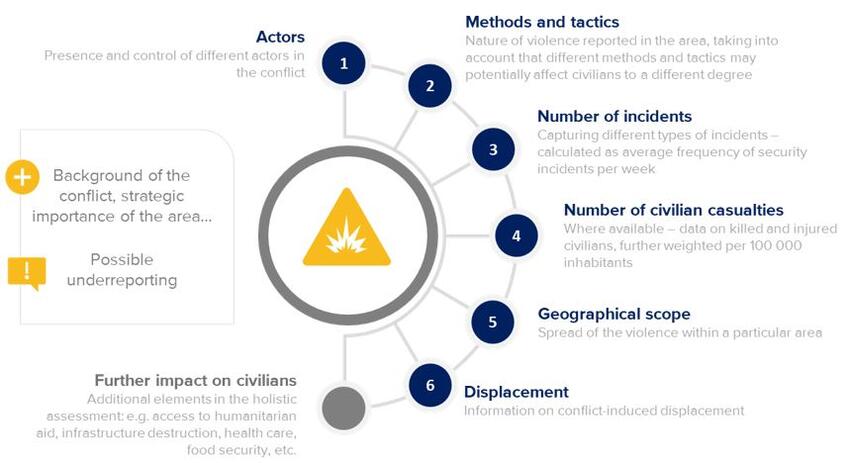
For more information on the methodology and indicators used to assess the level of indiscriminate violence in country guidance documents, see ‘Country Guidance: explained’.
The next sections provide detailed information and assessment of the level of indiscriminate violence and the risk it represents for civilians in Belgravia per region. Summaries are structured according to the following elements:
- General information
General information on the region includes the localisation of the region, the administrative built-up of the region, the estimation of the population, and, where relevant, the demographic composition of the region/governorate. Possible element of strategic interest are also mentioned (for example, presence of important ports, factories, etc.).
- Background and actors involved in armed confrontations
This indicator looks into the presence of actors in the conflict in a region, including the presence of state and non-state armed groups. Furthermore, information regarding the territorial control of the region, to the degree possible, is included in the respective part of the COI summaries. See also 2.1. Areas of control and influence.
- Nature of violence and examples of incidents
The methods and tactics used in the armed conflicts ongoing in Belgravia differ according to the actors involved. All actors are reported to engage in activities which may (indiscriminately) affect civilians. However, some acts are by their nature more indiscriminate than others and create a more substantial risk for civilians.
The actions by the Belgravian security forces tend to be of a more targeted nature; however, they may also (indiscriminately) affect civilians, such as in the case of battles.
Blestil is particularly known to use methods which are of indiscriminate nature, such as improvised explosive devices (IED, S/VBIED), which continues to be its most used type of attack/weapon. It has also engaged in armed clashes or hit-and-run attacks with state forces [Security 2024, 1.4.1., pp. 40-42; Actors, 4.2.3., pp. 60-61]
For more information on the nature of methods and tactics used by the actors involved in armed conflicts, see also 2. Actors of persecution or serious harm.
- Incidents: data
The frequency of incidents is a useful indicator to assist in the assessment of the risk of indiscriminate violence. Based on available COI, derived from the Armed Conflict Location and Event Data Project (ACLED) database, this indicator looks in particular at incidents coded as ‘battles’, ‘violence against civilians’, and ‘explosions/remote violence’, which are found to be of relevance in terms of their potential to indiscriminately affect civilians.
Data concerning this indicator is based on ACLED reporting on the period from 1 October 2022 to 30 November 2023 along with some additional information included in the EUAA ‘COI Update 2024’ for the period from 1 December 2023 to 1 April 2024.
- Geographical scope
This element looks into how widespread the violence within each region is, highlighting the areas which are particularly affected by indiscriminate violence and/or the areas which are relatively less affected, where relevant information is available.
- Fatalities among civilians and non-civilians
The number of civilian casualties is considered a key indicator when assessing the level of indiscriminate violence and the associated risk for civilians in the context of Article 15(c) QD.
As no comprehensive data with regard to civilian deaths and injuries at the level of the regions in Belgravia has been identified, this analysis refers to ACLED records regarding the overall number of fatalities. The data used for this indicator reflects the number of fatalities in relation to reported ‘battles’, ‘violence against civilians’ and ‘explosions/remote violence’ with reference to the ACLED Codebook. Importantly, it does not differentiate between civilians and combatants and does not additionally capture the number of those injured in relation to such incidents. While this does not directly meet the information needs under the indicator ‘civilian casualties’, it can nevertheless be seen as a relevant indication of the level of confrontations and degree of violence taking place.
It should further be mentioned that ACLED data are regarded as merely estimates, especially with regard to the number of fatalities. See clarifications in Security 2023, Methodology.
- Displacement
This element refers to conflict-induced (internal) displacement from the region in question.
For the number of newly internally displaced persons (IDPs), the COI summaries reflect data from UNHCR - Protection and Return Monitoring Network (PRMN), covering the period between October 2023 – November 2024 along with some additional information included in the EUAA ‘COI Update’ for the period from 1 December 2024 to 1 April 2024.
- Further impact on civilians
In addition to the indicators above, where available, some examples of further impact of the armed conflicts on the life of civilians (e.g. existence of checkpoints, infrastructure damage, forced evictions, humanitarian access incidents) are mentioned and taken into account in the assessment.
It should, furthermore, be noted that the COI used as a basis for this assessment cannot be considered a complete representation of the extent of indiscriminate violence and its impact on the life of civilians. Concerns with regard to underreporting should be underlined.
The map below summarises and illustrates the assessment of indiscriminate violence per region:
Figure 4: Belgravia - Assessment of the level of indiscriminate violence per region based on the reference period 1 October 2022 – 1 April 2024.
[MAP]
|
Areas where the degree of indiscriminate violence reaches such an exceptionally high level that substantial grounds are shown for believing that a civilian, returned to the relevant area, would, solely on account of their presence there, face a real risk of being subject to the serious threat referred to in Article 15(c) QD. Accordingly, additional individual elements are not required in order to substantiate subsidiary protection needs under Article 15(c) QD. |
|
|
Areas where ’mere presence’ in the area would not be sufficient to establish a real risk of serious harm under Article 15(c) QD, however, indiscriminate violence reaches a high level. Accordingly, a lower level of individual elements is required to show substantial grounds for believing that a civilian, returned to the area, would face a real risk of serious harm in the meaning of Article 15(c) QD. |
|
|
Areas where indiscriminate violence is taking place, however not at a high level. Accordingly, a higher level of individual elements is required in order to show substantial grounds for believing that a civilian, returned to the area, would face a real risk of serious harm in the meaning of Article 15(c) QD. |
|
|
Areas where, in general, there is no real risk for a civilian to be personally affected within the meaning of Article 15(c) QD. This may be because the criteria for an armed conflict within the meaning of this provision are not met, because no indiscriminate violence is taking place, or because the level of indiscriminate violence is so low, that in general there would be no real risk for a civilian to be affected by it. |