

COMMON ANALYSIS
Last update: June 2025
The analysis below is primarily based on the following EUAA COI report: Country Focus 2025, 1.1, 1.2.1, 1.2.2, 2.1 Country Guidance should not be referred to as a source of COI. The section below should be read in conjunction with most recent COI available at the time of the examination.
In Syria, a wide range of groups and individuals may be considered actors of persecution or serious harm. This includes a multitude of internal and external actors pursuing their own interests and goals.
The Assad regime, which was considered a main actor of persecution or serious harm in Syria, has vanished. On 27 November 2024, the militant Islamist group Hay’at Tahrir al-Sham (HTS), led by Ahmad Al-Sharaa, commanded a large-scale offensive in northwestern Syria. They faced minimal resistance as Syrian army forces abandoned their positions. HTS and its allied factions achieved control of the capital on 8 December 2024.
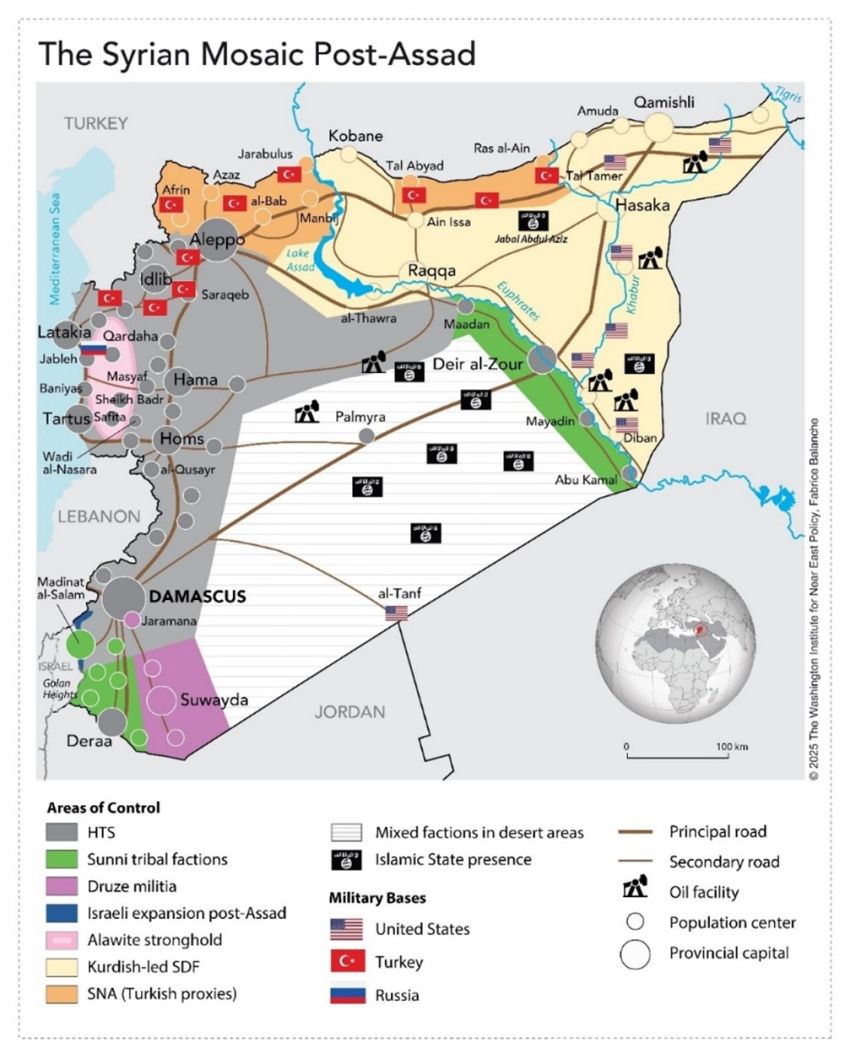
At the time of writing, the HTS-led coalition was in control of most areas previously held by the Assad regime, amounting to just over 60% of Syrian territory. In the north, various factions have struggled for influence and control. Clashes between Turkish-backed militias operating under the umbrella of the Syrian National Army (SNA) and the US-backed Kurdish-led Syrian Democratic Forces (SDF) continued.
After the takeover, the HTS established a transitional government primarily composed of officials from the former Syrian Salvation Government (SSG) in Idlib [see Security Situation 2023, 2.1.2(a)]. By mid-February, the transitional administration had successfully integrated around hundred armed factions, including the U.S.-backed Free Syrian Army, into a new Syrian military and Ministry of Defence. Some factions remain resistant. In early March 2025, the SDF signed a deal to integrate their armed forces and civilian institutions into the new Syrian government.
Shortly after the Assad regime fall, the Israeli military moved into the UN-patrolled buffer zone in the Golan Heights and beyond into Syrian territory, in the areas of southern Quneitra and south-west Dar’a. Also, Israel carried out hundreds of airstrikes in early December aimed at destroying weapon sites across Syria, more than half of which took place in Dar’a, Damascus, Rural Damascus and Latakia governorates. As of 20 February 2025, Israeli incursions into and beyond the buffer zone were ongoing.
The map below (Figure 1. © The Washington Institute for Near East Policy, Fabrice Balanche, Syria, Areas of control, 28 February 2025) outlines the approximate areas of control and influence in Syria as of March 3, 2025. This map presents an indication and cannot be seen as an absolute representation of the situation in terms of spatial or temporal accuracy. The depictions on this map do not imply any opinion on the part of the EUAA concerning the legal status or effective control over any territory in the country.
Figure 1. © The Washington Institute for Near East Policy, Fabrice Balanche, Syria, Areas of control, 28 February 2025 [Country Focus 2025, 1]
The contents of this section include: