

COMMON ANALYSIS | Last update: December 2025
The analysis below is based on the following EUAA COI reports and query: COI Update, 4.; Country Focus July 2025, 1.3., 2.4.2., 2.4.4., 5.2.2., 5.3.; Actors 2019, 1.1., 3.1.; Country Guidance should not be referred to as a source of COI.
This section should be read in conjunction with 1. Recent developments in Syria.
The Syrian armed conflict began in 2011 as a civil uprising against President Bashar al-Assad, inspired by the wave of Arab Spring protests across the Middle East. By 2012, the situation escalated into a full-scale civil war, with armed opposition groups confronting Transitional Government forces and seizing key territories. The fall of the Assad regime in late 2024 and the establishment of the Transitional Government in 2025 marked a significant turning point for Syria. However, the security situation remains highly fragile.
Although the state apparatus of the Assad regime has been dismantled, numerous actors from the civil war remain active. The security forces of the Transitional Government are still in the process of formation and have reportedly been overstretched outside of the main urban centres, limiting their effectiveness. Some armed groups nominally integrated into the structure of the new Syrian army continue to function semi-independently.
Incidents of retaliatory and sectarian violence have been reported. Between 6 and 10 March 2025, clashes between Transitional Government forces and their affiliates on one side, and pro-Assad remnants on the other, reportedly led to the deaths of hundreds of civilians, primarily in the coastal governorates of Latakia, Tartous, and to a lesser extent, Hama and Homs. In mid-August 2025, Assadist remnants have reportedly intensified their attacks against Transitional Government forces in coastal areas. In northeast Syria, longstanding tensions between The Syrian Democratic Forces (SDF) and The Syrian National Army (SNA) persist, rooted in Kurdish demands for autonomy. Disagreement between the SDF and the Transitional Government remains, particularly regarding the integration of the military and civilian institutions of the Democratic Autonomous Administration of North and East Syria (DAANES) into the state structure, despite an agreement reached in March 2025. In August 2025, sporadic clashes between local tribal fighters and SDF were reported in Deir Ez-Zor governorate. Since early September 2025, clashes between the SDF and transitional government’s forces have intensified.
In southern Syria, security incidents involving the Druze community have been reported, culminating in a surge of anti-Druze violence at the end of April 2025. In July 2025, violence sharply escalated in Sweida governorate, following intense clashes between Druze militias and Bedouin tribal fighters. More than one thousand casualties were reported among the Transitional Government security forces, Druze fighters, and civilians. In this context, Israel continued to carry out incursions and attacks in southern Syria and airstrikes on multiple targets across the country including in Damascus city.
The analysis below is based on the following EUAA COI reports and query: COI Update, 1.; Country Focus July 2025, 1.3.2., 5.1.1., 5.1.2., 5.1.3., 5.3.; Country Guidance should not be referred to as a source of COI.
The Transitional Government is in the early stages of establishing effective security across the country. It has consolidated control over key urban centres such as Damascus, Aleppo, and Hama, and expanded its presence in central, northern, and southern regions. The Transitional Government had control over villages in Sweida’s eastern and northern countryside, and conducted raids against pro-Assad remnants and individuals suspected to have committed crimes under the Assad regime across several governorates. Governmental security forces still face significant challenges in addressing various threats, including sectarian violence, kidnappings, and looting.
The Syrian Democratic Forces (SDF) maintain control in northern and northeastern Syria, including parts of Aleppo (east of the Euphrates), Raqqa, Deir Ez-Zor, and Hasaka. The SDF has conducted ambushes, artillery strikes and drone strikes, mainly targeting SNA forces, and ISIL.
The Syrian National Army (SNA) operates primarily in northern border regions, including the governorates of Aleppo, Raqqa, and Hasaka. SNA factions, nominally integrated into army divisions, have also been deployed in other areas, particularly Aleppo and Hama. The SNA carried out artillery attacks against the SDF, conducted drone attacks against SDF, employed the indiscriminate shelling of civilian areas, forcibly evicted civilians and prevented them from returning to their homes, extorted civilians at checkpoints, etc.
The activity of the Islamic State of Iraq and the Levant (ISIL) has significantly declined since the fall of the Assad regime. While ISIL continues to target the SDF, there are also reports of attacks against Transitional Government forces and civilians, primarily in the northeast. ISIL used improvised explosive devices (IEDs) and rocket propelled grenades (RPGs).
As of mid-September 2025, most of Sweida governorate including its capital were under the control of Druze local factions.
New groups and networks have emerged, composed of former senior military and intelligence officials from the Assad government. These factions, particularly those operating in Syria’s coastal areas, are considered among the most organised insurgent groups and aim to resist the new authorities and have been involved in armed clashes with the Transitional Government forces and the SDF.
For further information about the different armed actors present in Syria, see 3. Actors of persecution or serious harm. For further information on the tactics and weapons used by the different armed actors in Syria, see ‘EUAA, '5.1. Armed actors' in COI Report - Syria: Country Focus, July 2025’ and ‘EUAA, '4.5.2. Tactics and weapons used' in COI Report - Syria: Country Focus, March 2025’.
The analysis below is based on the following EUAA COI reports and query: COI Update, 4.; Country Focus July 2025, 5.4.; Country Guidance should not be referred to as a source of COI.
Data concerning this indicator are primarily based on ACLED reporting from 1 November 2024 to 31 May 2025 and from 1 June to 26 September 2025.
Please note that different sources use different methodologies for the recording of incidents, therefore some discrepancies on data are to be expected. For more information on the methodologies of data collection see ‘EUAA, COI Report - Syria: Country Focus, July 2025, Sources'.
Between November 2024 and May 2025, the highest number of security incidents documented by ACLED occurred in the lead-up to and immediate aftermath of the regime change, particularly in November, December 2024, and January 2025.
Following the fall of the Assad regime, ACLED recorded 4 271 security incidents in Syria between 9 December 2024 and 31 May 2025. Of these, 1 518 were classified as acts of violence against civilians, 1 907 as explosions or remote violence, and 846 as battles.
Most incidents occurred in January 2025, largely attributed to clashes between the SDF and Türkiye-backed armed groups, as well as incidents involving landmines and unexploded ordnance (UXOs). March 2025 also saw a spike in violence, primarily due to confrontations between Transitional Government forces and affiliated armed groups on one side, and anti-government militias on the other, alongside acts of violence against civilians reportedly committed by Transitional Government forces and unidentified armed actors. Incident levels declined significantly in April and May 2025.
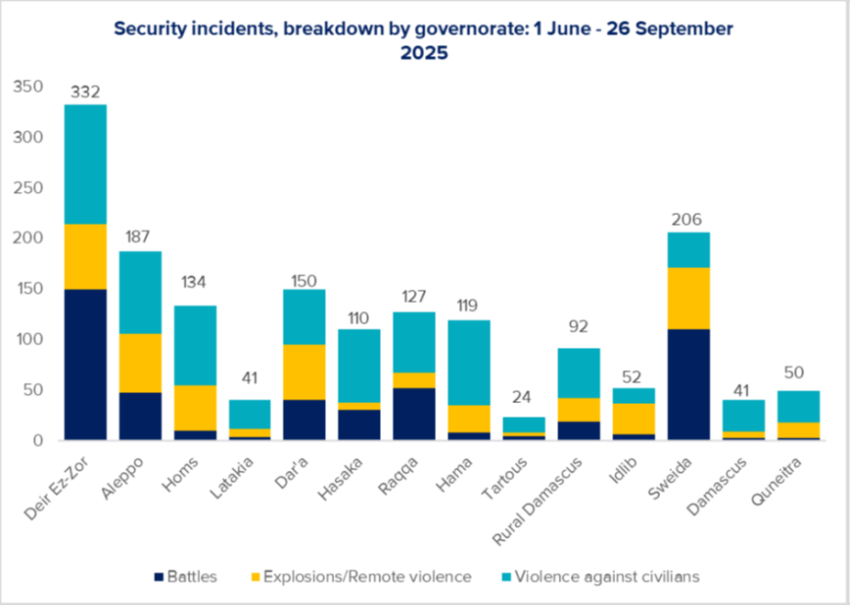
Between 1 June and 26 September 2025, ACLED documented 1 665 security incidents in Syria: 491 of these were coded as battles, 416 as explosions/remote violence, and 758 as violence against civilians. The highest number of security incidents occurred in the months of July and August 2025. Three governorates saw the highest number of security incidents: Deir Ez-Zor (332), Sweida (206) and Aleppo (187). Most battles in Deir Ez-Zor involved clashes between SDF and ISIL, SDF and unidentified armed groups, and SDF and tribal militias. In Sweida governorate, most security incidents were recorded by ACLED in July 2025 and attributed to clashes between Transitional Government forces and Druze militias, as well as between Bedouin and Druze militias. In Aleppo governorate, most incidents coded ‘involved clashes between Transitional Government forces and SDF, most of them recorded in September 2025 around frontlines. The lowest number of security incidents were recorded in the governorates of Tartous (24), Latakia (41) and Damascus (41).
Figure 3. ACLED security events coded ‘battles’, ‘explosions/remote violence’ and ‘violence against civilians’ on governorate level between 9 December 2024 and 31 May 2025.
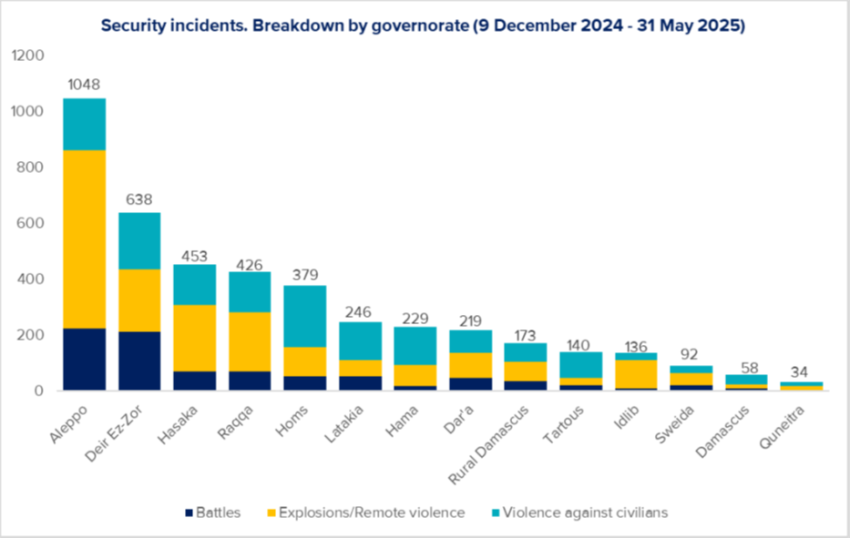
Figure 4. ACLED - security events coded ‘battles’, ‘explosions/remote violence’ and ‘violence against civilians’ on governorate level recorded between 1 June and 26 September 2025.
The analysis below is based on the following EUAA COI reports and query: COI Update, 4.; Country Focus July 2025, 5.5.; Country Focus March 2025, 4.5.3.; Country Guidance should not be referred to as a source of COI.
Data concerning this indicator are primarily based on SNHR reporting from 1 December 2024 to 31 May 2025, and from 1 June to 30 September 2025.
Please note that different sources use different methodologies for the recording of incidents, therefore some discrepancies on data are to be expected. For more information on the methodologies of data collection see ‘EUAA, COI Report - Syria: Country Focus, July 2025, Sources’.
Between December 2024 and May 2025, the Syrian Network for Human Rights (SNHR) documented 2 854 civilian fatalities. Except for December 2024 and March 2025, the majority of these fatalities were attributed to attacks by unidentified actors, as well as incidents involving landmines and unexploded ordnance (UXOs). The spike in fatalities during March was primarily linked to the outbreak of violence in Syria’s coastal regions.
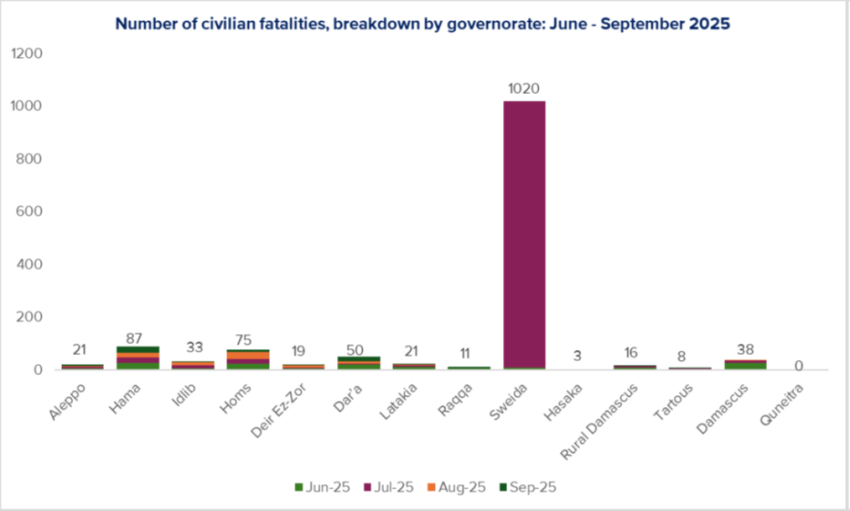
Between June and September 2025, SNHR documented 1 402 fatalities across Syria. Apart from the fatalities recorded in Sweida in July 2025, most civilian fatalities were attributed to gunfire and bombings by unidentified perpetrators, followed by landmines explosions, and to a significant lesser extent by Transitional Government forces and the SDF.
Further calculations on fatalities per 100 000 inhabitants in each region for the period, based on SNHR data, are provided in the hereunder section Assessment of indiscriminate violence per governorate.
Figure 5. Breakdown by governorate of number of civilian fatalities recorded by SNHR between December 2024 and May 2025.
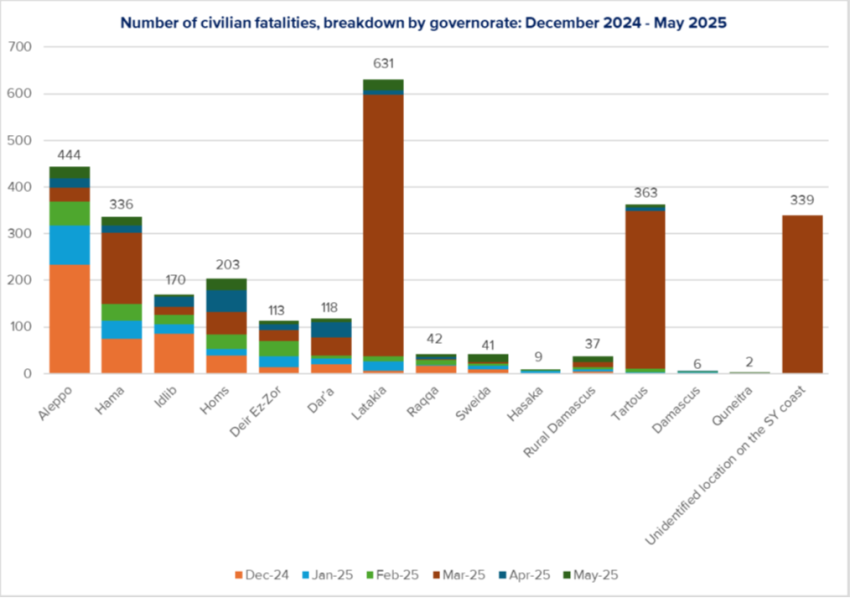
Figure 6. Breakdown by governorate of number of civilian fatalities recorded by SNHR between June and September 2025).
The analysis below is based on the following EUAA COI reports and query: COI Update, 4.; Country Focus July 2025, 5.6.; Country Guidance should not be referred to as a source of COI.
Data concerning this indicator are primarily based on UNHCR reporting from 27 November 2024 to 18 September 2025.
For more information on the methodologies of data collection see ‘EUAA, COI Report - Syria: Country Focus, July 2025, Sources.
As of mid-September 2025, there were around 7 million IDPs in Syria, residing in host communities (around 4.8 million) and IDP sites. Most IDPs were located in Idlib (30.06 %), Aleppo (22.5 %), Rural Damascus (13.15 %) and Damascus (8.3 %) governorates. The offensive which started in November 2024 and led to the fall of the Assad regime and the July violence in Sweida have triggered further displacement with more than 892 000 new IDPs reported as of 18 September 2025. In terms of IDP returns, UNHCR reported that 1 855 698 individuals returned to their homes since 27 November 2024 (972 085 since 8 December 2024). Most IDP returns were recorded in Aleppo (39.9 %), Hama (16.2 %), Idlib (14.1 %) and Homs (14 %) governorates.
The analysis below is based on the following EUAA COI reports: COI Update, 4.; Country Focus July 2025, 5.7.; Country Guidance should not be referred to as a source of COI.
Syria’s services and infrastructure have been severely impacted by years of conflict, with estimates indicating that approximately 50 % of the country’s infrastructure has been destroyed or rendered non-functional. This includes housing, agricultural land, hospitals, sewage systems, and roads, leaving many areas uninhabitable. Access to basic services remains particularly difficult in and around Aleppo, Rural Damascus, Homs, and Dar’a.
Unexploded ordnance (UXOs), explosive remnants of war (ERWs), landmines, and improvised explosive devices (IEDs) are reportedly widespread, affecting residential areas, farmland, infrastructure, and key access routes—especially in the governorates of Idlib, Deir Ez-Zor, Aleppo, Raqqa, Hasaka, and Rural Damascus. Deir Ez-Zor is among the most heavily contaminated regions, accounting for roughly a quarter of all such incidents.
Between 8 December 2024 and 1 June 2025, 532 incidents involving explosive ordnance resulted in 1 052 casualties (428 killed and 624 injured) out of which 360 were children. The areas with the highest contamination of explosive ordnances were Aleppo, Raqqa, Deir Ez-Zor, Idlib and Hama. Deir Ez-Zor accounted for at least one quarter of all incidents recorded. Casualties have steadily increased in early 2025, especially in regions with intense conflict and limited access for humanitarian partners. Notable areas affected include Manbij, Ein al Arab/Kobani, Ras al-Ayn, Tall Abyad, and the Deir Ez-Zor governorate.