

COMMON ANALYSIS | Last update: December 2025
For general guidance on the country guidance approach to this section, see ‘EUAA, 'Actors of persecution or serious harm' in Country Guidance: Explained, February 2025.
The following sections highlight the main actors of persecution and serious harm in Syria as well as their areas of control and influence, in a non-exhaustive manner. In Syria, a wide range of different groups and individuals can be considered as actors of persecution or serious harm, and a clear distinction between State and non-State actors within the meaning of Article 6 QD/QR may be difficult to make.
The analysis below is based on the following EUAA COI reports: COI Update, 1.; Country Focus July 2025, 5.1.3., 5.3., 5.8.3., 5.8.7.; Country Focus March 2025, 1.2.1., 2.; Country Guidance should not be referred to as a source of COI.
As of 29 September 2025,
-
The Transitional Government controls most Syrian territory besides Syrian Democratic Forces (SDF)-governed areas in northeast Syria and the mostly Druze-controlled Sweida governorate. The Transitional Government forces and the Syrian Democratic Forces (SDF) operate in close proximity in Raqqa and Deir Ez-Zor governorates. The Transitional Government has control over villages in Sweida’s eastern and northern countryside.
-
The Syrian National Army (SNA) remains active in Afrin, Ras al-Ayn and Tall Abyad despite a reduced presence. They control the areas between Afrin, Azaz and Jarabulus (Aleppo governorate) and the areas between Tall Abyad (Raqqa governorate) and Ras al-Ayn (Hasaka governorate) under the influence of the SNA.
-
The Syrian Democratic Forces (SDF) controls northern and northeastern Deir Ez-Zor, Hasaka governorate and parts of Raqqa, especially around Raqqa city. While the SDF controls most Iraqi border crossing points in eastern Syria, the Transitional Government forces maintain a presence at the Albu Kamal-Al Qa’im border crossing point.
-
The Islamic State of Iraq and the Levant (ISIL) has cells active predominantly in the Badiya desert in Homs, and Deir Ez-Zor. ISIL presence and activity have also been reported in Aleppo, Hasaka, Idlib, Raqqa, Rural Damascus, Sweida, and desert areas.
-
Most of Sweida governorate including its capital are under the control of Druze local factions.
-
Assad-aligned remnants are present in Homs, Hama, Latakia and Tartous and in small pockets Al-Mayadin, Abu Kamal, and eastern Deir Ez-Zor. See 3.6. Other actors.
-
Israel has been occupying parts of southern Syria and conducting extensive airstrikes, particularly in Dar’a, Damascus, and Latakia. It maintains a presence in the Golan Heights and actively engages with the Druze minority, opposing Syrian military deployment south of Damascus.
-
Türkiye and the US still have military presence in Syria and have been conducting armed operations in the country.
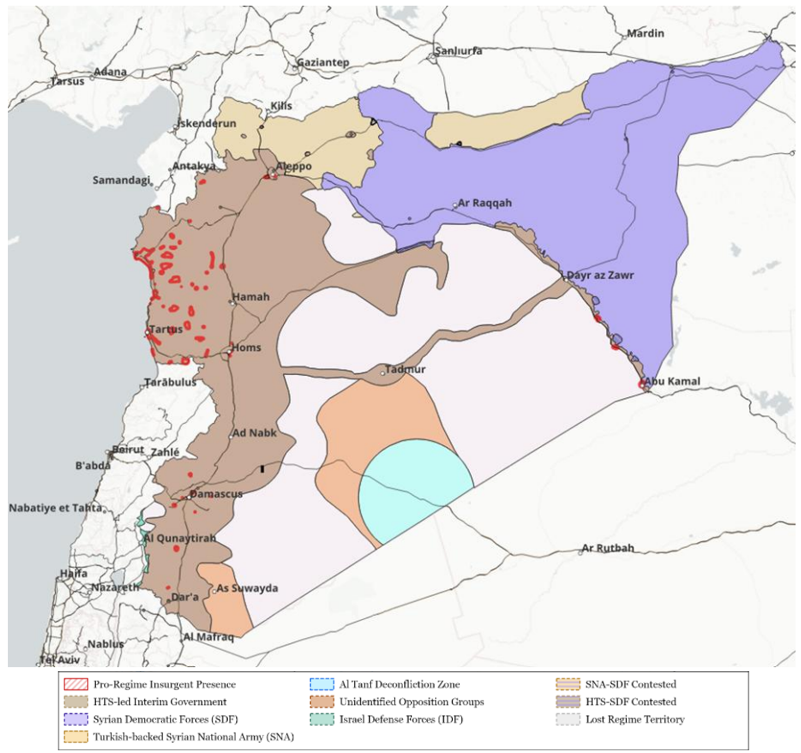
The approximate areas of control and influence of the main actors are outlined in the map below.
Figure 1. Assessed Control of Terrain in Syria, © Institute for the Study of War and AEI's Critical Threats Project, 29 September 2025. EUAA, Country of Origin Information Query, Syria: Major human rights, security, and socio-economic developments, October 2025.
The analysis below is based on the following EUAA COI reports: COI Update, 1.; Country Focus July 2025, 1.3., 1.3.1., 1.3.2.; Country Focus March 2025, 1.3.2., 2.1.; Actors, 4.1.4.; Country Guidance should not be referred to as a source of COI.
Following the fall of the Assad regime in December 2024, Syria has experienced significant shifts in territorial control and governance. On 27 November 2024, Hay’at Tahrir al-Sham (HTS), under Ahmad Al-Sharaa’s leadership, launched a large-scale offensive in north-western Syria, capturing the capital by 8 December 2024 amid minimal resistance. The Transitional Government subsequently consolidated control over major urban centres including Damascus, Aleppo, Homs, and Hama, and expanded into central, northern, and southern regions. Nonetheless, widespread insecurity persisted. As of September 2025, the Transitional Government controlled most territory besides the areas governed by the Syrian Democratic Forces (SDF) in the northeast and the Druze-controlled Sweida governorate.
Security operations are divided between the Ministry of Interior (MoI) and Ministry of Defence (MoD). The MoI, including the police and General Security Services (GSS) staffed by former HTS and Syrian Salvation Government (the governance body of HTS responsible for civilian functions) personnel, maintains a structured and professional force. The MoD oversees a loosely integrated army of former opposition factions, with limited cohesion and ongoing friction with MoI units, particularly over checkpoint control.
More precisely, the new Syrian army has been formed by integrating former opposition armed factions, based on an agreement signed in March 2025 between the Transitional Government and armed factions, in addition to new recruits. Instead of requiring reforms or restructuring, the MoD has largely rebranded these factions as official army divisions or brigades. Some factions nominally integrated into the structure of the MoD, such as the SNA, often operate semi-independently, committing violations against civilians, particularly in coastal and Druze-majority areas.
The agreement signed in March 2025 between the Transitional Government and the Syrian Democratic Forces (SDF) led to a significant decline in armed confrontations between the SDF and the Syrian National Army (SNA) factions nominally affiliated with the government. However, tensions between the SDF and the Transitional Government remained and the integration of military and civilian institutions of the Democratic Autonomous Administration of North and East Syria (DAANES) into the state remained largely unresolved as of late September 2025.
The Transitional Government remains in the early stages of establishing effective security across Syria. While its security forces have demonstrated the ability to carry out limited ground raids, Unmanned Aircraft Systems (UAS) strikes, and rocket and missile attacks, they possess minimal air defence capabilities and have received limited training in advanced weapons systems.
Security forces affiliated to the Transitional Government have committed numerous serious human rights violations such as arbitrary arrest, incommunicado detention, killing, torture, and abuse of individuals such as persons associated with the former Government of Syria and persons with perceived links to ISIL. In early March 2025, clashes between pro-Assad groups and security forces of the Transitional Government in Latakia, Tartous, and Hama governorates led to hundreds of civilians being killed, most of whom were Alawites. In July 2025, violence escalated sharply after intense clashes erupted on 13 July between Druze militias and Bedouin tribal fighters in Sweida. The conflict intensified between 14-16 July 2025 amid the deployment of Transitional Government forces in Sweida. Both events of violence included summary executions carried out by forces linked to the Transitional Government.
While the Transitional Government has made progress in consolidating formal structures and integrating some armed groups, it cannot be considered a unified actor. Its authority is fragmented, its control over armed factions is incomplete, and regional/local autonomy persists in many areas. The government’s legitimacy and effectiveness are further challenged by ongoing violence, sectarian tensions, and the presence of powerful non-state and external actors.
The analysis below is based on the following EUAA COI reports: COI update, 1., 4.; Country Focus July 2025, 1.3.2., 2.3.; Country Focus March 2025, 2.2.; Country Guidance should not be referred to as a source of COI.
The Syrian National Army (SNA) is a coalition of loosely affiliated militias supported by Türkiye. Despite its formal integration into the Syrian Ministry of Defence (MoD), the SNA has largely continued to operate within its original structures and areas of control. Many of its factions maintain independent sources of funding, primarily through Turkish financial support, and function with considerable autonomy from the MoD.
Following the deployment of the Transitional Government forces to Afrin in February 2025, SNA factions have largely reduced their presence in the region. Some SNA units are also active west of the Tishreen Dam in Aleppo governorate. Nominally integrated into official army divisions, SNA factions are deployed across various parts of Syria, particularly in Aleppo and Hama governorates.
Certain factions, such as the Suleiman Shah Brigade, wield significant influence. Their autonomy is reflected in the frequency and severity of violations attributed to them. SNA commanders implicated in serious violations have been appointed to prominent positions within the government’s military structure.
The SNA has committed numerous serious human rights violations. Following the recapture of Manbij in Aleppo governorate, the SNA threatened and robbed civilians and extorted bribes and valuables from them to pass checkpoints. They also committed summary executions, killings, arbitrary arrests and detentions, and torture against civilians.
In May 2025, the European Union sanctioned three SNA factions—the Suleiman Shah Brigade, the Hamza Division, and the Sultan Murad Division—along with their commanders, due to their involvement in violent incidents in coastal areas during March 2025. Since the end of March 2025, Türkiye and the Turkish-backed Syrian National Army (SNA) have refrained from engaging in hostilities.
For further information, see 4.9.2. Kurds, and 4.9.4. Alawites.
The analysis below is based on the following EUAA COI reports: COI Update, 1., 4.; Country Focus July 2025, 2.6., 2.7., 5.1.1.; Country Focus March 2025, 2.4.; Country Guidance should not be referred to as a source of COI.
The Syrian Democratic Forces (SDF) are a military alliance in which the Kurdish People’s Protection Units (YPG) is the prominent component.
In March 2025, the SDF and the Transitional Government agreed to integrate SDF forces into the national military and Ministry of Defence, ceasing hostilities and transferring control of strategic sites. Initial steps included SDF withdrawals from the Kurdish neighbourhoods of Sheikh Maksoud and Ashrafieh in Aleppo city in early April and a partial handover of the Tishreen Dam, with joint patrols marking early progress. However, a Kurdish call for federalism escalated tensions, prompting both sides to reinforce positions near the dam. By late May 2025, negotiations over the dam remained unresolved, with no final agreement reached, highlighting ongoing friction despite initial cooperation. On 9 August 2025, Syria’s state news agency reported that the Transitional Government withdrew from scheduled talks in Paris with the SDF after an SDF-backed conference called for decentralisation, highlighting ongoing difficulties in implementing the 10 March agreement on integrating the SDF into state institutions.
The SDF have committed numerous serious human rights violations. They engaged in arrests and/or detentions of persons perceived to be opposing the SDF/YPG, supporters of the Transitional Government, civilians and SNA personnel who had returned to their homes in SDF-held areas after prior displacement, persons who have defected from the SDF and their family members, as well as persons associated with the former Government of Syria. During some of the SDF-conducted raids, its members reportedly physically assaulted women and girls. Reports also describe violence against journalists and other media professionals and instances of forced or child recruitment.
The analysis below is based on the following EUAA COI reports: COI Update, 1., 4.; Country Focus July 2025, 5.1.3.; Country Focus March 2025, 2.5.; Country Guidance should not be referred to as a source of COI.
The threat posed by the Islamic State of Iraq and the Levant (ISIL) persists. The group continued to opportunistically exploit the volatile security landscape following the fall of the Assad regime.
ISIL has continued its attacks against the Syrian Democratic Forces (SDF). This coincided with growing concerns over the security of detention facilities housing ISIL fighters in the northeast, as funding for their maintenance and staffing become uncertain. Several attempted prison breaks have recently been thwarted.
Sporadic ISIL attacks targeting the Transitional Government forces and civilians particularly in Deir Ez-Zor governorate, were reported.
The analysis below is based on the following EUAA COI reports: COI Update, 5.; Country Focus July 2025, 2.1.2., 5.1.2.; Country Guidance should not be referred to as a source of COI.
Former Assad government senior military and intelligence officials formed new groups and networks aimed at fighting against the Transitional Government. Several armed formations occurred. Some of those groups have been accused of fuelling sectarian divisions while presenting themselves as defenders of the Alawite community. Among these, factions operating in Syria’s coastal regions have been described as the most organised insurgent elements. Reports indicate that insurgent attacks by Alawite militias affiliated with the former regime—primarily targeting government infrastructure and Sunni communities—have decreased and now occur with less frequency since reaching a peak in March 2025.
Following the collapse of the Assad regime, the Israeli military advanced into the UN-monitored buffer zone in the Golan Heights and further into the Syrian territory, specifically targeting areas in southern Quneitra and south-west Dar’a. In early December 2024, Israel conducted several hundred airstrikes across Syria, primarily aimed at dismantling weapons facilities. Over half of these strikes occurred in the governorates of Dar’a, Damascus, Rural Damascus, and Latakia. Israeli operations in south-west Syria continued, including ground incursions and aerial attacks on various strategic targets, notably in proximity to the Presidential Palace in Damascus. Israel has consistently opposed the deployment of the Transitional Government forces south of Damascus and has actively engaged with the Druze minority in the region, allegedly offering protection and seeking their support.
Türkiye carried out military attacks targeting the Syrian Democratic Forces (SDF), and conducted air and drone strikes in Northern Syria hitting civilians and critical civilian infrastructure. Since the end of March 2025, Türkiye and the Turkish-backed Syrian National Army (SNA) have refrained from engaging in hostilities. This pause in fighting extended from Kobane along the Euphrates River to Raqqa.
The ‘Revolutionary Youth Movement’, also known as ‘Patriotic Revolutionary Youth Movement’, an affiliated YPG/PKK armed group, detained children for recruitment. For further information, see Persons fearing forced or child recruitment by Kurdish-led forces.
Other actors, such as criminal gangs, unaffiliated gunmen, and other armed groups such as Saraya Ansar al-Sunnah also committed human rights violations. Some examples include revenge killings of persons associated with the former Government of Syria and Alawites, and trafficking in human beings of women and girls, including for the purpose of sex exploitation.
Family members and the society at large can also be considered actors of persecution or serious harm as they committed domestic, sexual and gender-based violence, forced and early marriage, and honour crimes against women and girls and violence against Persons with diverse SOGIESC.

For further information on human rights violations committed by different State and non-State actors and their relevance as potential exclusion grounds, see 8. Exclusion.