

GUIDANCE NOTE
Last update: March 2026
The current version of the document supersedes the one issued in October 2021.
The guidance note on Nigeria is produced by the EUAA together with EU+ countries4 in accordance with Article 11 of the EUAA Regulation5 It is based on and summarises the conclusions of the comprehensive common analysis. The aim of the guidance note and the common analysis is to assist EU+ countries in the examination of applications for international protection, thereby fostering convergence of asylum practices and decisions across the EU.
The guidance note is part of the ‘Country Guidance: Nigeria’ and should be read in conjunction with the Common analysis.
In Nigeria, a wide range of groups and individuals can be considered as actors of persecution or serious harm, including State and non-State actors, such as the Nigerian state forces, Boko Haram and other Islamist groups, pro-Biafra separatist groups, herders and farmers and other communal militias as well as criminal groups. Members of the family and community can also be perpetrators of human rights violations. Reporting on some of these groups often relies on broad labels, blurring distinctions between them, especially where their activities overlap. See Actors of persecution or serious harm.
Among the most commonly encountered profiles of applicants for international protection, the following would in general have a well-founded fear of persecution and would highly likely qualify for refugee status:
-
Journalists and other media workers perceived as critical
Further guidance is provided on the risk-impacting circumstances which may affect the probability of granting refugee status for the following profiles:
The treatment faced by Individuals refusing chieftaincy titles in general would not amount to persecution.
If an applicant is not considered eligible for refugee status, Member States should proceed to consider the granting of subsidiary protection, taking into account personal circumstances.
If there is a real risk for the applicant to face the death penalty or execution, and no nexus to a reason for persecution can be substantiated, subsidiary protection under Article 15(a) QD/QR shall be granted. Although no executions have been carried out since 2016, courts across the country still regularly issue death sentences. State-affiliated actors as well as non-state armed actors, including Boko Haram, vigilantes, and bandit groups have also carried out extrajudicial killings.
Article 15(b) QD/QR relating to the risk of torture, or inhuman or degrading treatment or punishment, may be applicable in certain cases. Criminality, including trafficking in human beings, remains pervasive in Nigeria.
With regard to subsidiary protection under Article 15(c) QD/QR, the guidance provides an assessment of the level of indiscriminate violence in each state as per the following map:
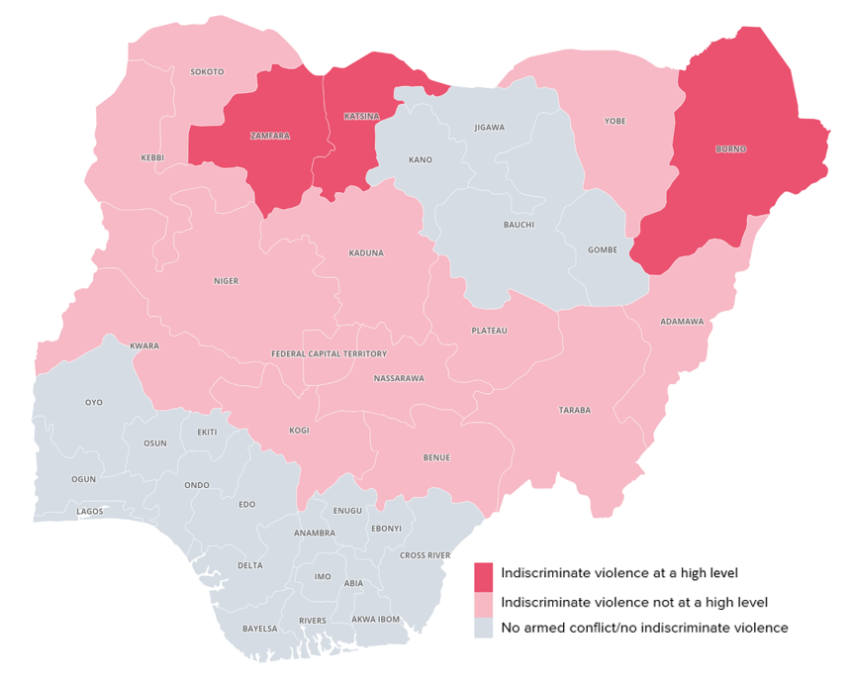
It should be noted that the dynamics of violence in Nigeria involve overlapping actors, making distinctions between farmer–herder clashes, inter- and intra-communal conflicts, and banditry increasingly blurred.
In the North-East states where Boko Haram has long-standing and widespread presence, state protection would in general be considered unavailable. In other areas affected by criminality or other types of violence, the capacity of the Nigerian state is generally limited, but may be available in individual cases. Age, gender, home area, religion and socio-economic status are among the factors that affect the accessibility of protection. The protection of the Nigerian state is also generally not available for certain categories of individuals, such as for women and children victims of violence, FGM/C and forced marriage. Even though the Nigerian state has made progress in combatting trafficking in human beings, the protection may be proven inaccessible or ineffective for the victims, especially for those outside major urban centres and those not returning with an assisted program. When the Nigerian state is the actor of persecution, as is the case for some profiles in Nigeria, it is presumed that protection is not available. See Actors of protection.
Internal protection alternative (IPA) may be applicable in Lagos and Abuja. More specifically, the requirement of safety may be satisfied in these cities, depending on the profile and the individual circumstances of the applicant. Furthermore, there are no legal or administrative restrictions to travel, access and settle in Lagos and Abuja. In relation to reasonableness, in general, IPA would be reasonable for single able-bodied men and for married couples without children, including where they have no support network, as long as they have no additional vulnerabilities and have access to financial means. In general, when a support network is lacking, IPA would not be reasonable for unaccompanied children, elderly persons or applicants with severe illnesses or disabilities, as well as for non self-reliant women. In the case of other profiles, the individual circumstances of the applicant, in particular in relation to ethnoreligious background, gender and age, the existence of a support/clan network, etc. should be given due consideration.
Finally, exclusion considerations may be relevant in a number of cases concerning applicants from Nigeria.
- 4
The assessment and guidance reflect the conclusions of the EUAA Country Guidance Network, which consists of EU Member States, Iceland, Norway and Switzerland. The guidance note has been endorsed by the EUAA Management Board.
- 5
Regulation (EU) 2021/2303 of the European Parliament and of the Council of 15 December 2021 on the European Union Agency for Asylum and repealing Regulation (EU) No 439/2010.