

This section focuses on the application of the provision of Article 15(c) QD/QR. Under Article 2(f) QD/ 3(6) QR in conjunction with Article 15(c) QD/QR, subsidiary protection is granted where ‘substantial grounds have been shown for believing that the person would face a real risk of suffering serious harm’ defined as ‘serious and individual threat to a civilian’s life or person by reason of indiscriminate violence in situations of international or internal armed conflict’.
Each element of the provision is addressed in a separate subsection.
Figure 5. Elements in the assessment of Article 15(c) QD/QR.
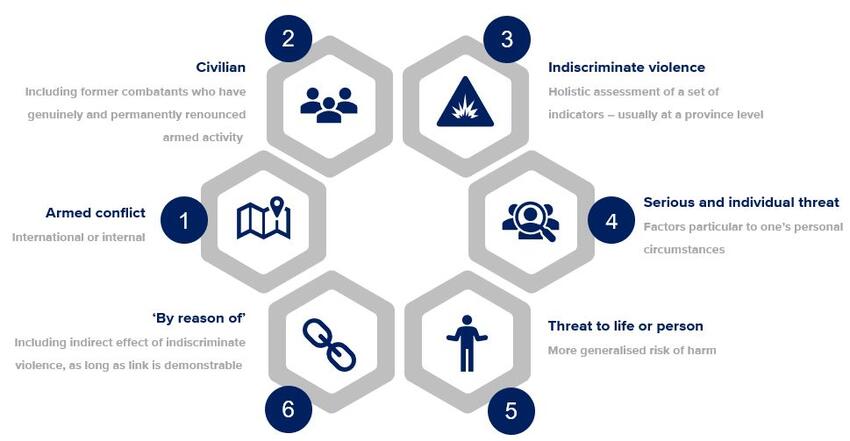
All of these elements have to be fulfilled in order to grant subsidiary protection under Article 15(c) QD/QR.
The analysis under this section builds on the most relevant European case law. Four judgments of the CJEU and one judgment of the ECtHR are particularly taken into account.
The judgment (10) is of importance for the interpretation of relevant concepts, and, in particular, of ‘internal armed conflict’.
In Diakité, the CJEU concludes that the concept of ‘internal armed conflict’ under Article 15(c) QD must be given an interpretation, which is autonomous from international humanitarian law.
[...] internal armed conflict exists, for the purposes of applying that provision, if a State's armed forces confront one or more armed groups or if two or more armed groups confront each other. It is not necessary for that conflict to be categorised as 'armed conflict not of an international character' under international humanitarian law;
CJEU, Diakité, para.35
In Diakité, the CJEU sets a low threshold to assess whether an armed conflict is taking place, noting that,
[...] nor is it necessary to carry out, in addition to an appraisal of the level of violence present in the territory concerned, a separate assessment of the intensity of the armed confrontations, the level of organisation of the armed forces involved or the duration of the conflict.
CJEU, Diakité, para.35
The judgment(11) is of importance with regard to the appreciation of the degree of indiscriminate violence and in particular with regard to the application of the ‘sliding scale’.
the more the applicant is able to show that he is specifically affected by reason of factors particular to his personal circumstances, the lower the level of indiscriminate violence required for him to be eligible for subsidiary protection.
CJEU, Elgafagi, para. 39
The consideration of personal circumstances in the assessment of Article 15(c) QD was reaffirmed in a recent CJEU judgment(12):
Article 15(c) of Directive 2011/95 does indeed cover the exceptional situation in which the level of indiscriminate violence resulting from an international or internal armed conflict is such that there are substantial grounds for believing that a civilian, returned to the relevant country or region, would, solely on account of his or her presence on the territory of that country or region, face a real risk of being subject to a serious and individual threat to his or her life or person.
However, […], that provision may also cover other situations, in which the combination, first, of a level of indiscriminate violence lower than that characterising such an exceptional situation and, second, of factors specific to the applicant’s personal circumstances is such as to materialise the real risk of being subject to a serious and individual threat within the meaning of the said provision.
CJEU, X and Others, paras.63 and 64
The judgment(13) is of particular importance for the assessment of the level of indiscriminate violence in the context of an international or internal armed conflict under Article 15(c) QD. The CJEU found that,
The elements to be taken into account in assessing whether there is a real risk of serious harm, within the meaning of Article 15(c) of Directive 2011/95 may also include the intensity of the armed confrontations, the level of organisation of the armed forces involved, and the duration of the conflict […] as well as other elements such as the geographical scope of the situation of indiscriminate violence, the actual destination of the applicant in the event that he or she is returned to the relevant country or region and potentially intentional attacks against civilians carried out by the parties to the conflict.
It follows that the systematic application by the competent authorities of a Member State of a criterion, such as a minimum number of civilian casualties injured or deceased, in order to determine the intensity of an armed conflict, without examining all the relevant circumstances which characterise the situation of the country of origin of the applicant for subsidiary protection, is contrary to the provisions of Directive 2011/95, in so far as it may lead those authorities to refuse to grant that protection in breach of the Member States’ obligation to identify persons genuinely in need of that protection.
CJEU, CF and DN, paras.43 and 44
In addition, the ECtHR judgment in Sufi and Elmi was consulted when developing the indicators for the assessment of the level of indiscriminate violence(14).
The country guidance documents usually contain a detailed section on Article 15(c) QD/QR, in which all elements of the legal provision are addressed separately as outlined below.

- 10
CJEU, judgment of 30 January 2014, Aboubacar Diakité v Commissaire général aux réfugiés et aux apatrides, C-285/12, https://curia.europa.eu/juris/liste.jsf?num=C-285/12
- 11
CJEU, judgment of 17 February 2009, Elgafaji v Staatssecretaris van Justitie, C-465/07, Grand Chamber, https://curia.europa.eu/juris/liste.jsf?language=en&num=C-465/07.
- 12
CJEU, judgment of 9 November 2023, X and Others v Staatssecretaris van Justitie en Veiligheid, C-125/22, Fourth Chamber, https://curia.europa.eu/juris/liste.jsf?language=en&td=ALL&num=C-125/22
- 13
CJEU, judgment of 10 June 2021, CF and DN v Bundesrepublik Deutschland, C-901/19, Third Chamber, https://curia.europa.eu/juris/liste.jsf?num=c-901/19.
- 14
ECtHR, judgment of 28 June 2011, Sufi and Elmi v United Kingdom, Applications nos. 8319/07 and 11449/07, https://hudoc.echr.coe.int/eng?i=001-105434. See in particular, para.241