
01
Overview
Introduction
The EUAA Annual Training Report 2025 provides a comprehensive overview of training activities carried out by the European Union Agency for Asylum (EUAA) during the reporting year. It adopts a descriptive and evidence-based approach, with the aim of describing the scope, reach and perceived impact of EUAA training. The report presents quantitative and qualitative evidence on training delivery, participation and user feedback, highlighting how training activities supported EU Member States and operational priorities throughout the year.
The main objective of the report is to present key findings in comparison with previous years, identify trends and patterns in training delivery and participation, reflect on user feedback and training outcomes and to position training activities within the broader context of training needs analysis and operational support. The report also highlights forthcoming developments relevant to EUAA training, including future planning priorities.
Following a foreword by the Executive Director, a preface by the head of the Training and Professional Development Centre and an executive summary, Chapter 1 (‘Overview’) introduces the purpose, scope and structure of the report, along with the methodological elements underlying the analysis. Chapter 2 (‘Training activities in 2025’) provides a comprehensive overview of training delivery across different forms of support, including permanent support to EU+ countries, operational support, ad hoc training and training related to the implementation of the new Pact on Migration and Asylum, combining key figures with descriptive analysis to illustrate the volume, distribution and focus of activities delivered during the year. Chapter 3 (‘Trends’) examines developments over time across 13 themes of training content, such as participation, completion, and response rates, and presents an exploratory analysis of changes observed across training content and delivery formats, supporting the identification of emerging patterns and areas for further attention. Finally, Chapter 4 (‘User experience, conclusions and future focus’) brings together insights from user feedback, links training provision to job-related tasks, presents updates on the EUAA training plan and training catalogue and concludes with reflections on the main findings of the report and the future priorities for EUAA training.
Overall, the annual training report serves as a key analytical and reference document for stakeholders engaged in asylum and migration. By examining training activities, delivery contexts and user perspectives, it supports evidence-based reflection on the effectiveness and relevance of EUAA training. The report also highlights how training contributes to supporting Member States in the implementation of the common European asylum system (CEAS), including preparations related to the Pact on Migration and Asylum. In the context of the Agency’s role in fostering quality in asylum procedures, and following the EUAA’s accreditation as a training academy, the report contributes to a shared understanding of current achievements and future directions in EUAA training.
EUAA training data
The EUAA applies a consistent and established approach to the collection and analysis of training data, building on the methodology applied in the previous annual training report. The metrics used in this report are aligned with those presented in the previous report, ensuring continuity and comparability over time. This approach enables the EUAA to monitor training performance in a systematic manner and to assess developments across reporting periods.
Training data are analysed using a set of core metrices that capture both the scale of training delivery and learner engagement. Training efficiency metrics provide an overview of training delivery, including participation levels, numbers of learners trained and training sessions delivered across different training activities. These metrics describe the scope and distribution of training activities during the reporting year.
Training effectiveness is assessed through established performance metrics reflecting learner engagement and perceived training outcomes. These include completion rates, response rates to feedback mechanisms and satisfaction rates, which capture participants’ feedback on the training content, delivery methods and overall learning experience. Together, these metrics provide a structured basis for assessing training performance and identifying areas for improvement.
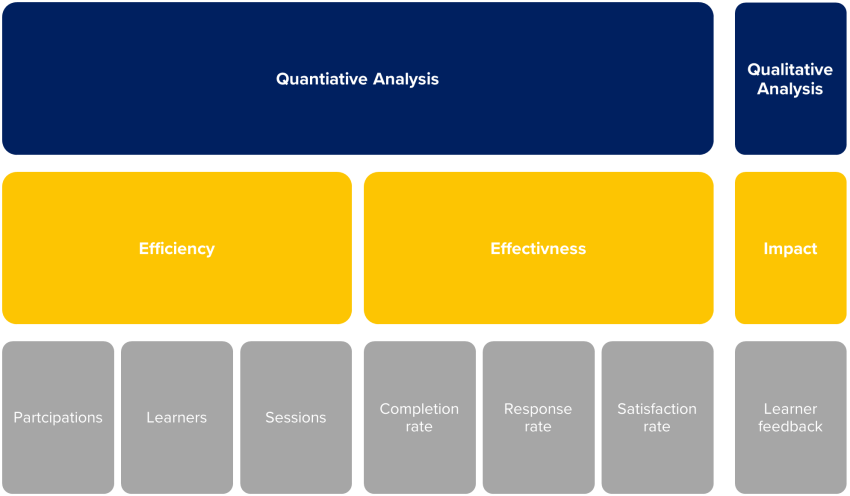
© European Union Agency for Asylum
Training data management process
Training data management are collected through the Learning Management System (LMS) and managed centrally in line with EU data protection requirements. The LMS supports the monitoring of training activities, including enrolments, completion and participant feedback.
Data are validated and processed to ensure consistency and comparability across training activities. Analytical and visualisation tools, including Power BI, are used to support reporting and present key trends.
Qualitative learner feedback is analysed using an AI-supported process Responses are translated into English and anonymised prior to analysis, and are then examined to identify overall sentiment, key themes and areas for improvement.
This approach ensures a consistent and reliable basis for monitoring training performance and support evidence-based decision-making.