
08
Legal safeguards for children and applicants with special needs
To increase protection responses for persons with special needs, the Pact includes measures for swifter identification and support to address their procedural and reception needs. A main challenge for EU+ countries remains the operationalisation of these safeguards. To increase capacity in this area, in 2025 national authorities delivered training to various stakeholders and enhanced information systems to facilitate cooperation among different professionals involved in the process.
In 2025, 22,000 asylum applications were lodged by self-claimed unaccompanied minors, approximately one-third less than in 2024 and the least since 2020. Despite recording the largest absolute decline, Germany continued to receive the most (4,100 applications), accounting for almost one-fifth of the total (see Figure 4). Germany was followed by the Netherlands (3,600), Italy (3,400) and Greece (3,100). Five nationalities accounted for more than one-half of all asylum applications lodged by unaccompanied minors in 2025, namely Afghans (2,800), Eritreans (2,400), Egyptians (2,300), Somalis (2,300) and Syrians (2,100, the least on record).
Asylum authorities continued to review their laws and policies towards a multidisciplinary age assessment, as required under the APR and in line with the EUAA’s practical guide published in 2025. Several EU+ countries were faced with an insufficient number of legal guardians to be appointed for the care and support of unaccompanied children. The EU-funded GuardianXChange project continued to strengthen guardianship services in the four participating EU+ countries, namely Belgium, Poland, Portugal and Slovenia.
With the revised EU Anti-Trafficking Directive to be transposed by July 2026, EU Member States implemented various projects and training activities for the prevention of trafficking in human beings and better identification of victims. Since the presentation of the Pact proposals, several stakeholders expressed concerns about the potential negative impact of the changes on applicants with special needs throughout the asylum procedure. As the legislative process is ongoing at the national level, those concerns often re-emerged in the national context through comments on the law proposals.
Despite efforts to better support applicants with special needs in reception, inadequate conditions and insufficient support were reported in several EU+ countries, for example due to the lack of resources or gaps and delays in funding. Concerns about the detention of persons with special needs, especially children, continued to be voiced, documented in court judgments and reported by international and civil society organisations. Several court cases also analysed special needs and vulnerabilities in the context of Dublin transfers and returns.
Figure 4. Top 10 EU+ countries receiving applications by self-claimed unaccompanied minors, 2025 compared to 2024 and share of applications lodged by the main citizenship of unaccompanied minors, 2025
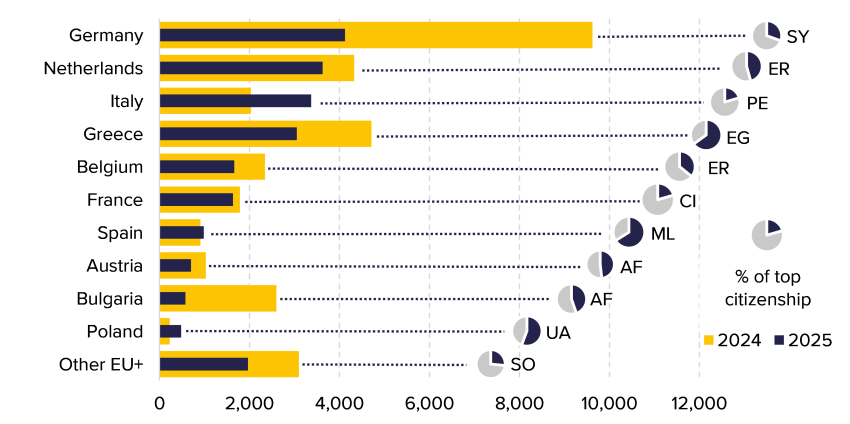
Source: EUAA EPS data as of 3 February 2026.