
05
Responsibility for an application for international protection
EU+ countries kept enhancing the effectiveness of the Dublin system, including through the continued application of the Dublin Roadmap, which was adopted in November 2022 to improve the implementation of transfers to the responsible Member State.
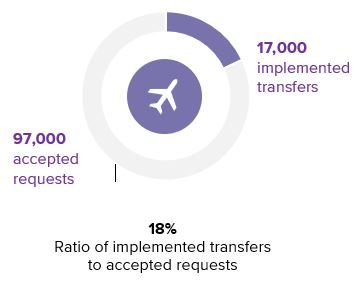
In total, 17,000 Dublin transfers were implemented in 2024, representing about a 14% increase compared to 2023. This was the most since 2019, while still far below pre-pandemic levels. Several reporting countries implemented more transfers than in 2023, with some implementing the most transfers on record.
In 2024, 147,000 decisions were issued in response to outgoing Dublin requests, according to provisional data which are regularly exchanged between the EUAA and 29 EU+ countries. This represented an 18% decrease from 2023 (record number of decisions) as asylum applications dropped by over a tenth and the ratio of Dublin decisions to applications decreased to 14% (lowest in eight years). The decrease suggests a reduction in the number of asylum seekers moving from the first country of arrival to another to lodge a new application (referred to as secondary movements) and, accordingly, of the impact on asylum caseloads overall.
EU+ countries further invested in digitalisation and ICT projects, either specifically for the Dublin units or as part of larger initiatives involving asylum or immigration processes in general. Cooperation among EU+ countries continued beyond the formalised channels of liaison officers and bilateral agreements. Several EU+ countries participated in the EUAA exchange programme in 2024, which focused on effective family reunification. Bilateral study visits allowed specific countries to further strengthen their collaboration. In the second half of the year, EU+ countries started preparations for the implementation of the Asylum and Migration Management Regulation (AMMR). To support the implementation of the Pact at the national level, the EUAA worked on new information provision leaflets on the AMMR and Eurodac, new guidance and a common template on family tracing, as well as guidance on remote interviewing (including for Dublin interviews). The reform and streamlining of the Dublin system remains a crucial element for the functioning of CEAS.