

News
Published: 21 October 2026
Sudan humanitarian crisis continues amid widespread violence
The EUAA has published two new Country of Origin Information (COI) reports on Sudan, examining political, judicial and human rights developments in the country as well as the socio-economic situation in Khartoum on the one hand (Country Focus report, August 2026) and the security situation on the other (Security Situation report, October 2026).
As violence continues to shape Sudan’s conflict, civilians face large-scale violence, human rights violations and mounting humanitarian needs. The newly published Security Situation report on Sudan examines the country’s security trends and the key actors involved in the conflict at national and regional level. It builds on the EUAA COI Country Focus report on Sudan published in August, which addresses the political, human rights and socio-economic context as well as the treatment of certain profiles and groups of the population in the country.
More than three years into the conflict between the Sudanese Armed Forces (SAF) and the Rapid Support Forces (RSF), authority remains increasingly fragmented in the country. International mediation efforts involving the African Union, IGAD, the United States of America, Saudi Arabia, Egypt, the United Arab Emirates, and Switzerland failed to achieve a lasting ceasefire. Disagreements between external actors, the SAF’s refusal to negotiate with the RSF on equal footing and conflicting political interests, have hindered progress.
Against this backdrop, civilians continue to be significantly impacted by the conflict as widespread human rights violations are reported, including extrajudicial killings, arbitrary detention, enforced disappearances, torture and sexual violence. The number of people at risk of sexual and gender-based violence rose by 350% between 2023 and mid-2025.
The impact of the conflict has been particularly severe in areas subjected to prolonged sieges and intense fighting. El Fasher, the last SAF stronghold in Darfur, fell to the Rapid Support Forces (RSF) in October 2025 after an 18-months siege. By late September, a 68-kilometres-long earth berm encircled the city, restricting access to food and medicines, trapping civilians and leaving people to starve. The RSF takeover was marked by widespread and systematic violence. In North Kordofan, El Obeid faced siege-like conditions for months, amid increasing use of drones by both parties. Reporting on events around the capture of El Fasher, the UN independent international fact-finding mission (FFM) for the Sudan concluded that the RSF committed crimes against humanity, war crimes and acted with genocidal intent, particularly targeting non-Arab communities, including the Zaghawa.
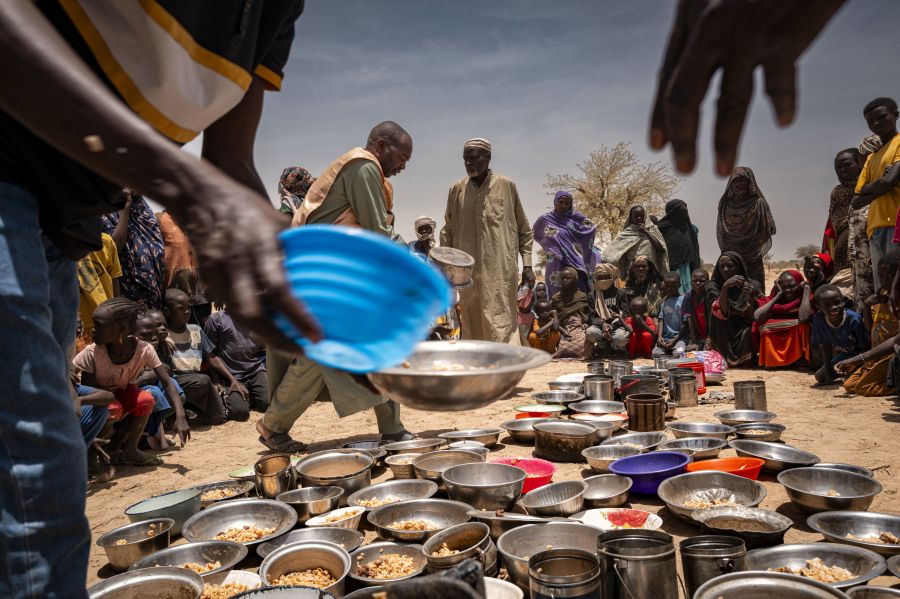
The humanitarian situation is equally dire. In 2025-2026, approximately 19.5 million people faced acute food insecurity and several areas in the country were affected by famine or the risk of it. Around 17 million people lacked access to safe drinking water, increasing the risk of disease outbreaks and malnutrition. At the same time, the conflict damaged agricultural infrastructure and disrupted supply chains, while rising food prices worsened hunger. Humanitarian assistance was severely restricted by armed attacks, bureaucratic barriers, blocked roads, and insufficient funding. By April 2026, an estimated 70% of Sudan's population was living in poverty, while, as of February 2026, around 29 million people required humanitarian food assistance.
EU Asylum situation for Sudan nationals
Between March 2025 and August 2026, Sudanese nationals lodged around 31,000 asylum applications in the EU+. Over three quarters of them were received by Greece (13,000) and France (11,000). Sudanese applications began to climb at the start of the conflict in April 2023 and rose sharply during 2025, reaching a record high in October. In the first eight months of 2026, the upward trend continued with 15,000 applications lodged in total, an increase of almost two thirds compared to the same period in 2025. This has made Sudan the top fifth nationality applying for asylum in the EU+ so far this year. During the reporting period, EU+ countries issued around 20,000 first instance decisions to Sudanese nationals, with an overall recognition rate of 66%. Greece (8,000) and France (7,900) issued the most decisions. At the start of August 2026, over 11,000 cases were pending a decision at first instance, around half of them in Greece (5,400).
Background
The EUAA regularly updates its Country-of-Origin Information reports, which aim to provide accurate and reliable up-to-date information on third countries to support EU+ asylum and migration authorities in reaching accurate and fair decisions in asylum procedures, as well as to support national policymaking.