

Emerging technologies offer exciting opportunities to enhance training and learning experiences
Konstantinos Apostolou works as a Training Production Officer in the European Union Agency for Asylum’s (EUAA) Training and Professional Development Centre. He is one of the people responsible for the production of training modules. Read his interview to discover more about Konstantinos’ work and the exciting possibilities offered by emerging technologies in the field of training and learning.
Can you introduce yourself, your background, and your work with the EUAA?

My name is Konstantinos Apostolou, and I am EUAA’s Training Production Officer. Over the last years, I have supported EUAA in the production of training modules. EUAA training helps the practical implementation of the Common European Asylum System through harmonisation of practices and the enhancement of quality standards. In essence, we are transforming text-based scripts or storyboards into digital learning experiences to make content more interactive and engaging. This is a long process with the involvement of several actors. For instance, it involves the expertise of subject matter experts, module design coordinators, instructional designers, eLearning developers, graphic designers, as well as several others.
What is the role of the instructional design in EUAA’s digital learning?
Instructional design is the process of designing and developing learning experiences. It is quite an interdisciplinary field that combines skills and methods of different sciences, as well as art but, in essence, instructional designers help people learn in the most effective way. They make learning easier and more enjoyable. When it comes to training people who are working directly with asylum applicants, the EUAA, through its learning opportunities, helps people doing their jobs more effectively by bridging gaps in knowledge or skills. Instructional design plays a critical role in digital learning by providing a framework for creating effective and engaging learning experiences that meet the needs of learners. Instructional designers use a systematic process to design, develop, and deliver digital learning content and experiences that align with learning objectives and take advantage of the unique capabilities of digital technology.
Walk us through the process. How does it work? How do you build an EUAA Training Module?
This is a general overview of the instructional design steps. In the drafting procedure, a team of subject matter experts creates content. During this process, the instructional designer creates a blueprint for the eLearning content. Once the design is finalised, the development process starts. In this step, the content is transformed into a coherent eLearning course. This includes creating what we call “learning objects”, meaning, self-contained units of educational material designed to achieve a specific learning outcome. Such learning objects can have the form of interactive simulations, games, quizzes, videos, infographics, e-books, scenarios audio clips and much more. The next step is to test the eLearning course to ensure that it is error-free and meets the objectives. The final step is to evaluate the effectiveness of the eLearning course. By following these steps, the eLearning development process within the EUAA can be successful in creating effective and engaging online courses that meet the needs of our learners.
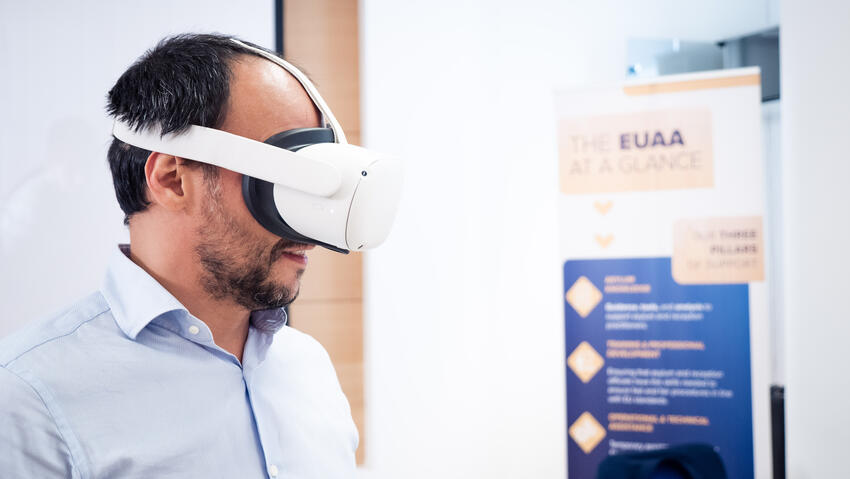
Can emerging technologies be used in learning? How is the Agency dealing with this?
Yes, emerging technologies can be used in learning. In fact, many training programmes today incorporate emerging technologies to enhance the learning experience. For example, virtual reality (VR) and augmented reality (AR) technologies can create immersive training environments that simulate real-world scenarios, allowing learners to practice skills in a safe and controlled environment. Artificial intelligence (AI) can also be used to create personalised learning experiences that adapt to the learner's needs and provide feedback in real-time. Overall, emerging technologies offer exciting opportunities to enhance training and learning experiences. However, we are not there yet. The next five years, most probably, will be revolutionary in this field. I am excited to be part of that journey!