
05
Responsibility for an application for international protection
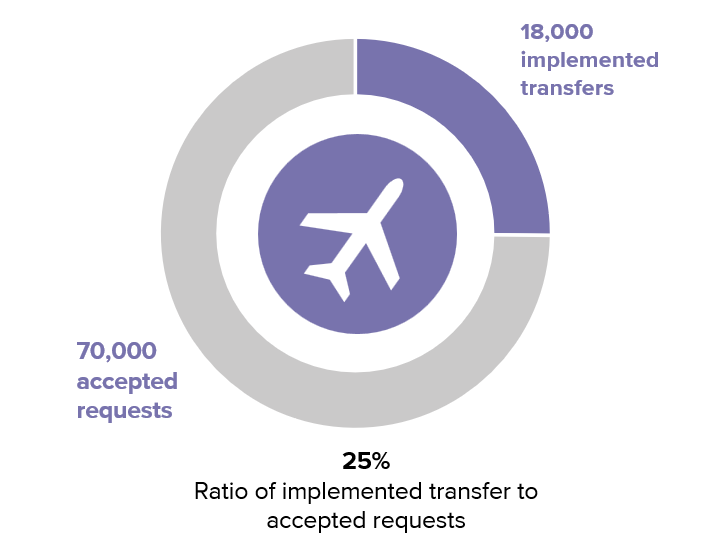
In total, 18,000 Dublin transfers were implemented in 2025 across EU+ countries, which is similar to 2024 (see Figure 2). This was the second-most since 2019, but far below the pre-pandemic levels. The implementation of Dublin transfers remained largely impacted by the pressure on reception systems in some EU+ countries. While national courts mostly confirmed transfers, one of the main reasons for overturning decisions of national authorities was up-to-date evidence of serious issues in accessing material reception conditions in the responsible state.
Figure 2. Number of implemented transfers over total accepted Dublin requests, 2025
Source: EUAA EPS data as of 3 February 2026.
EU+ countries focused on transitioning from the application of the Dublin III Regulation to the new Eurodac Regulation and the AMMR. Several legal and practical ambiguities were clarified during the year, but some questions remained until the Implementing Decision on establishing the annual Solidarity Pool 2026 was formally adopted on 19 December 2025. While some national authorities preferred to wait for the clarifications and then develop a more detailed implementation plan, the majority of administrations started to plan based on different scenarios.
Dublin units put concerted effort into clearing their backlogs to avoid as much as possible the simultaneous use of the former and new rules after the entry into application of the Pact. However, the shortage of staff in Dublin units remained a persisting issue. In addition, managing both the ongoing caseload and undertaking training in parallel were challenging for many Dublin staff. Several authorities highlighted that stakeholders outside of Dublin units were also in need of targeted training to ensure that they understood the new rules and, for example, could also inform applicants correctly about the procedure.
A major challenge for EU+ countries in the transition process was the adaptation of IT systems, including re-configuring case management systems to include new forms, templates and workflows. In several countries, IT projects linked to the application of Eurodac and AMMR form part of a wider digitalisation programme.
In 2025, 120,000 decisions were issued in response to outgoing Dublin requests, according to the EUAA’s provisional Early-Warning and Preparedness System (EPS) data. This represented a 24% decrease from 2024 and the lowest level since 2021. The decrease suggests a reduction in secondary movements, whereby asylum seekers move from the first country of arrival to another to lodge a new application, and is in line with the overall decrease in asylum applications.