03
Trends

Trends on content themes between 2012 and 2024

While modules for caseworkers were the most followed between 2012 and 2023, foundation modules took the lead in 2024, accounting for 34% of all participations (5 005). Notably, the modules on the themes of foundation, vulnerability, reception, interpretation, Dublin and the AMMR, registration, managers and Resettlement each reached a record high in training participations in 2024.

Caseworker modules followed, at 25% (3 755 participations), ahead of vulnerability (10%, 1 535), reception (9%, 1 270), interpretation (6%, 863), Dublin and the AMMR (4%, 632), exclusion and end of protection (3%, 427), registration (3%, 401), managers (2%, 330), COI and MedCOI (2%, 309), trainer horizontal (2%, 262) and Resettlement (1%, 108).

Each content theme is analysed separately in the sections below, providing further insights into trends and participation patterns.



Training insights

The previous chapters have outlined the results of participant training and the features of modules and sessions, while user feedback is presented in Chapter 4. The present chapter concentrates on outlining the characteristics of the training modules, uncovering associations among various factors (e.g. training content and participant engagement), and investigating the relationships among these elements. It makes use of exploratory data analysis approaches, whereby meaningful patterns in the data are presented using statistical graphics. This way, it presents useful data visualisations that shed light on potential factors influencing training outcomes, thereby informing future work that can utilise more research-oriented methods.

Two response variables (i.e. outcome measures) – completion rate and satisfaction – are considered in detail. Each is explored by means of its associations with one or more explanatory variables, e.g. delivery type (i.e. mode), duration, language (English vs other), organiser (EUAA vs other), level (introductory, intermediate or advanced), framework (permanent, operational, or third country), and module category (13 themes).

Each section presents a series of visual summaries using box-and-whisker plots (also knowns as box plots) to illustrate the relationship between the response variable and each explanatory variable. These plots offer a clear overview of typical values (the median, shown by central line) and the distribution of the data. The box represents the middle spread, where half the values fall (the interquartile range), while the whiskers extend to show the highest and lowest values that fall within 1.5x the interquartile range from the edge of each box. The relationship between each element also shows any skew in the data – for example, a long tail on one side suggests that values are more spread out in that direction. To further explore interactions among the variables, selected examples of three-way plots are also included. These extend the two-way visualisation by showing how the relationships between variables changes depending on a third. 


Completion rate*

*Indicates the percentage of learners who successfully completed a training activity. Ratio of completed participations to the number of enrolments.


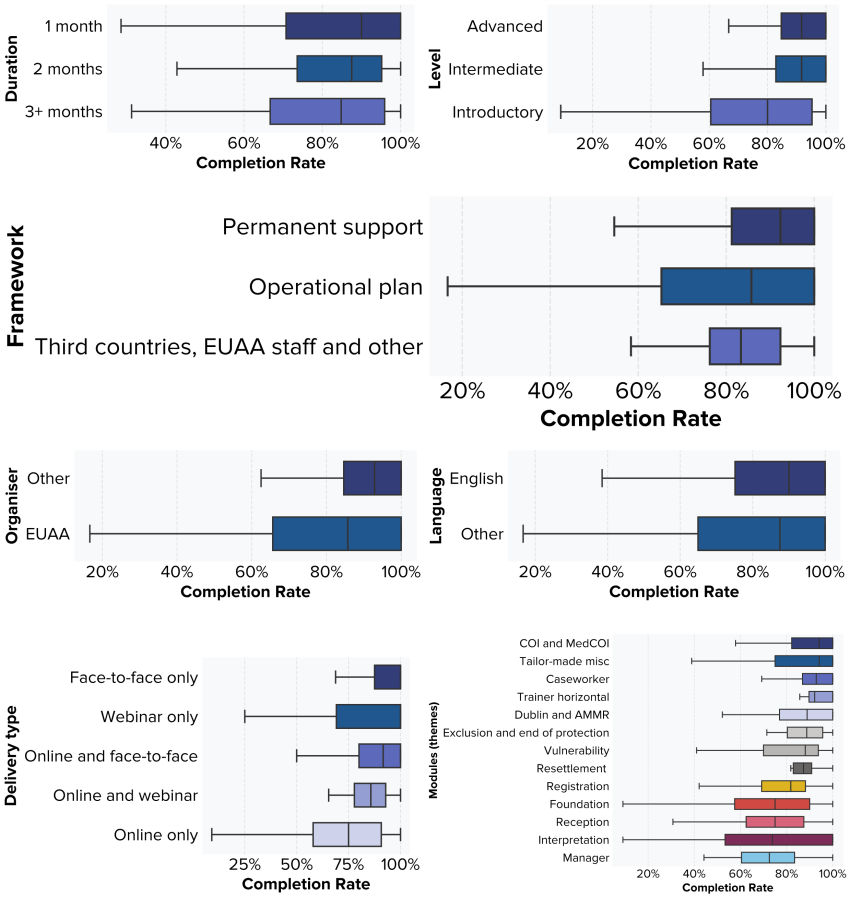
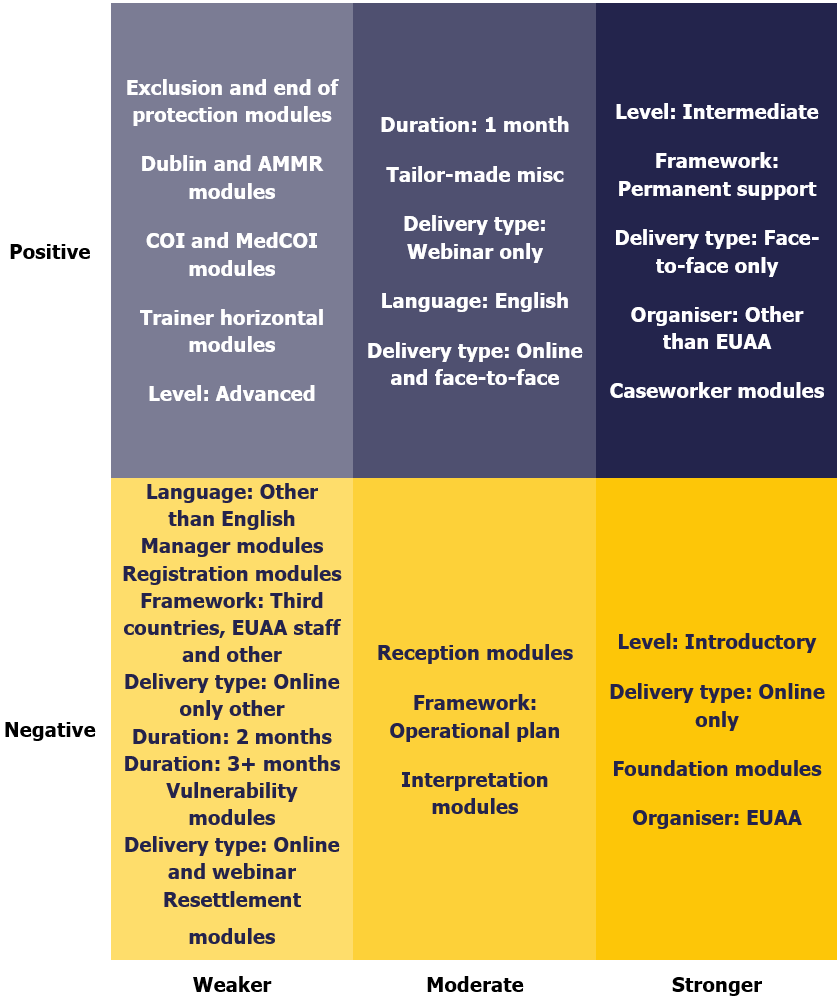
The following insights summarise the two-way associations between the completion rate and various explanatory variables: 

  • Duration: Modules with a longer duration tend to have lower completion rates. This may be due to reduced learner engagement over extended periods, difficulties in maintaining sustained motivation, increased likelihood of scheduling conflicts, or greater fatigue from prolonged learning activities.

  • Level: Introductory modules exhibit lower completion rates, suggesting that participants may disengage when the content is perceived as too simple.  

  • Delivery type: Fully online sessions exhibit lower completion rates compared to face-to-face or blended methods. This may be due to reduced learner engagement stemming from limited interaction, less immediate support or guidance, potential technological barriers, or difficulties in maintaining motivation in self-paced environments. Conversely, face-to-face or blended sessions typically offer direct trainer interaction and collaborative learning opportunities, which can enhance motivation, accountability and overall learner engagement.  

  • Framework: Sessions conducted in the context of permanent support have higher completion rates. This is likely because permanent support initiatives are integrated into long-term capacity-building frameworks, which provide structured follow-up, and dedicated resources – factors that may contribute to stronger learner engagement and commitment.

  • Organiser: Sessions organised by the EUAA have slightly lower completion rates compared to other sessions; however, this difference may be partly due to EUAA sessions typically enrolling more learners – on average, these sessions have 50% more enrolments than other organisers. Larger learner groups generally experience higher dropout rates, resulting in lower relative completion percentages.

  • Language: Sessions conducted in English show slightly higher completion rates compared to those delivered in other languages. This may indicate that participants find English-language materials more accessible or that such sessions attract learners who are more familiar with the training format. That said, translating modules into national languages remains essential to ensure accessibility, broaden participation, and enhance learner engagement.

  • Module category: Modules in the ‘Manager’, ‘Interpretation’, ‘Reception’ and ‘Foundation’ categories tend to show lower completion rates. This may be due to a combination of factors. Foundation modules are typically shorter, which may reduce engagement, while Manager and certain Reception modules are more complex and demanding, potentially increasing the risk of non-completion. Additionally, the high prevalence of online delivery and the inclusion of larger or more diverse learner groups in these categories may lead to reduced interaction, higher dropout rates, and ultimately lower completion rates.


Two-way relationships between the completion rate and each factor

figure 39
Source: European Union Agency for Asylum (EUAA)


The following insights summarise the two-way associations between the completion rate and various explanatory variables: 

  • Duration: Modules with a longer duration tend to have lower completion rates. This may be due to reduced learner engagement over extended periods, difficulties in maintaining sustained motivation, increased likelihood of scheduling conflicts, or greater fatigue from prolonged learning activities.

  • Level: Introductory modules exhibit lower completion rates, suggesting that participants may disengage when the content is perceived as too simple.  

  • Delivery type: Fully online sessions exhibit lower completion rates compared to face-to-face or blended methods. This may be due to reduced learner engagement stemming from limited interaction, less immediate support or guidance, potential technological barriers, or difficulties in maintaining motivation in self-paced environments. Conversely, face-to-face or blended sessions typically offer direct trainer interaction and collaborative learning opportunities, which can enhance motivation, accountability and overall learner engagement.  

  • Framework: Sessions conducted in the context of permanent support have higher completion rates. This is likely because permanent support initiatives are integrated into long-term capacity-building frameworks, which provide structured follow-up, and dedicated resources – factors that may contribute to stronger learner engagement and commitment.

  • Organiser: Sessions organised by the EUAA have slightly lower completion rates compared to other sessions; however, this difference may be partly due to EUAA sessions typically enrolling more learners – on average, these sessions have 50% more enrolments than other organisers. Larger learner groups generally experience higher dropout rates, resulting in lower relative completion percentages.

  • Language: Sessions conducted in English show slightly higher completion rates compared to those delivered in other languages. This may indicate that participants find English-language materials more accessible or that such sessions attract learners who are more familiar with the training format. That said, translating modules into national languages remains essential to ensure accessibility, broaden participation, and enhance learner engagement.

  • Module category: Modules in the ‘Manager’, ‘Interpretation’, ‘Reception’ and ‘Foundation’ categories tend to show lower completion rates. This may be due to a combination of factors. Foundation modules are typically shorter, which may reduce engagement, while Manager and certain Reception modules are more complex and demanding, potentially increasing the risk of non-completion. Additionally, the high prevalence of online delivery and the inclusion of larger or more diverse learner groups in these categories may lead to reduced interaction, higher dropout rates, and ultimately lower completion rates.

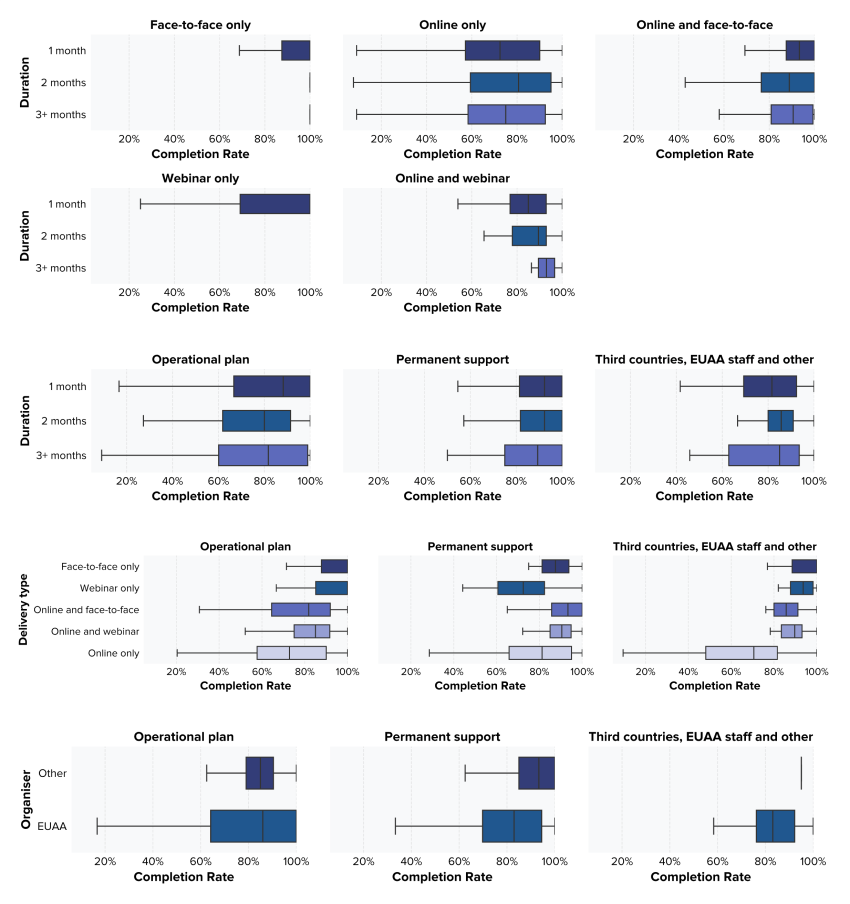
Three-way relationships between the completion rate and selected factors 

figure 40
Source: European Union Agency for Asylum (EUAA)

Satisfaction rate*

*Indicates overall learner satisfaction based on feedback calculated from closed questions regarding training content, teaching methods and overall experience.


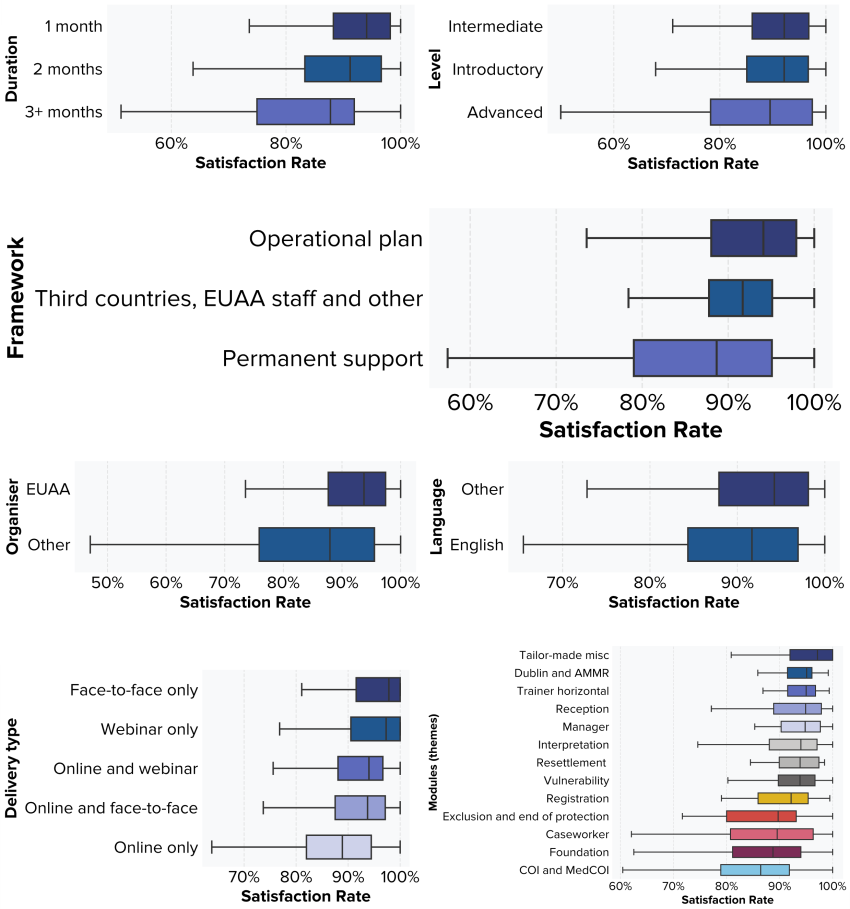
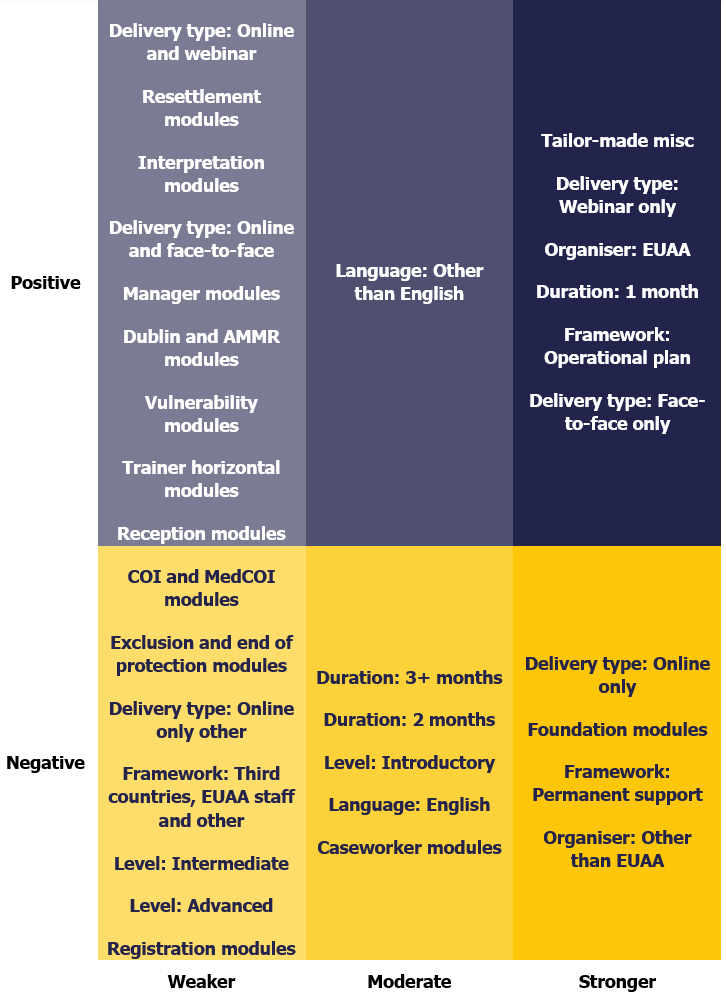
The following insights summarise the two-way associations between the satisfaction rate and various explanatory variables:  

  • Duration: Modules with a longer duration tend to have lower satisfaction rates, indicating potential fatigue or unmet expectations in longer training sessions.

  • Level: More advanced modules show lower satisfaction rates, suggesting that learners may find certain complex topics less accessible or may prefer simpler, more introductory or intermediate content.

  • Delivery type: Fully online modules exhibit lower satisfaction rates compared to face-to-face or blended methods. This may reflect reduced interaction, less immediate feedback, technological barriers, or challenges in sustaining motivation.

  • Framework: Sessions in the context of permanent support tend to have lower satisfaction rates compared to those delivered in the context of operational support. This may be because operational support sessions typically respond directly to immediate or urgent training needs, closely aligning with learner expectations and creating a clear sense of relevance.

  • Organiser: Sessions organised by the EUAA have higher satisfaction rates, implying effective management, alignment with learner needs, and/or robust course design and delivery.

  • Language: Sessions conducted in English have slightly lower satisfaction rates, potentially due to participants’ preference for or better comprehension of native/local language instruction.

  • Module category: Modules in the categories ‘COI and MedCOI’ ‘Foundation’, ‘Caseworker’ and ‘Exclusion and end of protection’ tend to show lower satisfaction rates, suggesting that these categories may include more specialised or demanding content and a greater reliance on online delivery with limited face-to-face interaction. This combination can diminish engagement and reduce perceived relevance, resulting in a wide range of learner experiences and contributing to lower satisfaction rates.

Two-way relationships between the satisfaction rate and each factor

figure 41
Source: European Union Agency for Asylum (EUAA)


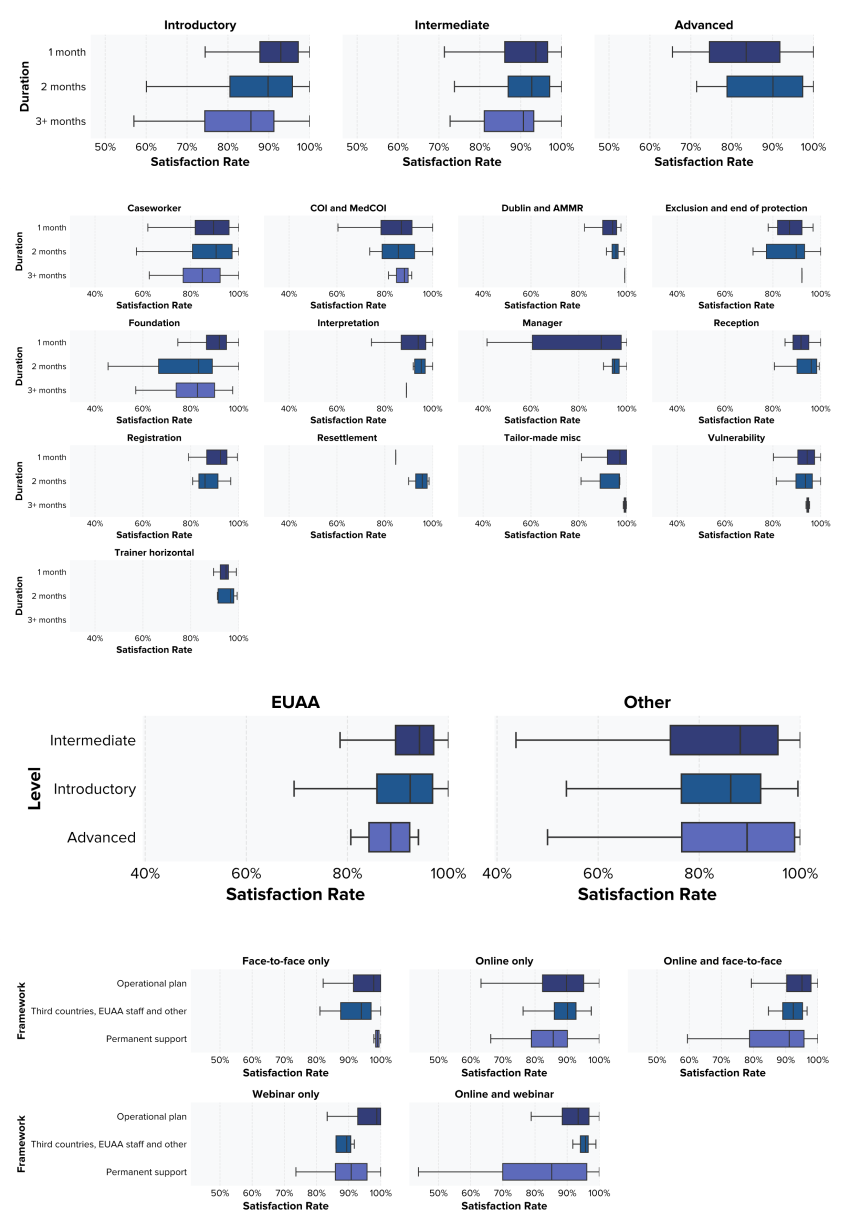
Below is a summary of the three-way (lattice) analyses, where each factor is examined with the satisfaction rate and in combination with a third variable to determine whether the original two-way relationships (outlined previously) remain consistent or show exceptions. Once more for reasons of space, a selection of three-way lattice plots is provided. Overall, many of the two-way patterns persist, though some differences emerge when additional variables are introduced:

  • Duration: Although longer modules generally show lower satisfaction rates (suggesting fatigue or unmet expectations), this effect remains consistent across most organisers, languages, modalities and support types, as well as for both introductory and intermediate levels. Conversely, the association does not hold for advanced-level modules or for several specific module categories – ‘COI and MedCOI’, ‘Dublin and the AMMR’, ‘Exclusion and end of protection’, ‘Manager’, ‘Reception’, ‘Tailor-made misc.’, ‘Resettlement’ and ‘Trainer horizontal’ where longer sessions do not necessarily reduce satisfaction.

  • Level: While more advanced modules typically show lower satisfaction rates, reflecting potential challenges in higher-level content, this effect remains consistent for most languages, delivery types, support types and session durations (particularly shorter durations). In contrast, this does not hold if the organiser is the EUAA (where intermediate modules yield the highest satisfaction) or if the modules are in the ‘Caseworker’ category (where advanced modules do not produce lower satisfaction). Furthermore, for two-month sessions, introductory- and advanced-level modules exhibit similar satisfaction rates.

  • Delivery type: Fully online sessions typically register lower satisfaction rates than face-to-face or blended approaches, likely due to reduced interaction and support. This relationship remains consistent across all organisers, module categories, module levels, languages, session durations and support types mentioned. No cases were reported where this effect does not hold, underscoring the robustness of this trend.

  • Framework: Sessions in the context of permanent support tend to show lower satisfaction rates compared to those in the context of operational support, possibly because operational plans address immediate training needs and appear more relevant to participants. This pattern remains consistent across different organisers and most modules, levels, languages and durations. However, it does not hold under the ‘face-to-face only’ modality – where permanent support sessions achieve the highest satisfaction – or for ‘Tailor-made misc.’ modules, where the permanent support context does not necessarily mean lower satisfaction rates.

  • Organiser: Sessions organised by the EUAA generally display higher satisfaction rates, likely reflecting effective design, strong alignment with learner expectations, or robust delivery strategies. This trend remains consistent for almost all module categories, levels, languages, durations, delivery types and support types. Nonetheless, it does not hold for ‘Registration’ modules, where EUAA-organised sessions do not consistently yield higher satisfaction.

  • Language: Sessions delivered in English typically have slightly lower satisfaction rates, suggesting that many participants may prefer local or native language instruction. This pattern remains consistent across most organisers, module categories, levels, support types and delivery types. By contrast, it does not hold for ‘Interpretation’, ‘Resettlement’ and ‘Tailor-made misc.’ modules – where English does not diminish satisfaction – or for longer-duration (3+ months) sessions, where language choice shows little effect on satisfaction rates.

Three-way relationships between the satisfaction rate and selected factors

figure 42
Source: European Union Agency for Asylum (EUAA)

Summary

Completion rate

Summary of the factors’ relationships with the completion rate

figure 43
Source: European Union Agency for Asylum (EUAA)
Satisfaction rate

Summary of the factors’ relationships with the satisfaction rate

figure 44

Source: European Union Agency for Asylum (EUAA)